US Regulatory Crackdown on DeFi Lending Under GENIUS Act Sparks Systemic Industry Overhaul


The landscape of decentralized finance (DeFi) is undergoing a monumental transformation as regulatory frameworks governing stablecoins and lending protocols tighten across the United States. Following the comprehensive implementation timeline set by the GENIUS Act, federal agencies—including the Federal Reserve and the Office of the Comptroller of the Currency (OCC)—have introduced stringent new guidelines aimed at reining in systemic risks within digital asset markets. These regulatory developments have sent shockwaves through the DeFi ecosystem, forcing protocols, liquidity providers, and institutional participants to fundamentally rethink their risk management strategies, borrowing mechanics, and cross-chain operations.
Regulatory Chronology and Implementation Milestones
The legislative momentum behind the regulatory shift began taking concrete shape when the Federal Reserve formally published its proposed rulemaking regarding the GENIUS Act on September 24, 2026. Designed to establish robust safeguards for stablecoin issuance and capital reserves, the framework required federal regulators to complete comprehensive internal compliance guidelines within a compressed timeframe.
The legislative clock officially ticks toward January 18, 2027, the hard enforcement deadline established by the statute. Upon reaching this date, the regulatory compliance window of 120 days since the final rules announcement will close, compelling financial institutions and crypto-native entities alike to adopt full compliance measures. The OCC followed suit by releasing its final rules and supervisory pathways for the GENIUS Act, setting a clear trajectory for national banks and fintech entities engaging with digital assets.

These regulatory mandates have exposed deep-seated vulnerabilities within decentralized lending markets, which have long operated in a regulatory grey area. Historically, DeFi protocols promoted algorithmic lending, over-collateralization, and autonomous liquidation loops as ironclad risk management tools. However, as regulatory compliance edges closer, the underlying friction between decentralized architecture and traditional financial oversight has become impossible to ignore.
The Anatomy of DeFi Bad Debt: Historical Case Studies
The pressure on DeFi lending markets is not merely theoretical; it is grounded in a series of high-profile financial stress tests that have accumulated over recent years. A retrospective look at incidents between 2025 and 2026 reveals how systemic vulnerabilities manifest when collateral values plummet and liquidation mechanisms fail.
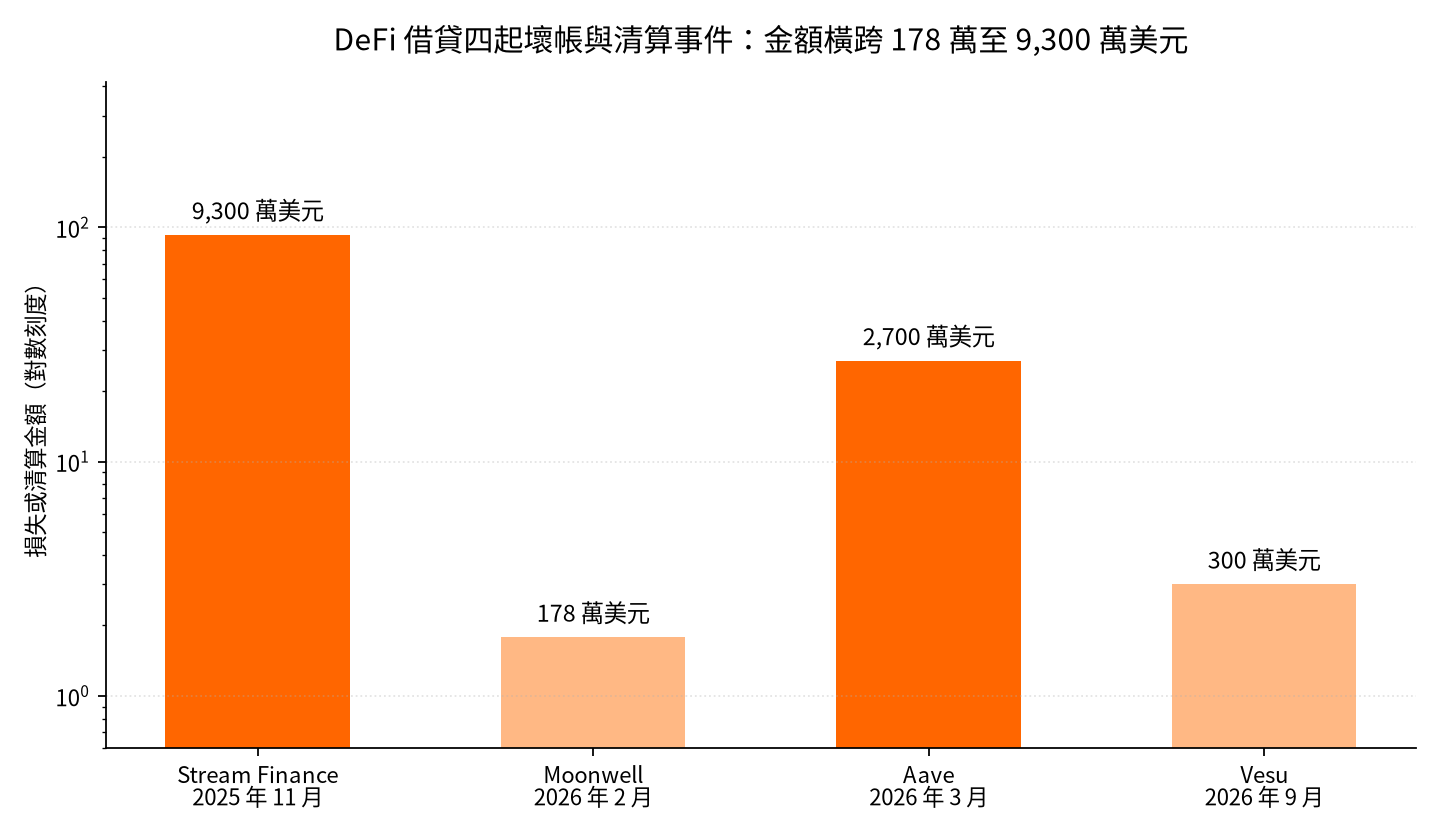
In November 2025, Stream Finance suffered a catastrophic liquidity drain when 9,300 wrapped bitcoin (WBTC) became distressed, eventually resulting in 2.85 billion dollars in bad debt distributed across prominent lending markets such as Euler, Silo, and Morpho. Similarly, in February 2026, Moonwell experienced an unmitigated shortfall when its cbETH collateral pool dropped by 1.12 billion dollars, leaving protocol reserves deficient by approximately 2,200 wrapped bitcoin and accumulating 178 million dollars in total bad debt.
Subsequent quarters brought no relief. In March 2026, Aave experienced a major utilization stress event that forced wstETH utilization rates to 2.85%, locking over 2,700 wrapped bitcoin in unliquidated bad debt. By September 2026, Vesu became the latest high-profile casualty of market volatility, absorbing 47 bad debt liquidations and cementing a cumulative deficit of 300 million dollars across its liquidity pools.

These recurring failures highlighted a fundamental flaw in traditional DeFi lending: while over-collateralization protects lenders in calm markets, it frequently breaks down during high-volatility events. When liquidation bots fail to execute due to network congestion, oracle manipulation, or cascading price crashes, protocols are left holding millions of dollars in unbacked debt, exposing systemic risks that regulators are now determined to eliminate.
No-Liquidation Lending Protocols Under Regulatory Scrutiny
Among the most heavily scrutinized innovations in the current cycle are "no-liquidation" lending protocols, championed by platforms like Ajna. These protocols promise a radically different approach to borrowing: users deposit collateral, and the protocol extends a credit line without standard margin calls or forced liquidations. Instead of relying on automated bots to sell off collateral during market downturns, these platforms utilize novel smart contract architectures, self-repaying debt structures, and decentralized matching engines.
Proponents argue that no-liquidation models eliminate the cascading liquidations that traditionally devastate DeFi markets during black-swan events. By allowing borrowers to maintain their positions indefinitely—provided they service their interest payments—these protocols theoretically insulate users from predatory liquidation bots and market manipulation.
However, financial regulators view these mechanisms with skepticism. Regulatory bodies question how credit can be sustained indefinitely without a forced liquidation mechanism to recover principal during prolonged market downturns. Analysts point out that while no-liquidation models reduce short-term liquidations, they may simply defer risk, turning acute solvency crises into chronic, systemic debt accumulations.
Industry Adaptation and Institutional Compliance
As the January 2027 enforcement deadline approaches, the DeFi industry is rapidly adapting. Protocols are overhauling their risk parameters, integrating institutional-grade oracle feeds, and establishing emergency insurance funds to buffer against sudden market shocks. Decentralized autonomous organizations (DAOs) are increasingly employing risk management firms to audit smart contracts and stress-test lending pools against severe macroeconomic downturns.
Furthermore, lending markets are exploring hybrid models that combine decentralized execution with regulatory-compliant identity verification (KYC/AML) layers. While this shift alienates purists who champion censorship resistance, industry leaders argue that compliance is the only viable path forward for mainstream adoption.
Broader Economic and Market Implications
The intersection of the GENIUS Act, OCC rulemaking, and decentralized lending represents a watershed moment for the digital asset economy. For years, the crypto industry operated under the assumption of regulatory immunity, allowing DeFi protocols to scale without traditional oversight. The impending enforcement of federal stablecoin and lending rules forces a maturation of the sector, shifting the paradigm from unregulated experimentation to regulated financial engineering.
While compliance costs will undoubtedly squeeze smaller protocols and independent developers, institutional participants view the regulatory clarity as a necessary foundation for long-term growth. As liquidity increasingly migrates toward fully compliant platforms, the gap between traditional finance and decentralized finance continues to narrow, setting the stage for a more resilient, transparent, and secure digital asset ecosystem.