A Mosaic of Martian Geology: NASA Releases Comprehensive Retrospective of Curiosity Rover Drilling Operations

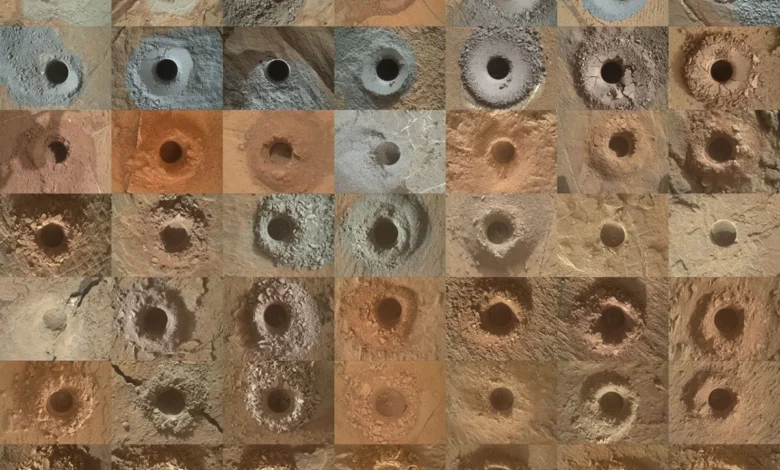
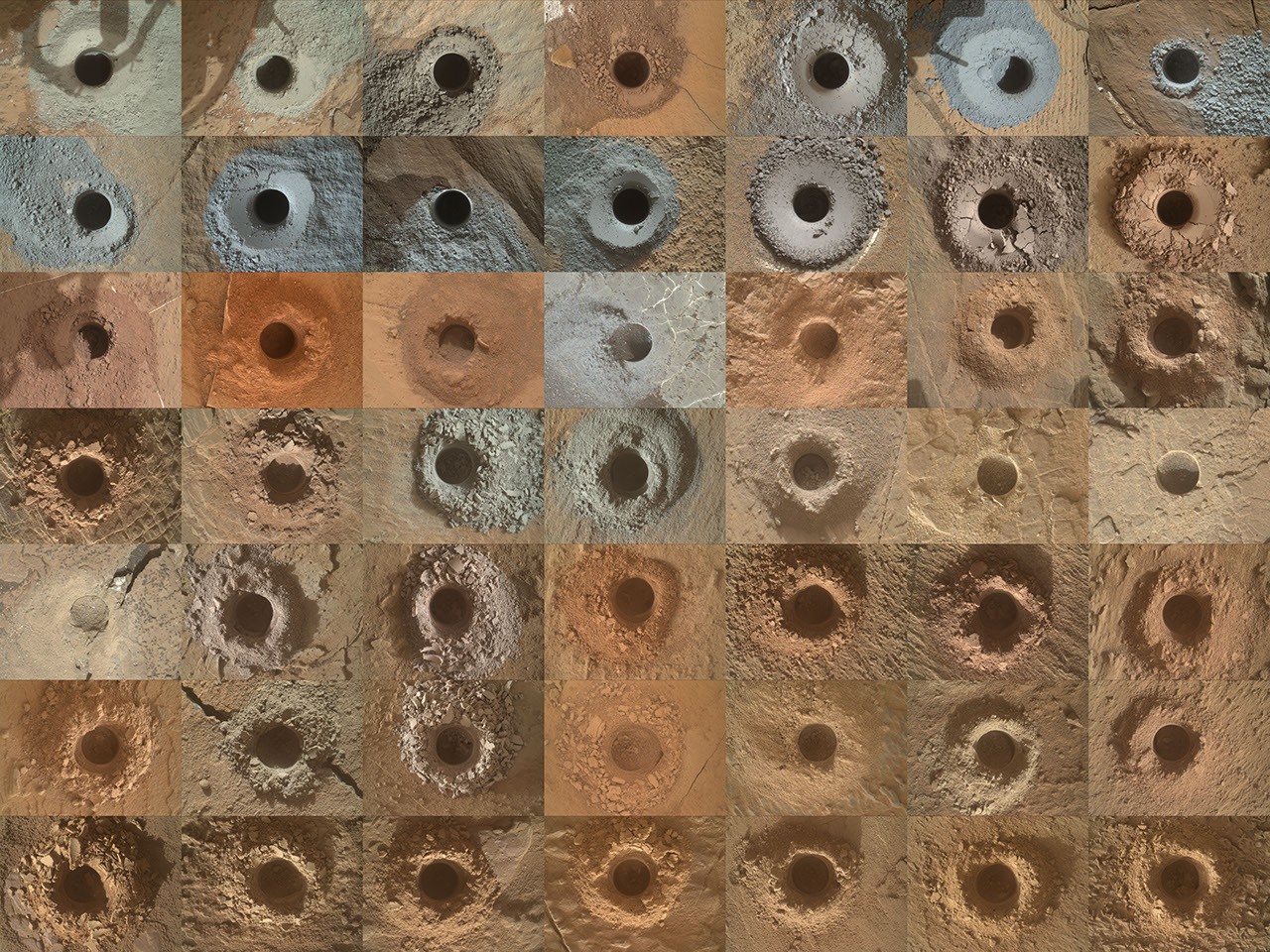
NASA has unveiled a striking new photographic mosaic capturing 49 distinct circular drill holes bored into the Martian surface by the Curiosity rover. Compiled to reflect the state of the mission, this unprecedented 7-by-7 grid offers a comprehensive visual inventory of a decade and a half of robotic geology. Each precision-drilled aperture, measuring precisely 0.63 inches (16 millimeters) in diameter, is encircled by distinctive rings of pulverized rock dust rendered in subtle shades of gray, brown, and reddish-orange. Captured by the Mars Hand Lens Imager (MAHLI)—a specialized macro camera mounted on the robotic arm—this composite highlights not only the mechanical endurance of the car-sized rover but also the meticulous, multi-step scientific methodology being applied to unravel the geological history of Gale Crater.
The evolution of Curiosity’s sampling strategy represents a masterclass in interplanetary engineering and remote-controlled science. When the rover touched down inside Gale Crater in August 2012, its primary objective was to determine whether Mars ever possessed environmental conditions capable of supporting microbial life. To achieve this, mission scientists needed access to pristine, unweathered material locked deep within the bedrock. Surface rocks on Mars are heavily altered by billions of years of cosmic radiation, wind erosion, and atmospheric oxidation. By utilizing a rotary-percussive drill mounted at the terminus of its two-meter-long robotic arm, Curiosity is able to shatter and ingest interior rock layers, transforming solid stone into fine powder. This material is then portioned out and delivered directly to sophisticated onboard laboratories, such as Chemistry and Mineralogy (CheMin) and Sample Analysis at Mars (SAM), for mineralogical and organic chemical analysis.
A Chronology of Exploration and Sampling Milestones
The accumulation of these 49 boreholes spans a rich chronology of discovery that has fundamentally transformed our understanding of the Red Planet.
In the early months of the mission in late 2012 and early 2013, Curiosity targeted its very first rock targets at a site named Yellowknife Bay. The successful drilling of the "John Klein" and "Cumberland" mudstones yielded definitive proof that Gale Crater was once the site of an ancient freshwater lake system containing all the key chemical ingredients necessary for life, including sulfur, nitrogen, hydrogen, oxygen, phosphorus, and carbon. This landmark finding achieved the primary goal of the mission within its first Martian year.
Following these initial triumphs, the mission entered an extended phase of exploration as Curiosity began its arduous ascent up the slopes of Mount Sharp (Aeolis Mons), a towering three-mile-high layered mountain rising from the center of Gale Crater. Each geological strata encountered on the mountain represents a different epoch of Martian history. Between 2014 and 2018, the rover traversed the Kimberley waypoint and the Murray Mudstone formation, executing numerous drill campaigns that revealed complex sequences of wet-dry cycles, fluctuating lake levels, and varying chemical environments.
As the mission progressed into the 2020s, the engineering and science teams faced new challenges. Mechanical wear on the drill feed mechanism and changing rock hardness—ranging from soft clay-rich mudstones to exceptionally tough sulfate-bearing minerals—required continuous adaptation. The inclusion of more recent drill sites in the current mosaic reflects the rover’s ongoing exploration of the Gediz Vallis channel and sulfate-rich mineral deposits, providing crucial insights into a period when Mars was drying out and transitioning into the arid desert world we see today.
Engineering Marvels and Scientific Instrumentation
The creation of the newly released mosaic is credited to the MAHLI instrument, built by Malin Space Science Systems in San Diego, California. MAHLI is capable of capturing close-up, high-resolution color images of rock textures and structures at microscopic scales, allowing geologists on Earth to examine individual mineral grains and crystal structures surrounding each borehole.
The physical act of drilling on Mars is an autonomous engineering ballet fraught with peril. Because communication signals take anywhere from 5 to 20 minutes each way between Earth and Mars, real-time joystick control is impossible. Engineers at NASA’s Jet Propulsion Laboratory (JPL) in Pasadena, California, must upload command sequences days in advance. The drill bit must hammer and rotate simultaneously, grinding through abrasive materials without overheating or becoming permanently wedged in the rock—a hazard that prematurely ended the use of Curiosity’s original wheel-mounted rock abrasion tool variants on earlier missions, but which was successfully mitigated through advanced software and redesigned percussion techniques on MSL.
Once a core sample is pulverized, it is sieved and routed through internal pathways to Curiosity’s analytical belly. CheMin uses X-ray diffraction to identify crystalline mineral structures, revealing clays, sulfates, and hematite that can only form in the presence of liquid water. Simultaneously, SAM heats the sample to high temperatures in small ovens, sniffing the released gases with a mass spectrometer and gas chromatograph to detect organic compounds and isotope ratios.
Perspectives from Mission Leadership and the Science Community
While direct quotes regarding this specific aesthetic compilation are rooted in the technical documentation provided by NASA’s Jet Propulsion Laboratory, planetary scientists familiar with the mission have frequently emphasized the profound significance of each core sample.
"Every time we drop a sample into Curiosity’s internal labs, we are reading a page from a book that was written billions of years ago," noted project scientists during major mission milestones. The accumulation of nearly five dozen holes is not merely a tally of mechanical operations; it represents a comprehensive stratigraphic column of an alien world. The diversity in dust color—ranging from pale grays rich in silica to dark browns and vibrant reds saturated with iron oxides—visually underscores the radical shifts in climate and aqueous chemistry that occurred over vast stretches of geological time.
Furthermore, the mission management team, led by JPL on behalf of NASA’s Science Mission Directorate in Washington, views the continued operational health of Curiosity as a testament to the robust engineering standards of the Mars Exploration Program. Despite operating long past its nominal two-year primary warranty, the rover continues to traverse challenging terrains, climb steep inclines, and operate its delicate robotic instruments under harsh environmental conditions characterized by freezing temperatures, dust storms, and intense solar radiation.
Implications for Future Exploration and Astrobiology
The data gleaned from these 49 drilling sites carry profound implications not only for our understanding of planetary evolution but also for the future of human exploration and the search for extraterrestrial life. By mapping the transition from a wet, habitable environment to a dry, acidic one, Curiosity has provided a vital case study in planetary climate change—a phenomenon of intense interest to scientists studying Earth’s own atmospheric dynamics.
Moreover, the analytical techniques perfected during Curiosity’s drilling campaigns have directly paved the way for subsequent missions, including the Perseverance rover currently operating in Jezero Crater and collecting cached samples for a potential future Mars Sample Return campaign. While Curiosity analyzes its samples in situ and transmits the digital data back to Earth, the overarching scientific framework—identifying high-value astrobiological targets, extracting pristine subsurface material, and interpreting complex mineralogical records—was largely established and refined by the Mars Science Laboratory team.
As Curiosity continues its ascent up Mount Sharp, the mission team anticipates adding many more drill holes to the historical record. Each new aperture bored into the Martian crust brings researchers one step closer to fully comprehending the environmental history of our planetary neighbor and answers fundamental questions about the distribution of habitable environments across the early solar system.