WHO and African Union Forge New Health Pact in Geneva to Combat Aid Cuts and Drive Continental Health Sovereignty

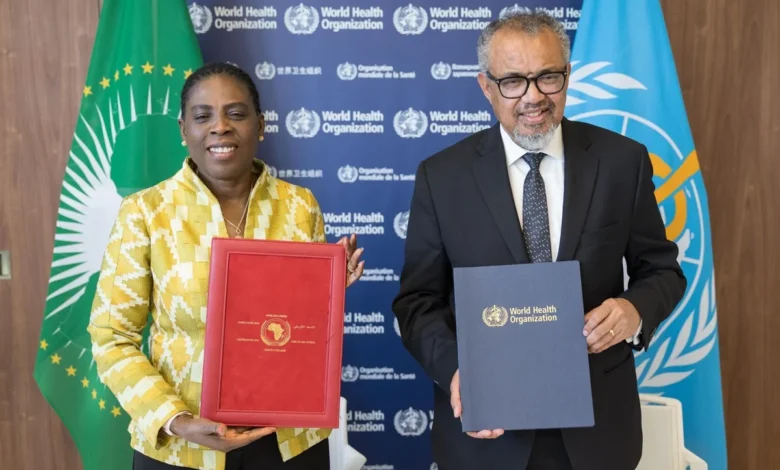
GENEVA — In a definitive move designed to reshape the trajectory of public health across the African continent, the World Health Organization (WHO) and the African Union (AU) Commission officially renewed their foundational strategic partnership on the sidelines of the 78th World Health Assembly in Geneva. Against a backdrop of unprecedented financial headwinds, shrinking bilateral aid packages, and complex post-pandemic recovery metrics, the two international bodies signed an updated Memorandum of Understanding (MoU). This comprehensive agreement is crafted not merely to reaffirm existing commitments, but to aggressively accelerate progress toward universal health coverage (UHC), fortify regional health security, and champion sustainable development goals across all 55 AU Member States.
The high-stakes signing ceremony positioned the Department of Health, Humanitarian Affairs, and Social Development of the AU Commission squarely at the epicenter of continental health policy implementation. Representing the African Union Commission, Her Excellency Ambassador Amma Adomaa Twum-Amoah, Commissioner for Health, Humanitarian Affairs and Social Development, signed the document on behalf of His Excellency Mahmoud Ali Youssouf, Chairperson of the African Union Commission. They were joined by Dr. Tedros Adhanom Ghebreyesus, Director-General of the World Health Organization. Together, these leaders underscored a unified vision: shifting Africa’s public health paradigm away from reactive crisis management and precarious aid dependency toward institutionalized health sovereignty and long-term self-reliance.
Background Context: A Evolving Global Health Architecture
The genesis of this renewed pact stretches back to previous cooperative frameworks, most notably the landmark 2019 MoU that established structured dialogues between the WHO and various organs of the African Union. However, the global health landscape has undergone seismic shifts over the intervening half-decade. The COVID-19 pandemic exposed profound vulnerabilities in global supply chains, vaccine equity, and local manufacturing capacities across the Global South. Furthermore, recent fiscal tightening and deep budget cuts to bilateral aid programs by traditional donor nations have placed millions of vulnerable Africans at risk, exposing the fragility of health systems overly reliant on external financing.
Simultaneously, the African Union has experienced a profound elevation in its geopolitical standing. Most notably, the AU’s historic inclusion as a permanent member of the G20 has amplified the continent’s collective voice in international economic and health governance. This newfound platform allows African leadership to advocate more forcefully for structural reforms in global financial institutions, debt relief linked to health investments, and equitable access to medical countermeasures. It is within this dynamic, high-stakes environment that the updated WHO-AU MoU has been forged, serving as a tactical blueprint to navigate financial volatility while consolidating regional regulatory and operational resilience.
Chronology of the Partnership and Strategic Milestones
To fully comprehend the weight of the Geneva agreement, one must evaluate the chronological progression of institutional cooperation between the two organizations over the past decade:
- 2017–2018: Heightened discussions following major regional disease outbreaks, such as the West African Ebola epidemic, catalysed the need for a more integrated, continental approach to emergency preparedness and health systems strengthening.
- February 2019: The WHO and the AU Commission signed a comprehensive Memorandum of Understanding, designed to align technical normative guidance with regional political mandates, paving the way for synchronized responses to both infectious and non-communicable diseases.
- 2020–2022: The crucible of the COVID-19 pandemic tested the efficacy of the 2019 MoU. Despite initial global vaccine hoarding, the partnership facilitated critical continental platforms like the Africa Task Force for Coronavirus (AFTCOR) and the African Vaccine Acquisition Trust (AVAT), proving that collective regional bargaining could yield tangible results.
- February 2023–2024: The establishment and operationalization of the Africa Centres for Disease Control and Prevention (Africa CDC) as an autonomous health agency of the AU marked a turning point. The WHO intensified its technical backing to ensure seamless synergy between global standards and Africa CDC’s operational directives.
- May 2025: During the 78th World Health Assembly in Geneva, the culmination of months of strategic restructuring resulted in the signing of the updated, streamlined MoU, explicitly tailored to address contemporary financial shocks, aid reductions, and the imperative for health sovereignty.
Core Pillars and Strategic Focus Areas
The newly minted Memorandum of Understanding outlines an aggressive, multifaceted framework for collaboration designed to eliminate redundancies and optimize resources. While historical agreements often suffered from fragmented execution, the updated framework streamlines cooperation across all AU entities, ensuring that the WHO’s central technical and normative leadership directly informs the AU’s policy machinery.
Although the detailed operational annexes cover numerous technical domains, the strategic architecture of the MoU concentrates on five core, high-impact areas of collaboration:
- Advancing Universal Health Coverage (UHC) and Primary Health Care (PHC): Strengthening local health service delivery systems so that basic, high-quality healthcare is accessible and affordable to all populations, particularly marginalized and rural communities.
- Enhancing Health Security and Emergency Preparedness: Building robust, synchronized early-warning systems, laboratory networks, and rapid-response capabilities to detect and contain cross-border epidemics before they escalate into continental or global crises.
- Fostering Local Manufacturing and Regulatory Harmonization: Empowering the African Medicines Agency (AMA) and supporting regional hubs to manufacture vaccines, therapeutics, and diagnostics locally, thereby insulating the continent from external supply chain shocks.
- Addressing the Social and Environmental Determinants of Health: Tackling the health impacts of climate change, food insecurity, water scarcity, and socioeconomic inequities through cross-sectoral policy integration.
- Institutionalizing Sustainable Financing for Health: Moving away from unpredictable donor aid by assisting member states in developing domestic resource mobilization strategies, innovative financing models, and health-focused fiscal policies.
Official Responses and Perspectives from Leadership
The signing ceremony in Geneva was marked by passionate addresses from key leaders, highlighting the urgency and profound aspirations underpinning the agreement.
Her Excellency Ambassador Amma Adomaa Twum-Amoah, Commissioner for Health, Humanitarian Affairs and Social Development, delivered a compelling statement on behalf of AU Commission Chairperson Mahmoud Ali Youssouf. She stressed that the agreement represents an absolute turning point in how the continent manages its collective well-being.
"This Agreement marks a new chapter in AU-WHO cooperation. By working together more closely, we can better respond to the health needs of our populations and ensure that no one is left behind," Commissioner Twum-Amoah stated. She further emphasized the philosophical shift required by African nations in the current economic climate, adding, "The African Union values WHO’s central and leading role in global health and looks forward to deepening this strategic partnership in support of our shared goals. We need to move from budgeting for survival to planning for health sovereignty."
Echoing these sentiments, Dr. Tedros Adhanom Ghebreyesus, Director-General of the World Health Organization, pointed directly to the existential threat posed by international aid cuts and the imperative for self-determination.
"This renewed agreement comes at a critical time, as cuts to bilateral aid imperil the health of millions in Africa," Dr. Tedros warned. "It reflects our determination to translate our partnership into tangible results for the people of Africa, and support countries to leave behind the era of aid dependency and transition to sustainable self-reliance. We are proud to stand with the African Union in driving forward the health priorities of the continent."
Fact-Based Analysis of Implications and Broader Impact
The implications of this renewed MoU extend far beyond diplomatic symbolism; they carry profound economic, operational, and geopolitical consequences for the international community.
From an economic perspective, the timing of the agreement addresses an immediate structural crisis. With traditional donor nations facing domestic budgetary pressures and shifting foreign policy priorities, international development assistance for health (DAH) directed toward Africa has experienced noticeable contractions. By pivoting toward "health sovereignty," the AU and WHO are jointly signaling to national governments that domestic resource allocation—such as fulfilling the Abuja Declaration targets of allocating at least 15% of annual national budgets to health—must be accelerated. Furthermore, fostering local pharmaceutical manufacturing reduces long-term foreign exchange expenditures on imported medicines, keeping capital within local economies.
Operationally, the streamlined nature of the MoU eliminates bureaucratic friction between global multilateral institutions and regional bodies. By aligning the normative authority of the WHO with the political and implementing might of the AU Commission and Africa CDC, the partnership creates a unified command-and-control framework during health emergencies. This operational cohesion will likely reduce response times, streamline data sharing, and ensure that technical assistance is deployed where it is most urgently required.
Geopolitically, the agreement cements the African Union’s status as an equal, assertive partner in global health governance. No longer viewing Africa merely as a passive recipient of aid or a testing ground for foreign health interventions, global health actors must now engage through a framework defined by African priorities and leadership. This structural evolution aligns seamlessly with the continent’s broader integration goals under the African Continental Free Trade Area (AfCFTA) and Agenda 2063: The Africa We Want.
Conclusion and Future Outlook
As the 78th World Health Assembly proceeds in Geneva, the renewed Memorandum of Understanding between the World Health Organization and the African Union Commission stands out as a pragmatic, forward-looking beacon of multilateral cooperation. By confronting head-on the harsh realities of declining bilateral aid, systemic vulnerabilities, and the absolute necessity of primary health care, the two organizations have charted a sustainable course for the future.
The success of this landmark agreement will ultimately be measured on the ground—in the resilience of local clinics, the security of supply chains, the prevention of outbreaks, and the tangible improvement of health outcomes for over 1.4 billion people across the African continent. Through unwavering political will, strategic financial planning, and an unyielding commitment to self-reliance, the AU and WHO have laid the foundational blocks for an era defined not by survival, but by enduring health sovereignty.
For further media inquiries and institutional correspondence, official representatives can be reached through the designated contact channels:
- Professor Julio Rakotonirina | Director | Department of Health, Humanitarian Affairs and Social Development | African Union Commission | Email: [email protected]
- Ms. Stéphanie Seydoux | Director | DG Envoy for Multilateral Affairs | World Health Organization | Email: [email protected]
- WHO Media Team | World Health Organization
- Mr. King David Cartey | African Union Commission
Related posts: