Capturing the Cosmos: Perseid Meteor Streaks Past the Advanced Large-Sized Telescope and Milky Way at La Palma Observatory

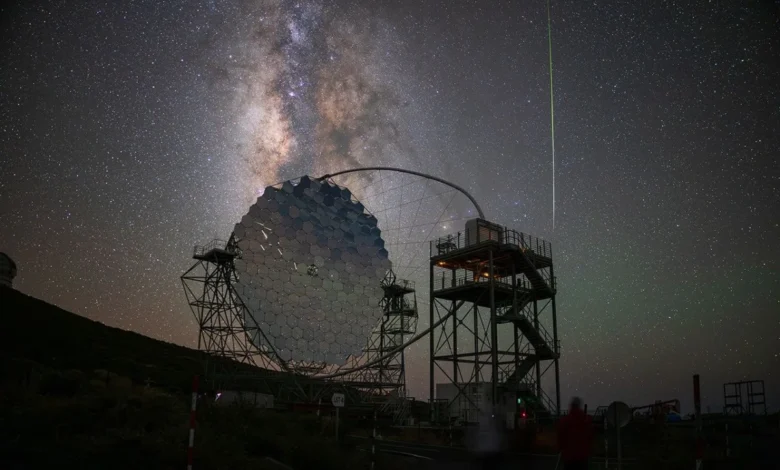
The intersection of ground-breaking astrophysics infrastructure and ephemeral celestial phenomena was captured on August 15, when a brilliant Perseid meteor streaked across the night sky above the Canary Islands. The vibrant meteor trail was photographed against the luminous backdrop of the Milky Way’s central band at the Observatorio del Roque de los Muchachos on La Palma, Spain. Hovering in the foreground of this cosmic tableau is the imposing 23-meter-diameter structure of the prototype Large-Sized Telescope (LST-1), the vanguard instrument of the upcoming Cherenkov Telescope Array Observatory (CTAO).
This striking astronomical image, selected as NASA’s Astronomy Picture of the Day (APOD), highlights the convergence of traditional stargazing astrophotography with next-generation high-energy gamma-ray astronomy. Beyond its aesthetic appeal, the photograph underscores the dual operational reality of modern astronomical facilities: while sophisticated instruments scan the skies for invisible cosmic signatures, they frequently bear silent witness to the classic, unfiltered wonders of our solar system and galaxy.
Main Facts of the Celestial Event
The celestial photograph, captured by astrophotographer Jeff Dai, features three primary astronomical elements: a dynamic Perseid meteor, the glowing band of the Milky Way galaxy, and the cutting-edge LST-1 gamma-ray telescope.
The Perseid meteor shower is an annual astronomical event occurring as Earth passes through the debris trail left by Comet Swift-Tuttle. Composed of tiny dust particles and rock fragments shed by the comet over millennia, these meteoroids vaporize upon entering Earth’s upper atmosphere at speeds exceeding 59 kilometers per second (approx. 132,000 miles per hour). The kinetic energy of the impact ionizes air molecules, creating the brief, glowing ionization trails visible from the ground.
Dominating the upper portion of the frame is the central region of the Milky Way. Spanning the constellations of Sagittarius and Scorpius toward the galactic center, this dense concentration of billions of stars is bisected by intricate dark lanes of interstellar dust and gas.
Dominating the foreground is the LST-1, a technological marvel specifically engineered not to take pretty pictures of the night sky, but to hunt for elusive Cherenkov radiation. Comprising 198 individually adjustable hexagonal mirror segments mounted on a lightweight carbon-fiber and steel framework, the 23-meter dish acts as a light collector for ultra-fast, faint blue flashes of light produced in Earth’s upper atmosphere.
Chronology of the Perseid Peak and Observation Window
The event captured in the photograph occurred during the peak activity period of the 2026 Perseid meteor shower, a multi-week astronomical window that typically runs from mid-July to late August, peaking around August 11 to August 13.
- Mid-July: Earth enters the outer fringes of the Comet Swift-Tuttle debris stream, initiating the annual Perseid season.
- August 11–13: The core peak of the meteor shower, during which observers under dark skies can witness dozens to over a hundred meteors per hour.
- August 15: The specific night of the captured photograph. Although past the absolute hourly peak, late-season Perseids continue to produce bright, colorful fireballs due to larger meteoroid fragments intersecting Earth’s orbit.
- Night of August 15: Astrophotographer Jeff Dai frames the Observatorio del Roque de los Muchachos, timing the exposure to catch a brilliant Perseid fireball streaking directly parallel to the Milky Way’s core, with the LST-1 mirror array reflecting ambient light and capturing the atmospheric flash.
Supporting Data and Technical Background on LST-1
The Observatorio del Roque de los Muchachos, situated at an altitude of approximately 2,400 meters (7,900 feet) on the island of La Palma, provides some of the clearest, most stable atmospheric viewing conditions in the Northern Hemisphere. This makes it an ideal location for both optical astrophotography and high-energy gamma-ray astronomy.

The LST-1 is the first prototype of the Large-Sized Telescope class developed for the Cherenkov Telescope Array Observatory (CTAO). The CTAO represents the next generation global ground-based gamma-ray observatory, featuring dozens of telescopes across northern and southern hemisphere sites to survey the universe in very high-energy gamma rays.
Key technical parameters of the LST-1 include:
- Dish Diameter: 23 meters, making it one of the largest single-dish telescope structures of its kind.
- Mirror Assembly: Composed of 198 individual hexagonal glass-ceramic mirror segments, which can be actively aligned using computer-controlled actuators to maintain optimal optical performance.
- Camera System: Equipped with a high-efficiency, highly pixelized photomultiplier tube (PMT) camera capable of recording temporal events down to the nanosecond scale.
- Primary Objective: To detect Cherenkov radiation—faint, cone-shaped blue light flashes lasting only a fraction of a microsecond (about a billionth of a second). These flashes are generated when ultra-high-energy gamma rays from deep space collide with molecules in Earth’s upper atmosphere, triggering a cascade of secondary subatomic particles moving faster than the local speed of light in air.
On the night of the photograph, the sensitive optical systems and individual mirror segments of the LST-1 did not merely serve as a scenic foreground; they actively intersected and reflected the atmospheric illumination produced by the Perseid meteor, bridging the gap between optical meteor observation and high-energy particle detection.
Official Responses and Institutional Context
While the APOD feature is curated daily by professional astronomers—traditionally led by Robert Nemiroff (Michigan Technological University) and Jerry Bonnell (University of Maryland)—the inclusion of the LST-1 highlights ongoing outreach efforts by the CTAO collaboration and international astrophysical institutions.
Representatives from the Instituto de Astrofísica de Canarias (IAC), which hosts the Observatorio del Roque de los Muchachos, have frequently emphasized the synergy between public engagement astrophotography and rigorous scientific research. Sites like La Palma are designated as natural reserves for starlight quality, protected from light pollution to ensure that both professional instruments and amateur astronomers can continue to study the cosmos.
Furthermore, the publication of this image coincides with administrative transitions for NASA’s Astronomy Picture of the Day. As noted in the platform’s recent announcements, APOD is modernizing its digital infrastructure by migrating its main NASA hosting architecture from its legacy domain (apod.nasa.gov) to its updated institutional home (science.nasa.gov/apod), ensuring long-term accessibility and enhanced security for millions of daily space enthusiasts, students, and educators worldwide.
Broader Impact and Implications for Astronomy
The juxtaposition of a historical meteor shower against a cutting-edge gamma-ray telescope illustrates the evolving methodology of modern astrophysics.
For centuries, astronomy was limited to the visible light spectrum—observing stars, planets, and nebulae through optical telescopes much like the human eye perceives them. Today, multi-messenger and multi-wavelength astronomy dominate the field. Instruments like the LST-1 expand human perception into the invisible realm of high-energy gamma rays, uncovering the violent physics behind supermassive black holes, active galactic nuclei, supernova remnants, and gamma-ray bursts billions of light-years away.
At the same context, images like the one captured by Jeff Dai serve an essential cultural and educational purpose. They demystify complex scientific installations, transforming multi-million-dollar government and international research facilities from sterile industrial installations into poetic participants in the night sky. By showing a simple shooting star reflected in the mirrors of a gamma-ray collector, the photograph reminds the public that humanity’s most advanced technological probes remain deeply connected to the natural rhythms of our solar system and the shared heritage of planet Earth.
Related posts: