Unseen Foundations: Why Earth’s Mycorrhizal Fungal Networks Require Urgent Global Protection

The silent, intricate web of life beneath our feet is facing a crisis of invisibility that threatens the stability of the global climate and the future of food security. According to a landmark study published in the journal Nature, researchers from the Society for the Protection of Underground Networks (SPUN) have revealed that 90 percent of the world’s most critical mycorrhizal fungal biodiversity hotspots currently exist outside of protected areas. These subterranean networks, which act as the planet’s circulatory system by cycling nutrients and sequestering vast quantities of carbon, are being ignored by current conservation agendas, leaving them vulnerable to the dual threats of habitat destruction and climate change.
The research represents a massive leap forward in our understanding of soil ecology. By leveraging a dataset comprising over 2.8 billion fungal sequences across 130 countries, scientists have successfully generated the first high-resolution, predictive maps of global mycorrhizal fungal communities. These maps serve as a diagnostic tool for policymakers, offering the first clear visual evidence of where unique, endemic fungal communities are thriving—and where they are most at risk of extinction.
The historical oversight of these organisms is what experts have termed "fungus blindness"—a systemic failure to account for the microorganisms that underpin terrestrial life. For centuries, the focus of conservation has remained almost exclusively aboveground, prioritizing charismatic megafauna and visible flora while the "ecosystem engineers" responsible for their survival remained in the dark.
A Chronology of Underground Discovery and Mapping
The initiative to map the Earth’s fungal networks began in earnest in 2021, when SPUN was established to bridge the gap between mycological research and environmental policy. The organization’s mission was built on the recognition that while satellite imagery has revolutionized our understanding of deforestation and glacial melt, the underground, which holds the key to forest regeneration and crop resilience, remained largely unmapped.
Over the past three years, a global effort involving an international network of 96 "Underground Explorers" and more than 400 scientists has been underway. These researchers have traveled to some of the most remote and challenging environments on the planet—including the temperate rainforests of Tasmania, the Guinean forests of West Africa, and the Cerrado savanna in Brazil—to collect samples.
To date, the SPUN dataset includes more than 40,000 physical specimens representing 95,000 distinct mycorrhizal fungal taxa. This immense volume of data allowed the team to move beyond descriptive biology into predictive modeling. The study published in July 2025 stands as the first large-scale scientific application of this mapping initiative, confirming that the current global network of protected areas is woefully inadequate for preserving the fungal diversity that sustains the planet.
The Ecological Significance of Mycorrhizal Fungi
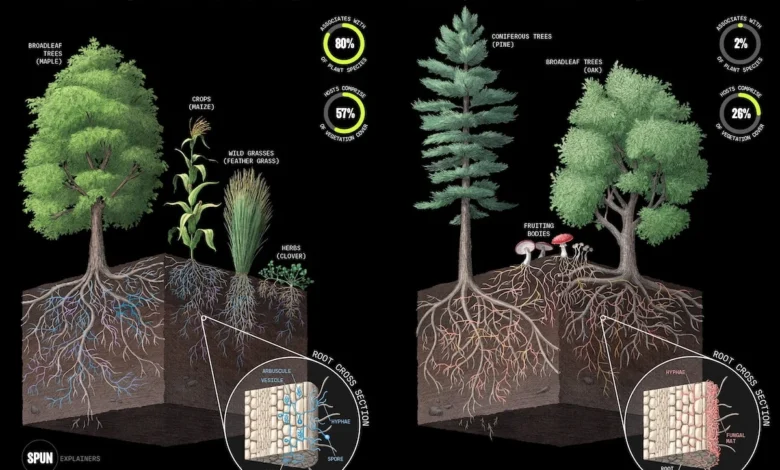
Mycorrhizal fungi are essential symbionts; they form intricate relationships with the roots of the vast majority of land plants. Through these networks, fungi supply plants with essential nutrients—most notably phosphorus and nitrogen—in exchange for carbon that the plants capture through photosynthesis.

The scale of this exchange is staggering. Globally, these fungi draw an estimated 13 billion tons of carbon annually into the soil. This figure represents approximately one-third of the total carbon emissions produced by global fossil fuel consumption. By effectively locking carbon into the soil, these networks act as a natural carbon sink, yet they remain largely absent from national climate strategies and carbon credit frameworks.
Beyond carbon sequestration, these networks are vital for ecosystem stability. They improve soil structure, increase water retention, and protect host plants against pathogens. Dr. Toby Kiers, Executive Director of SPUN, noted that the relationship between plants and fungi is an ancient one, dating back some 450 million years. "It was because of these mycorrhizal fungal networks that plants colonized the planet and began supporting human life," Kiers explained. "If we have healthy fungal networks, then we will have greater agricultural productivity, bigger and beautiful flowers, and can protect plants against pathogens."
Analyzing the "Protection Gap"
The data provided by the new maps paints a stark picture of current conservation failures. While 9.5 percent of fungal biodiversity hotspots are currently located within protected areas, the vast majority—more than 90 percent—remain exposed to land-use changes, industrial agriculture, and infrastructure development.
The implications of this gap are profound. When these networks are disrupted by deep tilling, excessive chemical fertilizer use, or deforestation, the result is a cascade of negative effects: forest regeneration slows, crop yields become unstable, and the resilience of ecosystems to extreme climate events, such as drought or flooding, is significantly diminished.
The lack of protection is particularly problematic because these fungal communities are not uniformly distributed. They exhibit high levels of endemism, meaning that certain species are found only in specific, localized environments. When a local habitat is destroyed, it is not just the vegetation that is lost, but a unique, localized network that may have taken millennia to evolve.
Official Responses and Strategic Implications
The research has drawn widespread attention from the scientific community and conservation leaders. Prominent figures, including conservationist Jane Goodall and authors Michael Pollan and Paul Hawken, have served as advisors to the project, underscoring the shift in perspective regarding the necessity of soil-focused conservation.
"The idea is to ensure underground biodiversity becomes as fundamental to environmental decision-making as satellite imagery," said Jason Cremerius, SPUN’s chief strategy officer. This sentiment is echoed by Dr. Merlin Sheldrake, who serves as the organization’s impact director. Sheldrake emphasizes that the maps are not merely academic products; they are actionable tools for land managers and policymakers.
From a policy perspective, the integration of these maps into international conservation agreements could be transformative. For instance, the Kunming-Montreal Global Biodiversity Framework, which aims to protect 30 percent of the planet’s land and sea by 2030, could be significantly enhanced by using fungal diversity data to identify high-priority zones for protection.

Dr. Alex Wegmann of The Nature Conservancy noted that restoration practices have historically been "dangerously incomplete" because they ignored the soil microbiome. By providing quantitative targets for what healthy fungal communities should look like, these maps allow restoration managers to move beyond "planting trees" to "restoring ecosystems."
Broader Implications for Global Resilience
The findings published in Nature suggest that the path to climate resilience must run through the soil. As the world faces the growing pressures of a warming climate, the ability of ecosystems to adapt will depend on the strength of their underground infrastructure.
The economic implications are equally critical. With global food security under pressure from changing precipitation patterns and soil degradation, the agricultural sector stands to benefit immensely from protecting mycorrhizal networks. Healthy soil—defined by a robust, diverse, and intact fungal web—is more capable of buffering crops against the shocks of climate change.
As the scientific community continues to analyze the data, the focus is shifting toward "underground conservation corridors." By connecting protected areas with soil-healthy zones, it may be possible to create pathways for fungal species to migrate and adapt to shifting climate zones.
Moving Forward: The Future of Soil Conservation
The challenge now lies in translating these maps into concrete policy outcomes. The publication of this study marks a turning point in the field of conservation biology, shifting the focus from the surface to the substrate. The ongoing expeditions by the "Underground Explorers" will continue to refine these maps, adding resolution and depth to our understanding of the planet’s most vital, yet overlooked, assets.
Ultimately, the research serves as a sobering reminder of what is at stake. As Dr. Kiers stated, these maps reveal "what we stand to lose if we fail to protect the underground." By ignoring the foundational life forms that have sustained terrestrial ecosystems for hundreds of millions of years, the global community risks losing a critical ally in the fight against climate change and biodiversity loss. The era of "fungus blindness" is coming to an end, and in its place, a new, science-based approach to the stewardship of our planet’s underground networks must emerge. The data is clear: to protect the life we see, we must first protect the life we do not.