Cracking the Code of the Lycurgus Cup: Scientists Replicate an Ancient Roman Optical Masterpiece

For over 1,600 years, the Lycurgus Cup has stood as one of the most enigmatic artifacts of the Roman Empire. Held within the permanent collection of the British Museum, this fourth-century cage cup possesses a unique, almost supernatural optical property: it appears jade-green when lit from the front, but shifts to a vibrant, translucent ruby-red when illuminated from behind. This dichroic effect, long a source of fascination for historians and materials scientists alike, has finally been replicated through a rigorous, multi-year scientific endeavor led by the University of Sheffield. By bridging the gap between ancient craftsmanship and modern nanotechnology, researchers have not only decoded a chemical mystery but have opened new avenues for the development of light-responsive, sustainable materials.
The Mystery of the Fourth-Century Nano-Engineers
The Lycurgus Cup, carved from a single piece of glass, depicts the mythical death of King Lycurgus of Thrace. While the intricate relief carving is a triumph of Roman lapidary skill, the true genius lies in the glass matrix itself. In the 1990s, electron microscopy revealed the secret behind the cup’s color-changing abilities: the glass contains trace amounts of silver and gold nanoparticles, ground to a size of approximately 50 nanometers—less than one-thousandth the width of a human hair.
The Romans had unknowingly mastered the principles of plasmonics. When light hits these nanoparticles, the electrons oscillate, scattering specific wavelengths of light depending on the size and shape of the particles. While the 2020 Dutch study demonstrated that this effect could be mimicked in 3D-printed nanocomposites, a consistent, replicable, and traditional glass-making recipe remained elusive. The challenge was not merely adding gold and silver to molten glass, but achieving the precise distribution and size uniformity required to trigger the dichroic shift without ruining the clarity or structural integrity of the glass.
A Chronology of Discovery
The path to replicating the Lycurgus glass was paved with years of trial and error. The project, spearheaded by University of Sheffield technician Lisa Hollands and glass expert Caroline Jackson, began with the premise that the Roman method was likely far more intuitive than current industrial processes.
- Pre-2020: Theoretical study of the cup’s chemical composition, confirming the presence of silver-gold colloidal particles.
- 2020: Dutch researchers successfully produce a 3D-printed nanocomposite mimicking the dichroic effect, providing a proof-of-concept for the optical properties.
- 2021–2023: Hollands and Jackson initiate experimental glass melts at the University of Sheffield. The team tests various furnace configurations, atmospheric oxygen levels, and chemical additives—including, in one notable trial, the addition of sugar to influence the chemical reduction of the metallic particles.
- 2024: Hollands successfully identifies the specific thermal and chemical parameters required to suspend the particles in the correct configuration.
- Mid-2024: The discovery is showcased at the "LightFest" event as part of the Molecular Photonic Breadboards project.
- Late 2024: Commissioning of artist Elliott Walker to translate the scientific breakthrough into a contemporary art piece.
The Science of the "Masterpiece"
Lisa Hollands, who possesses over 25 years of experience in glass craft, noted that the task was fundamentally different from modern glass production. "I knew that making a glass of this type was likely to be a complex task, as it is not just a case of adding nanoparticles to glass," Hollands remarked. The scientific difficulty lies in "nucleation"—the stage where the particles form and grow. If the temperature is too high or the cooling process too rapid, the particles aggregate into larger clusters, causing the glass to appear opaque or murky rather than the brilliant, shifting red-green of the original.
The team’s success serves as a profound reminder of the sophisticated empirical knowledge held by Roman glassmakers. While they lacked the language of "nanotechnology" or "plasmon resonance," they possessed an advanced understanding of metal chemistry and furnace atmospheres. Hollands acknowledged the humility required for this research: "I’ve used the knowledge and experience I’ve gained, coupled with a modern scientific understanding, although if the Romans could have seen me experimenting, they’d probably laugh and ask: ‘Why does she not know how to make this?’"
Bridging the Gap: Art Meets Engineering
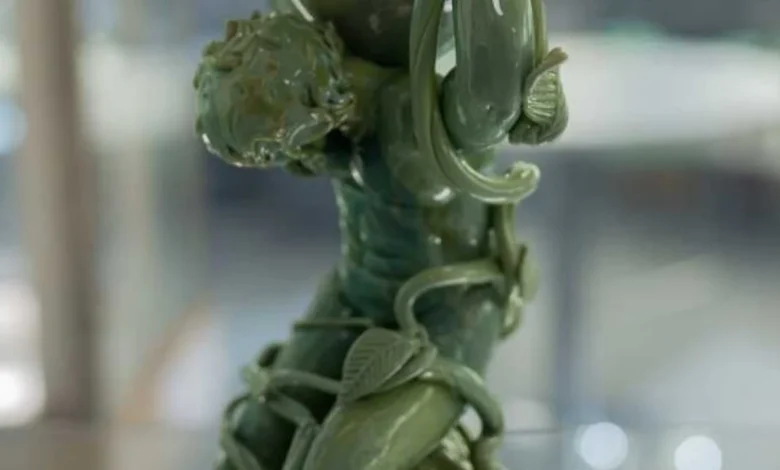
To celebrate the scientific breakthrough, project leaders turned to Elliott Walker, an acclaimed glass artist and the Series 2 winner of the Netflix competition Blown Away. Walker was tasked with creating a sculpture that would serve as both a homage to the original artifact and a demonstration of the newly synthesized glass.
"It is a very rare thing to have the opportunity to work with glass developed from ancient mixtures and recipes," Walker said. "It’s like shaking the hands of the glassmakers of the past." Walker’s sculpture draws inspiration from the Farnese Atlas—a famous Roman statue—replacing the globe with a cup to symbolize the weight of history and the scientific discovery of the Lycurgus properties. The integration of the blown glass element into the sculpture serves as a physical testament to the material’s durability and visual brilliance.
Broader Implications for Material Science
The ability to replicate the Lycurgus glass is more than an exercise in historical curiosity; it has significant implications for contemporary technology. The research is part of the broader "Molecular Photonic Breadboards" project, which seeks to design materials that harness light for sustainable energy solutions.
Dichroic materials have potential applications in:
- Smart Windows: Glass that can shift transparency or color in response to sunlight to regulate building temperatures, reducing the need for HVAC energy consumption.
- Sensors: The extreme sensitivity of plasmonic nanoparticles to their environment makes them ideal for high-precision chemical and biological sensors.
- Data Storage: Investigating how light-responsive materials can be used in next-generation optical data storage, which offers higher density and lower energy usage than traditional magnetic storage.
By decoding the ancient recipe, the team at Sheffield has demonstrated that the "primitive" techniques of the past may hold the key to solving some of the most pressing material challenges of the future.
Public Access and Future Display
The scientific achievement and the artistic tribute will be made available to the public in the coming month. The sculpture by Elliott Walker is scheduled to be unveiled at the University of Sheffield’s "Festival of the Mind" held at the Millennium Gallery. This festival, which highlights the intersection of academic research and creative practice, provides an ideal venue for a project that relies so heavily on the marriage of historical inquiry and modern scientific rigor.
Following the festival, the sculpture will be relocated to the Turner Museum of Glass at the University of Sheffield, where it will remain on permanent display. For researchers and art enthusiasts alike, the piece serves as a physical narrative: a story of ancient ingenuity, the persistence of the scientific method, and the timeless beauty of a material that continues to captivate the human eye 1,600 years after its creation.
The project stands as a benchmark for interdisciplinary research. By involving historians, materials scientists, and professional artists, the University of Sheffield has ensured that the "recipe" for the Lycurgus glass is not just a formula in a lab notebook, but a living, visible reality. As the scientific community continues to explore the potential of plasmonic materials, the Lycurgus Cup remains the ultimate proof of concept—a piece of history that, quite literally, continues to change with the light.
Related posts: