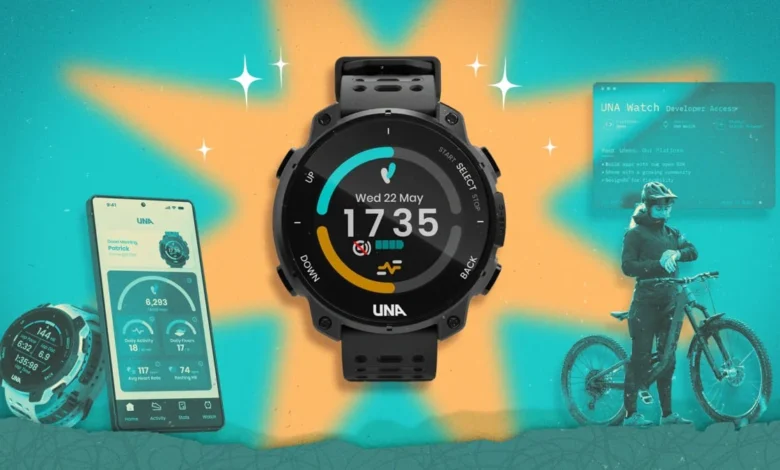
The emergence of the Una watch represents a significant departure from the established paradigm of consumer electronics. While industry titans like Apple, Samsung, and Garmin have spent the last decade building increasingly closed ecosystems, the Una watch enters the market as a modular, open-source device designed explicitly for developer modification and user customization. This shift toward "hackable" hardware marks a return to the ethos of early computing, where the value of a device is determined not by its pre-loaded suite of software, but by the community’s ability to manipulate its architecture.
At its core, the Una watch features an interchangeable design and an open development environment that invites users to treat the device as a canvas rather than a locked-in consumer product. While the device may appear barebones at launch, lacking the polished integration of major competitors, its functional limitations are arguably its primary feature. By providing a low barrier to entry for amateur developers, the Una project is positioning itself as a hub for innovation in the wearable sector.
A Chronology of Open-Hardware Wearables
To understand the significance of the Una watch, one must look at the historical trajectory of wearable technology. The early 2010s saw the rise of the fitness tracker, with devices like the Fitbit and Jawbone Up setting the standard for proprietary data collection. Following this, the 2015 launch of the Apple Watch shifted the narrative toward multifunctional smartwatches that mirrored the capabilities of smartphones.
However, these devices were defined by "walled garden" software architectures. Developers were largely restricted by APIs (Application Programming Interfaces) set by the manufacturers. The Una watch project was conceived in response to this restriction. Development began in early 2022, with a focus on creating a hardware platform that utilized standard components—such as a universal USB-C charging port—to minimize the need for proprietary accessories. After eighteen months of prototyping and a successful initial launch phase, the device is now entering a critical stage where community adoption will determine its long-term viability.
Technical Infrastructure and Utility
The technical design of the Una watch prioritizes interoperability. One of the most notable examples of this is the decision to integrate a standard USB-C interface. In standard consumer wearables, charging usually requires a specialized magnetic dock or proprietary cradle. By contrast, the Una watch allows for power transfer via standard USB-C to USB-C cables, enabling users to draw power directly from a mobile phone or any standard power delivery source. This reduces the logistical friction of travel and underscores the device’s emphasis on utility over aesthetic streamlining.
Furthermore, the display technology utilized—a Memory-in-Pixel (MIP) screen—offers distinct advantages in power efficiency and visibility. Unlike OLED screens, which require significant power to maintain high brightness, MIP displays are reflective and energy-efficient, making them ideal for the open-source applications currently being developed by the community.
Community-Driven Software Development
The current ecosystem surrounding the Una watch is defined by a series of experimental applications that address common user needs without the overhead of cloud-based tracking platforms. The Slumber application, for instance, provides a localized analysis of sleep duration and consistency. Unlike major platforms that utilize complex, often opaque algorithms to calculate "sleep stages," Slumber offers a transparent data set processed entirely on the device.
The HabitLab application represents a more sophisticated attempt at data integration. By aggregating subjective user inputs—such as dietary habits or alcohol consumption—with objective metrics like Heart Rate Variability (HRV) and resting heart rate, the app attempts to correlate lifestyle choices with recovery. While initial reports suggest the app is still in a developmental state regarding long-term trend analysis, the focus remains on empowering the user to interpret their own biological data rather than relying on a black-box algorithm managed by a third-party corporation.
Expanding the Utility of Wearables
The potential for the Una watch extends into physical-world integration through the use of standardized barcode and QR code applications. Because the device’s software environment allows for the storage of alphanumeric data, users have successfully repurposed the watch for practical, everyday tasks.
The Barcode app, originally designed for the parkrun 5K community to track race results, has been effectively utilized for library cards, grocery loyalty programs, and other identity-based QR codes. The efficacy of these scans is largely attributed to the contrast ratios of the MIP display, which often outperforms the high-glare surfaces of traditional glass-screen smartwatches. This practical application highlights how open-source software can solve specific user problems that are often overlooked by larger companies focused on mass-market features.
Environmental Awareness and Geospatial Utility
The Sun & Moon Face application demonstrates the device’s capability for environmental data visualization. By querying the user’s GPS coordinates on a once-daily basis, the watch calculates solar trajectories to provide real-time updates on daylight availability. While this feature is primarily informational, it serves as a proof of concept for how the watch can manage location-based services without the constant battery drain associated with continuous background tracking.
The shift in screen color based on these solar calculations is an example of the creative freedom afforded to developers. By allowing the UI to adapt based on time of day, the watch provides a tactile, visual connection to the natural environment—a design philosophy that prioritizes the user’s experience over the manufacturer’s brand identity.
Broader Implications and Market Impact
The long-term impact of the Una watch project may lie in its democratization of app development. The platform offers a suite of development tools compatible with Windows, macOS, and Linux, lowering the technical threshold for those wishing to create custom glances or widgets. By providing about a dozen example templates, the project is effectively building a knowledge base for a new generation of hardware developers.
Industry analysts suggest that while the Una watch is unlikely to replace mainstream smartwatches in the near term, it fills a growing gap for privacy-conscious users and developers who prioritize control over their data. In an era where data privacy is increasingly under scrutiny, the ability to perform analysis locally on the wrist—without transmitting health data to external cloud servers—is a compelling value proposition.
The success of the Una watch will ultimately depend on the persistence of its community. For such a project, the "network effect" is critical: the more developers there are creating, debugging, and sharing applications, the more robust the platform becomes. If the project can maintain its current trajectory of user-driven innovation, it may well serve as a blueprint for a future where hardware is bought, but software is built by the end-user.
In conclusion, the Una watch serves as a microcosm for the broader "right to repair" and "open-source hardware" movements. By stripping away the layers of proprietary software that characterize the current wearable market, the device forces a conversation about what a watch should actually do. As the community continues to refine its applications, the Una watch stands as a testament to the idea that technology is most effective when it is flexible, transparent, and built by the people who use it. Whether it achieves mass adoption or remains a niche tool for tech enthusiasts, its presence ensures that the market for wearable technology remains open to innovation from outside the traditional corporate structure.