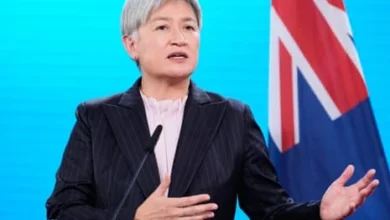
Trump says Hegseth has done a fantastic job a day after impeachment effort against defense secretary withers

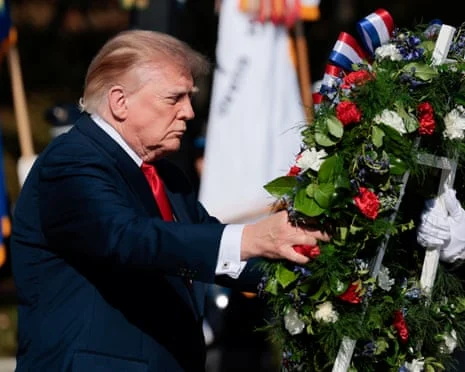
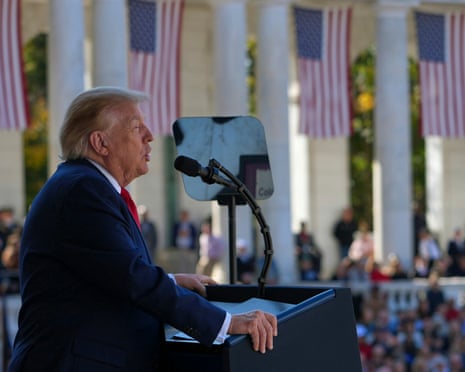
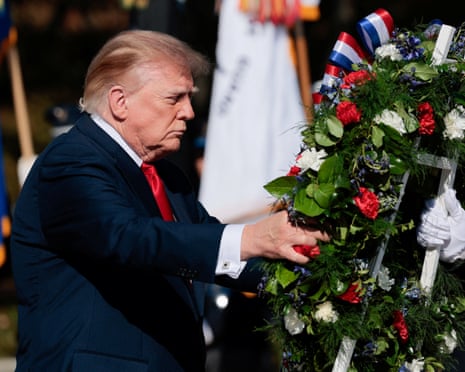
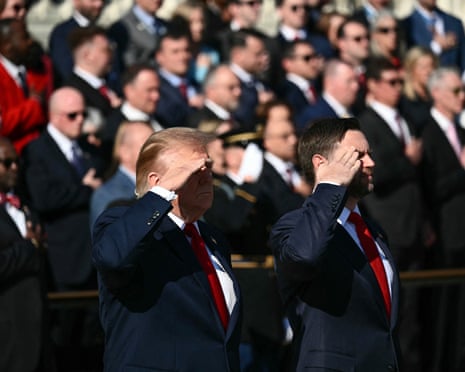
President Donald Trump delivered a spirited defense of his embattled Secretary of Defense, Pete Hegseth, during a Veterans Day commemoration at Arlington National Cemetery on Wednesday. The remarks followed a significant legislative victory for the administration, as House Republicans effectively derailed an effort to impeach the defense chief just 24 hours prior. Standing before an audience of veterans and military officials, Trump praised Hegseth’s leadership, declaring, "I had a feeling that was going to happen. He’s done a fantastic job. He loves you, and he protects you—he’s all about you."
The presidential endorsement provided a stark contrast to the growing political volatility surrounding the Department of Defense. The impeachment resolution, spearheaded by outgoing Republican Representative Thomas Massie, had sought to oust Hegseth on charges related to the unsanctioned launch of military strikes in Iran and broader allegations of procedural violations. The motion failed on Tuesday in a 211-204 vote, largely along party lines, after Republican leadership maneuvered to refer the articles to the House Judiciary Committee, a move widely interpreted as a procedural death knell for the effort.

A Tense Atmosphere at the Tomb of the Unknown Soldier
The political tension appeared to spill over into the solemnity of the Veterans Day ceremony. During the event, video footage captured by the network pool showed a U.S. sentinel at the Tomb of the Unknown Soldier reprimanding Hegseth and his delegation. The group, which included his wife, Jennifer, Chief of Staff Ricky Buria, Deputy Chief of Staff Patrick Weaver, and senior adviser Tami Radabaugh, were reportedly engaged in conversation and laughter while posing for photographs near the sacred site.
The guard’s sharp intervention—"All visitors will maintain an atmosphere of silence and respect at all times"—highlighted the delicate balance of decorum required at one of the nation’s most hallowed sites. A Pentagon spokesperson later issued a statement asserting that the Secretary of Defense and the Department of Defense "have always honored—and will always honor—the sacrifices our military men and women have made to keep America safe," while acknowledging the soldier’s action as a correct and respectful reminder of cemetery protocols.
The Impeachment Saga: A Legislative Postmortem
The failed impeachment effort has exposed deep fissures within the Republican Party. Representative Thomas Massie, who broke ranks with his party to introduce the resolution, likened the GOP’s current trajectory to the passengers of the Titanic. "They know it’s a sinking ship but are committed to staying on board," Massie remarked.
Political analysts have noted that the failure of the impeachment motion was compounded by internal Democratic disarray. Eleven Democratic representatives, including former Speaker Nancy Pelosi, were absent during the procedural vote. While several lawmakers cited a massive traffic jam in Washington D.C. caused by a motorcade as the reason for their absence, the missed vote has sparked sharp criticism from party members. Abdul El-Sayed, the Democratic senator-elect from Michigan, did not mince words in a CNN interview, calling on his colleagues to "show up and do your job." El-Sayed also addressed the Defense Secretary directly, stating, "Why are you still doing this job? You are failing your responsibility. You have mishandled this war, and nobody really understands what it is you’re about."
Triumphalism and Legal Friction: The Arlington Arch
Beyond the immediate political fallout, President Trump used the Veterans Day platform to reassert his vision for the physical landscape of the capital. He touted his plans for a 250-foot gilded "triumphal arch" to be constructed in a traffic circle facing the entrance of Arlington National Cemetery.
"Soon we’re going to dedicate a magnificent, triumphal arc to our veterans, and that’s in honor of our great veterans and our great militaries. They’ve been waiting for it for 200 years," the President claimed. The proposal, however, faces significant legal and cultural hurdles. On Tuesday, nine members of the Kennedy family filed a lawsuit seeking to block construction, arguing that the massive structure would "obstruct the clear sightline of the Kennedy Gravesites" and fundamentally alter the experience of visiting their family’s memorial. The project has already faced a temporary setback; last week, U.S. District Judge Tanya Chutkan issued a 14-day injunction blocking the administration from breaking ground.
Escalating Conflicts: The White House and Oversight
The friction between the executive branch and Congress is not limited to the Department of Defense. White House General Counsel Will Scharf recently issued a formal letter to Democratic Representative Robert Garcia, the incoming chair of the House Oversight Committee. The letter threatened members of Congress with potential criminal investigations if they launch oversight inquiries deemed to be "deployed to harass and aggrandize" administration officials.
Scharf’s letter, first reported by Punchbowl News, claims that the administration is monitoring "abusive and capricious threats" from legislators. The House Oversight Committee, however, holds broad authority to investigate government offices, provided there is a valid legislative purpose. Representative Garcia remained undeterred by the administration’s warning. "It appears Donald Trump has something to hide," Garcia said in a statement. "Congress has wide latitude to conduct investigations and oversight, an authority inherent in the power to legislate. We are a co-equal branch of government and will not be deterred by baseless threats."
Broader Implications for the Administration
The current climate of political instability is further reflected in the security measures surrounding high-ranking officials. The U.S. Treasury Secretary, Scott Bessent, has reportedly relocated to a secure military base due to credible threats against his life linked to Iranian intelligence. This move reflects a broader trend within the administration, with figures such as Secretary of State Marco Rubio and Chief of Staff Stephen Miller also utilizing military housing for protection. National Intelligence Chief Jay Clayton recently confirmed that Tehran has "substantially increased" its efforts to target American officials, citing the ongoing war in the Middle East as the primary catalyst.
As the administration grapples with these domestic and international crises, the internal power dynamics of the Republican Party are shifting. With the midterm election results leaving the party in a weakened position, discussions regarding the 2028 presidential nominee have already begun. Recent reporting from Politico indicates that a growing faction of GOP lawmakers is looking toward Marco Rubio as a potential successor to the current leadership, viewing him as a more unifying and effective communicator than Vice President JD Vance, whose political brand remains closely tied to the administration’s controversial foreign policy.
Public Health and Policy Controversies
Adding to the administration’s list of challenges is the looming health crisis concerning measles. The U.S. is on the brink of losing its "measles-free" status, a development that public health experts attribute to a decline in vaccination rates. The current outbreak, which has seen over 5,400 cases nationally, is the worst since 1991. The involvement of health secretary Robert F. Kennedy Jr. in the administration’s vaccine policy has drawn intense scrutiny, with critics arguing that his approach has contributed to a "tremendous step backward" in national public health.
As the country navigates this confluence of political, legal, and public health challenges, the atmosphere in Washington remains deeply polarized. With the House set to transition to new leadership in January, the promise of a more aggressive oversight agenda by Democrats suggests that the current battles over impeachment, executive privilege, and the scope of administrative power are far from over. For the White House, the coming months will be a test of its ability to manage these multiple, overlapping fronts while attempting to project stability in a time of significant national unease.