Hubble Space Telescope Captures Dwarf Galaxy NGC 4449 Revealing Surprising Cosmic Mechanics and Missing Oxygen

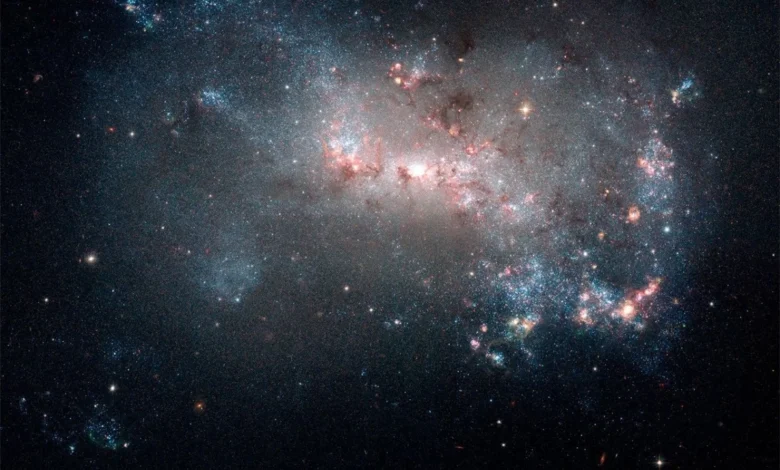
Astronomers analyzing recent observational data from the NASA/ESA Hubble Space Telescope have trained their lenses on the remarkable dwarf galaxy NGC 4449, uncovering complex evolutionary processes that challenge long-held models of galactic formation. Released as part of NASA’s ongoing Astronomy Picture of the Day initiative, the detailed imagery highlights a celestial body that defies its diminutive classification. While dwarf galaxies are frequently overlooked in favor of massive spiral giants like our own Milky Way, objects such as NGC 4449 are proving to be critical laboratories for understanding how heavy elements are distributed throughout the universe.
The image, captured by a collaborative team of international researchers including principal investigators from the Space Telescope Science Institute (STScI) and the European Space Agency (ESA), showcases a vibrant, bow-tie-shaped expanse of stars, glowing gas, and interstellar dust. Yet, beneath the visual spectacle lies a profound scientific mystery: these compact stellar systems are missing significant quantities of oxygen, a chemical anomaly that has forced astrophysicists to re-evaluate the potency of stellar winds and supernova feedback within small-scale galaxies.
Main Facts of the Observation
NGC 4449 is classified as a dwarf irregular galaxy, residing approximately 12.5 million light-years away from Earth in the constellation Canes Venatici. Unlike grand spirals with well-defined structural arms, dwarf irregulars possess chaotic, disorganized shapes, often fueled by intense episodes of star formation. The Hubble observation emphasizes the galaxy’s brilliant core, which is saturated with glowing pink clumps of ionized hydrogen gas, intermingled with bright, young blue-white stellar clusters and intricate tendrils of dark, absorbing dust.
The primary scientific takeaway from the recent campaign centers on chemical abundance measurements. Spectroscopic analyses of NGC 4449, alongside several comparable nearby dwarf galaxies, indicate a deficit of oxygen relative to what standard galactic evolution models predict. Because oxygen and other heavier elements are synthesized exclusively within the nuclear furnaces of massive stars and subsequently dispersed during supernova explosions, scientists expected these elements to remain tightly bound within the host galaxy’s gravitational potential well.
The observed shortage, however, provides empirical proof that powerful galactic-scale outflows are actively stripping these elements away. Stellar winds generated by dense clusters of massive stars, combined with explosive supernova events, act as colossal cosmic blowtorches. They expel gas and heavy elements out of the shallow gravitational wells of dwarf galaxies and into the diffuse, tenuous environment of intergalactic space.
Chronology and Background Context of Dwarf Galaxy Research
The study of dwarf galaxies has undergone a dramatic paradigm shift over the past several decades. Historically, observational astronomy heavily favored majestic, high-luminosity targets like the Andromeda Galaxy or the Sombrero Galaxy, leaving smaller stellar systems largely unexplored due to their faintness and low surface brightness. However, modern theoretical models and deep-sky surveys have established that dwarf galaxies are numerically dominant, representing the most common type of galaxy in the observable universe.
During the late 20th and early 21st centuries, space-based observatories such as Hubble transformed our understanding of these systems by resolving individual stars within nearby galaxies rather than viewing them as monolithic smudges of light. Ground-based facilities, including the Very Large Telescope (VLT) and the Keck Observatory, subsequently added crucial spectroscopic depth, allowing astronomers to map chemical abundances across various cosmic distances.
The lineage of observations for NGC 4449 specifically spans many years of dedicated study. As a prominent member of the Canes Venatici I cloud—a loose collection of galaxies gravitationally interacting with the greater M51 group—NGC 4449 has long been recognized as a starburst galaxy. A starburst galaxy is characterized by an exceptionally high rate of star formation compared to its long-term average. The current epoch of rampant star birth in NGC 4449 is widely believed to have been triggered by gravitational interactions and minor mergers with smaller companion galaxies over the past billion years.
Supporting Data and Astrophysical Metrics
To contextualize the scale of NGC 4449, it is helpful to contrast its dimensions with those of standard spiral systems. The Milky Way spans approximately 100,000 light-years in diameter and accommodates an estimated 100 billion to 400 billion stars, supported by a massive dark matter halo. In contrast, typical dwarf galaxies possess diameters roughly one-tenth that size and contain only a few billion stars, or in some ultra-faint cases, merely a few thousand.
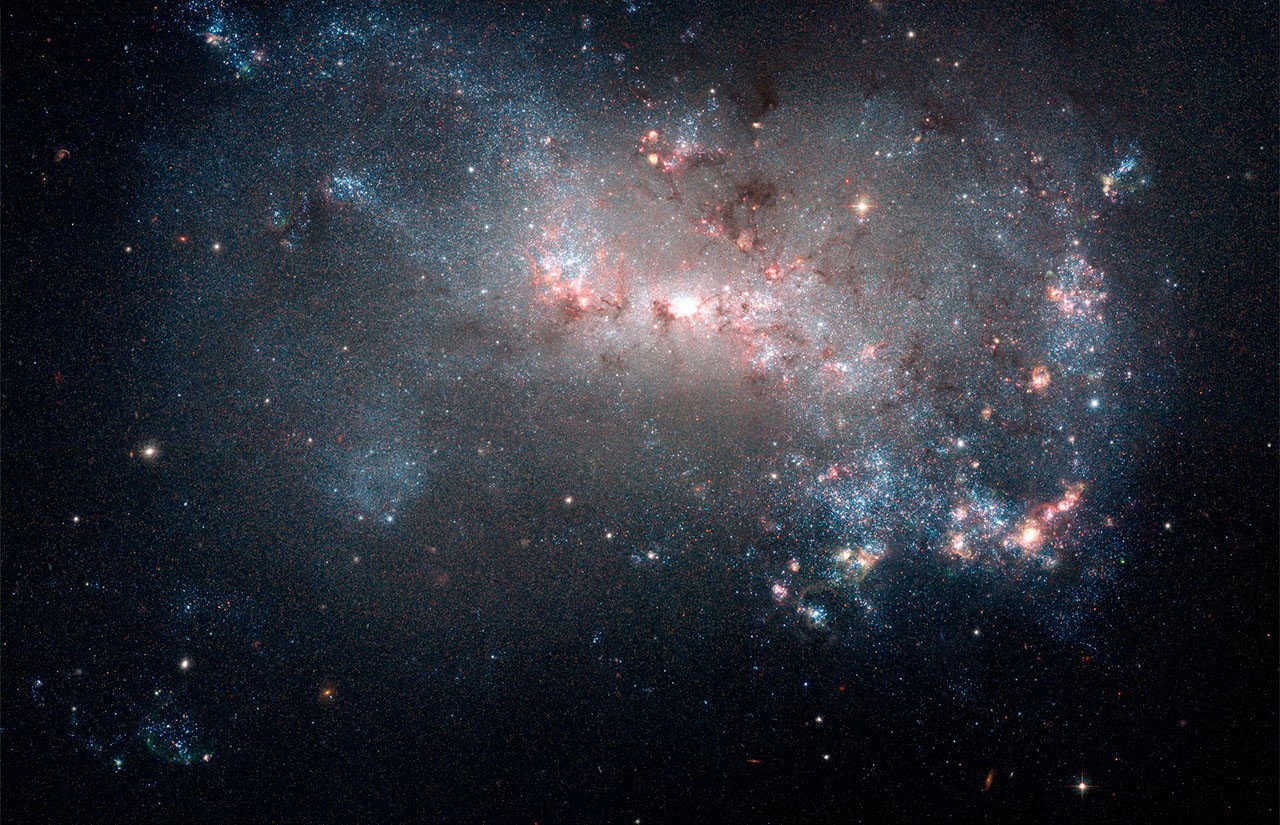
Despite their modest proportions, dwarf galaxies pack a disproportionate punch in terms of astrophysical feedback mechanisms. Data compiled from Hubble’s Wide Field Camera 3 (WFC3) and Advanced Camera for Surveys (ACS) reveal that the active star-forming regions within NGC 4449 boast star cluster formation rates orders of magnitude higher per unit mass than those observed in the Milky Way disk.
The mechanism responsible for the missing oxygen involves a delicate balance between a galaxy’s mass and its kinetic feedback capacity. When hundreds of massive stars ignite and rapidly evolve within a confined volume, their collective stellar winds sweep up surrounding interstellar medium. When these massive stars reach the end of their lifelines and detonate as core-collapse supernovae, they release kinetic energies exceeding $10^51$ ergs per event. In a massive galaxy like the Milky Way, the deep gravitational well successfully retains this heated gas, allowing it to cool and form subsequent generations of stars enriched with heavy elements—a process astronomers term chemical enrichment.
In a dwarf galaxy, the escape velocity is significantly lower. The cumulative pressure from multiple supernovae creates immense galactic superwinds that easily punch through the tenuous interstellar medium, blowing out enriched gas into the intergalactic void. This dynamic explains why dwarf galaxies often exhibit lower-than-expected metallicities despite undergoing intense phases of star formation.
Official Responses and Expert Perspectives
Astrophysicists and stellar evolution modelers have increasingly focused on these outflows to reconcile theoretical discrepancies in cosmological simulations. Dr. A. Aloisi of the Space Telescope Science Institute, a prominent contributor to the Hubble Heritage research team associated with the NGC 4449 campaigns, has repeatedly emphasized the importance of high-resolution imaging in isolating localized starburst events from global galactic properties.
"High-resolution space-based observations are indispensable when attempting to map the lifecycle of star formation in chaotic environments," noted researchers within the Hubble project documentation. "Systems like NGC 4449 allow us to witness extreme physical processes in real-time—processes that mirror the conditions of the early universe, when galaxy interactions and primordial starbursts were far more common."
Furthermore, theoretical astrophysicists studying chemical feedback loops point out that dwarf galaxies may have acted as the primary engines responsible for seeding the early universe with heavy elements. During the epoch of reionization, when the first generation of galaxies formed, dwarf systems were abundant and active. Their ability to efficiently expel heavy elements via galactic winds suggests they were instrumental in enriching the intergalactic medium, transforming pristine primordial hydrogen and helium into an environment capable of supporting rocky planet formation and, ultimately, life.
Broader Impact and Future Implications
The implications of the Hubble observation extend far beyond the aesthetic appeal of a distant stellar nursery. By confirming that dwarf galaxies are surprisingly efficient at distributing heavy elements, astronomers gain crucial insights into the cosmic metal cycle.
Heavy elements—such as carbon, nitrogen, oxygen, silicon, and iron—are fundamental prerequisites for the assembly of terrestrial worlds and biological systems. Understanding how these elements migrate from the dense cores of massive stars into the wider cosmos helps resolve longstanding questions regarding galactic metallicity gradients and the formation history of the local universe.
Looking forward, the scientific community anticipates complementary data from next-generation observatories. While the Hubble Space Telescope continues to provide unmatched optical and ultraviolet resolution for nearby targets, the James Webb Space Telescope (JWST) is currently expanding these investigations into the infrared spectrum. JWST’s high-sensitivity infrared instruments can pierce through thick blankets of cosmic dust within galaxies like NGC 4449, revealing obscured stellar nurseries and providing a more comprehensive census of deeply embedded star formation.
Additionally, upcoming wide-field surveys from facilities such as the Vera C. Rubin Observatory will catalog millions of faint dwarf galaxies, enabling statistical studies of galactic winds and metal loss across cosmic time. Through these combined efforts, the humble dwarf galaxy—once viewed as a mere cosmic footnote—continues to occupy a central role in our evolving narrative of the cosmos, illustrating how the smallest systems can generate some of the most profound impacts on the universe at large.