Treasurer Jim Chalmers is set to unveil Australia’s seventh Intergenerational Report (IGR) this Monday, a document that promises to paint a complex portrait of a nation navigating a "fragmented and uncertain world." While the report will highlight the inevitable pressures of an aging population and declining fertility rates, its primary focus will be on the transformative—and potentially disruptive—power of the artificial intelligence revolution. As the government grapples with these long-term demographic and technological shifts, Prime Minister Anthony Albanese is simultaneously engaging in high-stakes diplomacy in New York, where he is lobbying for a permanent seat on the United Nations Security Council and seeking a global consensus on AI governance.
The IGR serves as a critical diagnostic tool for the Australian economy, projecting fiscal sustainability over the next four decades. This year’s edition is particularly significant, arriving at a moment defined by what the treasurer describes as a "fraying of the intergenerational promise." Chalmers’ rhetoric suggests that while Australia enters this era of volatility with stronger fundamentals than many of its international peers, the traditional pathways to prosperity are being challenged by structural shifts that require proactive policy intervention.

The Demographic Challenge and Economic Realignment
Central to the IGR’s findings is the projected slowing of Australia’s population growth. The latest data indicates that the nation’s population is expected to reach 39.3 million by 2065-66. Notably, this is a downward revision of 1.8 million people compared to previous forecasts, a shift largely attributed to persistently lower fertility rates. For decades, the "intergenerational contract"—the idea that each generation would enjoy a higher standard of living than the last—has been underpinned by steady workforce growth and a manageable dependency ratio. With fewer children being born and the population aging, the pressure on the tax base to support healthcare, aged care, and pension systems is intensifying.
However, the report identifies technology, specifically AI, as a potential lever to offset these demographic headwinds. By increasing productivity in an economy with a smaller relative workforce, AI could provide the necessary growth to maintain Australia’s standard of living. The challenge, as the report outlines, is not merely the adoption of the technology, but the creation of a regulatory framework that manages the risks to the labor market while capturing the economic gains.
Diplomacy and the Global AI Framework
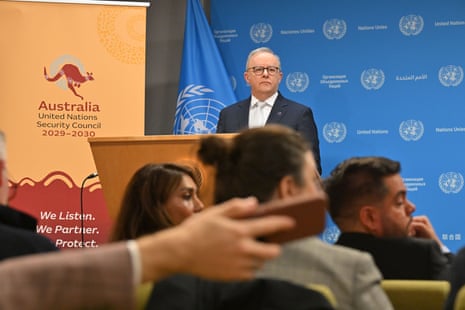
While Chalmers prepares to defend the IGR before the domestic press, Prime Minister Anthony Albanese is engaged in an intensive week of diplomacy in New York. The prime minister’s presence at the United Nations General Assembly is driven by two strategic objectives: securing a non-permanent seat on the UN Security Council for the 2029-2030 term and establishing a global standard for AI safety.

Albanese has adopted a "middle power" diplomatic strategy, urging the "big two" global giants—the United States and China—to treat AI development as a collaborative effort rather than a zero-sum arms race. The prime minister’s rhetoric emphasizes that artificial intelligence is a borderless technology; therefore, the governance of its development must be multilateral. During his meetings, Albanese has expressed his intention to advocate for robust safeguards, noting that the economic and social implications of the technology are so profound that they demand international oversight.
The prime minister’s diplomatic mission also involves navigating the political complexities of the current US administration. Amid reports that President Donald Trump has dismissed AI fears as a "hoax" while simultaneously proposing an "AI Force" and an AI czar to monitor the sector, Albanese has maintained a disciplined, professional stance. He has stated that he will engage with the President constructively and respectfully, asserting that Australia’s advocacy for safety measures is a matter of national interest that will be pursued both in private meetings and public forums.
New Diplomatic Appointments and Strategic Presence
In tandem with his UN bid, the prime minister has announced significant changes to Australia’s diplomatic representation. The appointment of Siobhan McKenna as the new Consul-General in New York is a move seen as a pivot toward deeper economic and financial engagement. McKenna, a former News Corp executive and current chair of Australia Post, brings extensive experience in the private sector to the role. Her appointment replaces outgoing Consul-General Heather Ridout, whose four-year term concludes in December.

The appointment has drawn some scrutiny regarding McKenna’s long-standing professional ties to the Murdoch family, but the prime minister has dismissed these concerns, characterizing the selection as one based strictly on merit. Albanese argued that the intersection of private-sector acumen and public-sector experience is essential for Australia’s representation in a major financial hub like New York, particularly as the nation seeks to attract investment and advocate for its interests on the global stage.
Foreign Minister Penny Wong also announced a broader reshuffling of key diplomatic posts to bolster Australia’s regional influence. Joel McGregor has been named Ambassador to Egypt, Jamie Isbister as the High Commissioner to Papua New Guinea, and Lucienne Manton as the Ambassador to Timor-Leste. These appointments are part of a broader strategy to strengthen Australia’s diplomatic network in the Indo-Pacific and the Middle East, areas where geopolitical tensions are increasingly influencing global trade and security.
Domestic Policy: Renewable Energy and Infrastructure
While the federal government focuses on international affairs, the New South Wales state government is moving forward with a significant domestic environmental reform. The state has launched a consultation process for a mandatory solar panel recycling scheme, aiming to address the growing volume of waste generated by the rapid adoption of rooftop solar. With approximately 14,000 tonnes of solar waste currently generated annually—a figure projected to surge to 89,000 tonnes by 2045—the NSW government is setting a precedent that may eventually be adopted at the federal level.

This initiative is a tangible example of the "endless opportunities" mentioned by the treasurer. By treating the transition to renewable energy as an industrial challenge that includes the full lifecycle of components, Australia can develop new circular economy industries. NSW Environment Minister Penny Sharpe emphasized that the scheme would hold manufacturers accountable for the end-of-life management of their products, ensuring that valuable materials like silver, copper, and silicon are recovered rather than consigned to landfills.
The Legal Spotlight: A High-Profile Trial
Returning to the domestic front, the legal system will be under intense scrutiny this week as the trial of former NSW police officer Beau Lamarre-Condon commences in Sydney. Lamarre-Condon faces two counts of murder and one charge of aggravated break and enter related to the deaths of Jesse Baird and Luke Davies in February 2024. The trial, to be presided over by Justice Natalie Adams at the NSW Supreme Court, is expected to span two to three months and involve testimony from more than 200 witnesses.
The case has been a source of significant public distress and media attention, and the start of the trial marks a critical juncture for both the families of the victims and the NSW Police Force. Given the nature of the charges and the identity of the accused, the trial is expected to be one of the most closely watched judicial proceedings in the state in recent years.
Conclusion: Navigating a Period of Uncertainty
As the week progresses, the Australian government faces a multifaceted set of challenges that span from the courtroom in Sydney to the corridors of the United Nations. The release of the Intergenerational Report by Jim Chalmers will set the tone for the national conversation, moving beyond the immediate news cycle to address the structural realities of a changing population and a technological revolution.
The government’s overarching narrative is one of managed transition. By engaging globally to influence the development of AI, strengthening diplomatic ties in key regions, and addressing the logistical realities of the green energy transition, Canberra is attempting to project stability. However, as the treasurer’s remarks suggest, the "fraying of the intergenerational promise" is a serious concern. Whether the combination of prudent fiscal management, strategic diplomacy, and technological adaptation will be sufficient to secure Australia’s future in an increasingly dangerous and divided world remains the central question of the current political era.
The coming days will likely reveal whether the government’s efforts to build a "global framework" for technology and a more robust diplomatic footprint will resonate with a domestic audience currently focused on cost-of-living pressures and the integrity of its institutions. With the IGR providing the long-term data and the Prime Minister providing the international vision, the week ahead represents a critical snapshot of Australia’s attempt to position itself as a resilient and influential actor on the world stage.