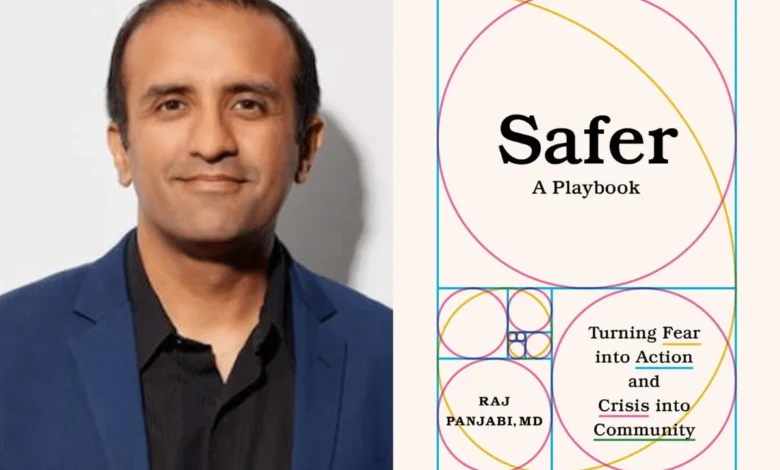
In the annals of public health history, February 2020 has been etched into the collective consciousness as "the lost month"—a period defined by the silent, exponential transmission of a novel coronavirus that traversed borders and communities while the world largely maintained a facade of normalcy. This era of inaction, characterized by a profound failure to recognize the impending catastrophe, serves as the foundational inquiry for Dr. Raj Panjabi, a physician and lecturer at Harvard Medical School. In his latest work, Panjabi interrogates the psychological mechanisms that govern human behavior during global upheavals, offering a framework for navigating the fine line between rational caution and paralyzing fear.
The failure to act in the early weeks of 2020 was not merely a failure of intelligence; it was a testament to the cognitive phenomenon known as normalcy bias. This bias describes the human inclination to believe that the future will mirror the past, leading individuals and governments alike to dismiss warning signs as aberrations rather than harbingers of systemic collapse. Panjabi himself admits to falling prey to this trap. During the height of the "lost month," he navigated international travel to London and subsequently took his family, including a daughter with a precarious heart condition, to Disney World. Reflecting on those days, he acknowledges that had he possessed a full grasp of the pandemic’s trajectory, he would have fundamentally altered his family’s itinerary and safety protocols.
A Chronology of the Lost Month
The chronology of February 2020 remains a stark reminder of the lag between detection and intervention. By the first week of February, the World Health Organization (WHO) had declared a Public Health Emergency of International Concern. Yet, across Western nations, public discourse remained focused on the feasibility of containment rather than the reality of community spread.
By mid-February, the focus of global health agencies shifted toward the potential for a pandemic, yet domestic policy in the United States and elsewhere remained stalled in a state of suspended animation. Hospitals were beginning to experience the initial ripples of strain, but public mandates—masking, social distancing, and large-scale testing—were not yet standard. It was not until the second week of March 2020 that the reality of the crisis compelled a total societal pivot. This delay, experts argue, likely accounted for thousands of preventable infections and deaths, as the virus utilized the vacuum of inaction to establish firm footholds in metropolitan hubs.
The Science of Crisis: From Denial to Action
Panjabi’s "Safer" is structured as a strategic manual, or "playbook," designed to distill the complexities of disaster response into actionable, modular steps. The book argues that crisis management is not merely the domain of government agencies but a skill set essential for everyday life, whether one is navigating a personal medical diagnosis or a sudden economic shock.
A cornerstone of his methodology is the "if/then" trigger system. This approach aims to bypass the emotional paralysis of denial by establishing objective, pre-negotiated milestones for action. For instance, in a municipal setting, an "if/then" trigger might stipulate: "If local hospital bed capacity exceeds 80 percent, then emergency protocols for elective surgery cancellations will be activated."
On an individual level, the application is equally practical. Panjabi cites the management of his daughter’s heart condition as an example: rather than reacting to the onset of heart failure, he and his family established clear medical benchmarks—such as ultrasound results—that dictate specific interventions long before a crisis manifests. By removing the need to debate the severity of a situation during a moment of high stress, the trigger system allows for preemptive, rational decision-making.
The Biosocial Model and the Burden of Inequality
Central to the arguments presented in the book is the concept of "biosocial" risk, an idea popularized by the late Dr. Paul Farmer, co-founder of Partners in Health. Farmer, a mentor to many in the global health community, posited that disease is never an isolated biological event; it is inseparable from the social, economic, and political conditions of the affected population.
This reality was made painfully clear to Panjabi during his service at the MGH Chelsea Community Healthcare Center in Massachusetts. Chelsea, a city with a high concentration of low-income, immigrant households, became a epicenter for COVID-19 infection. The official public health guidance of the time—urging those who tested positive to isolate in separate bedrooms—was structurally impossible for many residents living in crowded, multigenerational housing.
This disconnect between top-down policy and on-the-ground reality underscored a critical failure in public health communication. Panjabi’s analysis suggests that when government guidelines fail to account for socioeconomic realities, they not only become ineffective but exacerbate the marginalization of vulnerable groups. Consequently, he argues that "dialing up protections" must be a social enterprise rather than an individual one. Protection, in this context, involves providing the resources—such as temporary housing or financial support—that make safety a tangible possibility for all, rather than a privilege for the few.
Data and Implications for Future Preparedness
The implications of Panjabi’s work extend to the broader field of emergency preparedness and resilience. Data from the COVID-19 pandemic indicate that regions with high levels of social trust and established communication networks fared significantly better in terms of vaccination uptake and adherence to safety guidelines.
According to a 2021 report from the Centers for Disease Control and Prevention (CDC), the failure to establish robust, community-level outreach programs in the early stages of the pandemic contributed to a widening gap in health outcomes. Panjabi’s "playbook" approach is an attempt to bridge this gap by fostering a culture of preparedness. By formalizing the way we communicate about risk, we can move away from the reflexive desire to retreat into isolation during a crisis.
The research presented in the book suggests that while the instinctive human response to danger is to "lock the door," this isolation is often counterproductive. Instead, the most resilient systems are those that emphasize connection and collective action. This "throughline" of the book suggests that the path to safety is not found in solitary vigilance, but in the creation of community-based frameworks that account for the shared nature of modern risk.
Addressing the Future of Global Health
Panjabi’s background, spanning his childhood in Liberia during civil war to his professional tenure as a frontline responder and advisor to the Biden administration, provides him with a unique vantage point on the intersection of personal and national crisis. He has witnessed firsthand the degradation of social systems and the subsequent loss of life that occurs when institutional failure meets individual unpreparedness.
The "Safer" playbook is, in many ways, an attempt to democratize the knowledge gained from these experiences. It aims to transform the abstract concepts of epidemiology and disaster management into a usable language for the public. Whether it is addressing the needs of an aging parent, managing the volatility of a job loss, or responding to a burgeoning pandemic, the principles of identifying triggers and sharing the burden of protection remain consistent.
In the final analysis, Panjabi argues that we cannot aim for zero risk, as that is a statistical impossibility in a dynamic world. Instead, the objective must be to foster a society that is consistently "safer." This requires a shift in perspective: from viewing crisis as an external, inevitable force to viewing it as a phenomenon that can be managed through intentional, collective action. By transforming our fear into structured, communal responses, the author contends that we can replace the vulnerability of the "lost month" with a more robust and sustainable form of resilience.
As society looks toward the inevitable challenges of the future—whether in the form of climate-induced emergencies, future pandemics, or local disruptions—the tools outlined in this playbook provide a template for how we might, together, navigate the unknown without surrendering to the comforts of normalcy bias. The call to action is clear: in a world where the systems we rely on may falter, our primary source of security must remain our capacity to connect, communicate, and act in concert.