NASA Astronomy Picture of the Day Features the Milky Way Arching Over Brazil Lençóis Maranhenses National Park

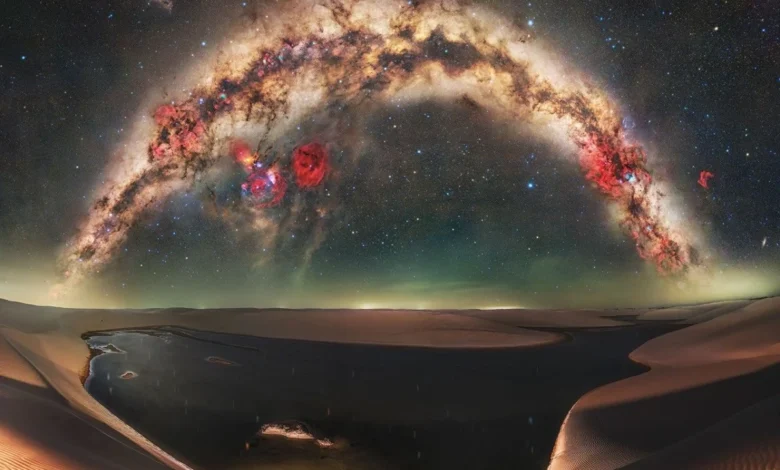
The cosmos met the terrestrial wonders of South America in a breathtaking celestial display featured as NASA’s Astronomy Picture of the Day (APOD) for November 26, 2026. Captured by astrophotographer Ignacio Fernández through his project @igneis.nightscapes, the newly published composite image showcases the glowing arch of the Milky Way galaxy framing a dark, tranquil lagoon nestled amidst the pristine white sand dunes of Lençóis Maranhenses National Park in northeastern Brazil. The striking visual presents a unique alignment where the curvature of the galaxy mirrors the contours of the earthly landscape, creating an optical illusion that resembles a giant cosmic eye gazing back from the heavens.
Main Facts of the Astronomical Showcase
The featured photograph was captured during a dark July night from a latitude of approximately two degrees south. Operating under pristine, low-light conditions far from major urban light pollution, Fernández utilized advanced wide-angle photographic techniques to capture the fine details of our home galaxy. The resulting image reveals prominent astrophysical features of the Milky Way, including intricate dark dust lanes—interstellar clouds of gas and cosmic dust that block visible light—alongside vibrant, glowing stellar nurseries known as nebulas, where new stars actively form.
While the image depicts the Milky Way bending in a dramatic, rainbow-like arch across the night sky, astronomers emphasize that this appearance is an optical byproduct rather than a physical reality. To the naked human eye or through standard imaging equipment without wide-angle distortions, the Milky Way stretches across the celestial sphere as a broad, straight band of light. The curved presentation is an intentional artistic framing made possible by wide-angle lenses, skillfully aligned by the photographer to harmonize with the crescent shape of the lagoon below.
Chronology and Context of the Capture
The journey to capturing this celestial masterpiece involved meticulous planning and favorable environmental conditions. Lençóis Maranhenses National Park, located in the state of Maranhão, Brazil, is globally renowned for its unique geography. Spanning roughly 1,550 square kilometers, the park is characterized by vast expanses of sweeping white sand dunes interspersed with thousands of crystal-clear freshwater lagoons. These lagoons form seasonally between January and June as heavy tropical rains collect in the valleys between the dunes.
By July, when Fernández captured the scene, the rainy season had subsided, leaving behind stable atmospheric conditions, clear skies, and full water levels in the lagoons—ideal parameters for nightscape astrophotography. The apparent rotation of the Earth throughout the night shifts the position of the Milky Way relative to the horizon, requiring precise timing to align the galactic core with terrestrial landmarks. Fernández waited for the optimal hour in the dead of night to align the galactic center directly over the dark waters of the lagoon, engineering an ephemeral perspective that highlights both the scale of our galaxy and the surreal beauty of Earth’s desert-like wetlands.
Supporting Data and Astrophysical Background
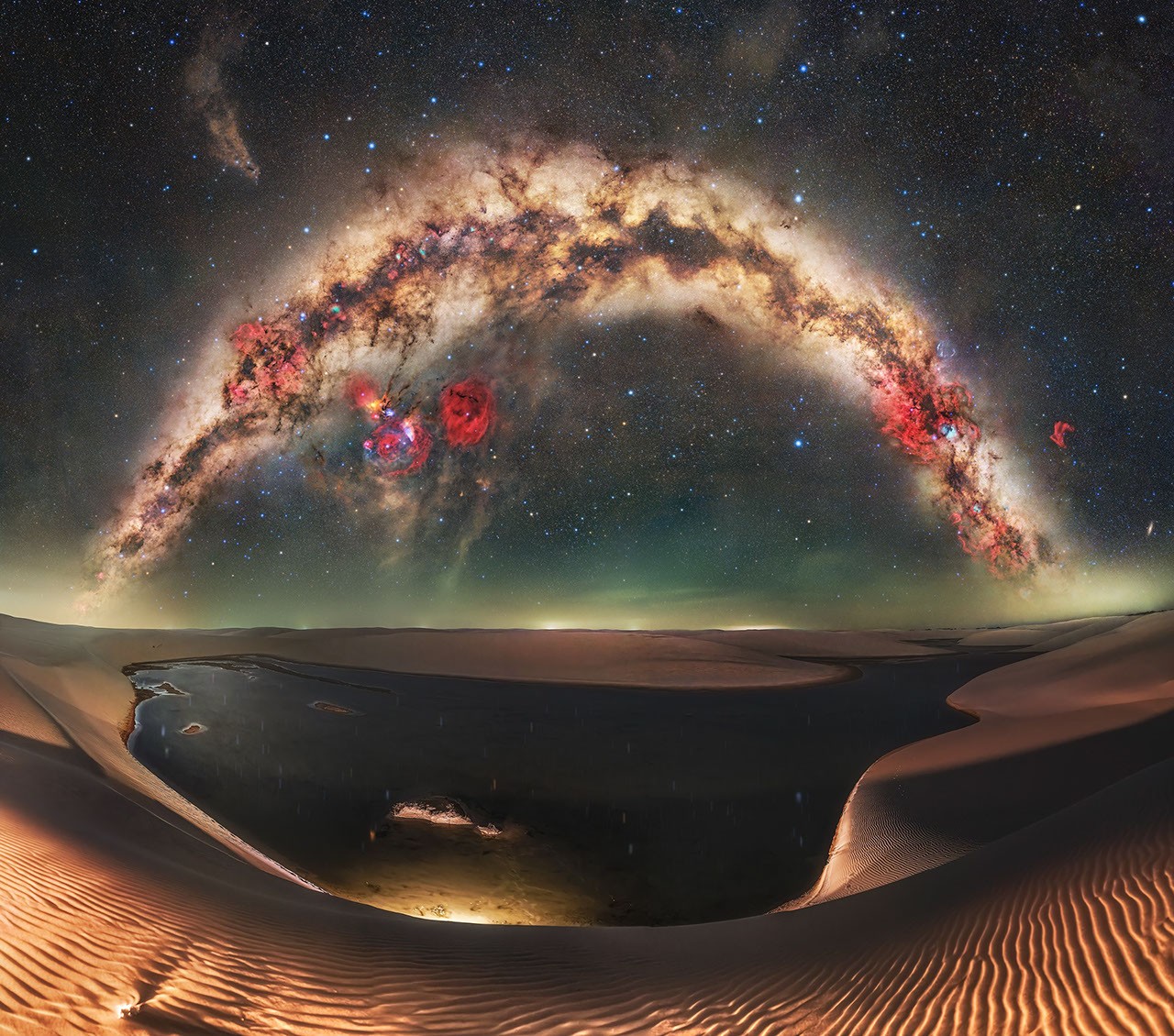
To understand the scale of the captured image, observers must look beyond the immediate terrestrial foreground into the vast structure of the Milky Way. As a barred spiral galaxy, the Milky Way spans an estimated 100,000 to 200,000 light-years in diameter and contains upwards of 100 billion to 400 billion stars. Earth resides within the Orion Arm, situated roughly 26,000 light-years away from the dense galactic center located in the direction of the constellation Sagittarius.
When astrophotographers capture the Milky Way from low-latitude regions like northern Brazil (approximately 2° south), the galactic center rises high into the night sky, offering exceptional visibility of southern hemisphere constellations and deep-space objects. The dark bands visible winding through the bright stellar background in Fernández’s image are dense concentrations of interstellar dust. These regions absorb and scatter optical light from background stars, creating the characteristic shadowy patches that have inspired cultural mythologies and driven modern astrophysical research into star formation dynamics.
Official Responses and Collaboration
The Astronomy Picture of the Day service, which published the image, is a long-standing collaborative educational outreach initiative operated jointly by the Astrophysics Science Division at NASA’s Goddard Space Flight Center, NASA Science Activation, and Michigan Technological University (MTU). Edited by professional astronomers including Cecilia Chirenti, Robert Nemiroff, Jerry Bonnell, and Keighley Rockcliffe, APOD serves as a premier global platform for public engagement in astronomy.
While NASA’s involvement does not constitute a formal research expedition to the park, the inclusion of such imagery aligns with the agency’s mission to foster public curiosity about Earth and space science. Professional editors select submissions that not only highlight scientific wonders—such as nebulae, dust lanes, and galactic mechanics—but also bridge the gap between terrestrial geography and deep space exploration. The accompanying caption for the November 26 feature reflected this interdisciplinary appreciation, noting how art and science intersect when humanity attempts to visually capture its place in the universe.
Broader Impact and Implications for Astrotourism
The publication of the Lençóis Maranhenses Milky Way photograph underscores a growing intersection between environmental conservation, dark-sky preservation, and global astrotourism. Protected natural areas like Lençóis Maranhenses—designated both as a Brazilian national park and a UNESCO World Heritage Site—are increasingly recognized not only for their unique terrestrial ecosystems, but also as invaluable cultural and scientific assets for night sky observation.
Light pollution has become an escalating concern for professional and amateur astronomers alike, as urban expansion encroaches upon traditional dark-sky viewing areas. Images like the one captured by Fernández demonstrate the profound value of preserving unblemished nightscapes. By highlighting remote, ecologically sensitive regions under pristine dark skies, such photography advocates for the protection of nocturnal environments. Furthermore, showcasing these landscapes through prominent platforms like NASA APOD drives international interest in astrotourism, encouraging sustainable travel to regions that prioritize the preservation of both natural earthly wonders and the unobstructed view of the cosmos above.