NASA Marks Major Milestone as Artemis III Core Stage Integration Unfolds at Kennedy Space Center

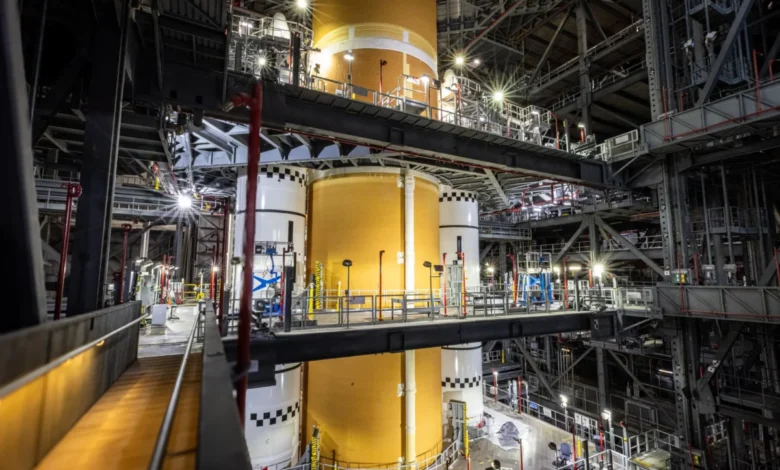
In a decisive step forward for humanity’s return to the lunar surface, technicians and engineers at NASA’s Kennedy Space Center in Florida achieved a critical assembly milestone on October 28, 2026. Inside the cavernous confines of the Vehicle Assembly Building (VAB), teams successfully integrated the Space Launch System (SLS) core stage for the Artemis III mission alongside its twin solid rocket boosters. This towering assembly operation within High Bay 3 marks a tangible acceleration of NASA’s deep-space exploration architecture, transforming decades of theoretical engineering and design into flight-ready hardware destined to carry a multi-national crew of explorers back toward the Moon.
The delicate, precision-driven maneuver required the deployment of specialized heavy-machinery and meticulous coordination among hundreds of aerospace professionals. As the program transitions from component manufacturing to full-stack integration, the agency is systematically checking off the exhaustive prerequisites required to clear the human-rated rocket for flight. With the core stage now physically married to the twin boosters on the mobile launcher platform, the Artemis III vehicle assumes its iconic, imposing silhouette, signaling to the global scientific community that the next chapter of crewed lunar exploration is actively taking shape.
The Complex Choreography of VAB High Bay Integration
The physical integration of the Artemis III SLS core stage is an engineering feat of unprecedented scale. Measuring an astonishing 212 feet in length, the massive structural backbone of the rocket had to be transferred from its staging area in High Bay 2 to High Bay 3. To accomplish this, ground teams utilized a specialized, one-of-a-kind lifting beam—an apparatus engineered specifically to handle the immense weight, distribution, and structural sensitivities of the core stage without imposing undue stress on its delicate propellant tanks and avionics bays.
The operation began in the early morning hours, as overhead cranes gripped the towering cylinder, slowly rotating it from a horizontal orientation to a vertical position before hoisting it high into the air. Technicians then guided the 212-foot structure downward with millimeter-level precision, nesting it snugly between the two solid rocket boosters that had previously been stacked on the mobile launcher. Every movement was monitored by a suite of digital sensors and physical spotters to ensure that structural tolerances were strictly maintained.
This milestone follows months of rigorous individual component testing at various NASA facilities across the United States. The core stage itself, manufactured primarily at NASA’s Michoud Assembly Facility in New Orleans by prime contractor Boeing, arrived at Kennedy Space Center via the agency’s Pegasus barge after undergoing structural checks. Once inside the VAB, engineers performed comprehensive inspections of the stage’s four RS-25 engines, electrical harnesses, and propulsion systems before greenlighting the lifting sequence.
A Rigorous Testing Roadmap Ahead: The Path to Launch Pad 39B
With the core stage now fully integrated with the twin solid rocket boosters, the mobile launcher and its payload are entering a rigorous phase of electrical and mechanical checkouts. Engineers must ensure that the avionics systems of the core stage communicate flawlessly with the boosters, the mobile launcher umbilical interfaces, and the firing room software located inside the Launch Control Center.
Once these integrated tests are completed and signed off by mission managers, NASA will execute a critical operational dry run: the roll out to Launch Pad 39B. Unlike a traditional wet dress rehearsal that loads propellants into every stage of the rocket, the Artemis III profile calls for a specialized tanking test. During this exercise, cryogenic propellants—specifically liquid hydrogen and liquid oxygen—will be loaded exclusively into the SLS core stage.
Launch controllers and engineering teams will use this opportunity to practice and refine countdown procedures, test loading timelines, evaluate ground support equipment for potential cryogenic leaks, and validate automated software sequences under real-world conditions. This targeted testing strategy allows NASA to verify the performance of the core stage’s thermal protection systems and propellant loading protocols without unnecessarily cycling hardware through full-system wet dress rehearsals unless mandated by emerging data. Following the conclusion of the tanking test, the vehicle will be rolled back to the VAB for final integration of the Orion spacecraft and its European-built service module.
Mission Profile and Crew Lineup for Artemis III
The Artemis III mission stands as a distinct departure from its immediate predecessor, Artemis II, which served as a crewed lunar flyby test. While Artemis II proved that the Orion spacecraft’s life support and communications systems could sustain a human crew in deep space, Artemis III is designed to test complex orbital mechanics, rendezvous, and docking capabilities in the harsh environment of lunar space.
The crew selected for this historic flight represents a truly international coalition of space exploration agencies. NASA astronauts Randy Bresnik, Frank Rubio, and Andre Douglas will be joined by European Space Agency (ESA) astronaut Luca Parmitano. This diverse lineup underscores the collaborative spirit of the Artemis Accords, emphasizing multilateral participation in the sustainable exploration of the Moon.
Upon reaching lunar orbit atop the SLS rocket and enclosed within the Orion spacecraft, the crew will not immediately descend to the lunar surface. Instead, the Artemis III profile focuses on a vital proving ground objective: testing and validating rendezvous, proximity operations, and docking procedures between Orion and commercial human landing systems (HLS) developed by private sector partners Blue Origin and SpaceX.
By conducting these intricate orbital maneuvers, NASA aims to de-risk the hardware and operational interfaces required for subsequent missions that will actually land astronauts on the lunar regolith. The mission serves as an essential bridge, validating that commercial architecture and NASA’s deep-space transportation systems can seamlessly integrate in the lunar environment.
Chronology of the Artemis Program: From Conception to Assembly
To fully appreciate the significance of the October 28 integration milestone, it is essential to examine the broader historical chronology of the Artemis program and the development of the Space Launch System.
The origins of the heavy-lift architecture trace back to the authorization of the Space Launch System under the NASA Authorization Act of 2010, which mandated a vehicle capable of launching deep-space payloads beyond low-Earth orbit. Over the ensuing decade, the program weathered shifting political priorities, budget reallocations, and technical hurdles, culminating in the successful uncrewed Artemis I flight in late 2022.
Artemis I served as a comprehensive flight test of the integrated SLS rocket and Orion spacecraft, pushing the capsule thousands of miles beyond the Moon and returning it safely to Earth after a 25.5-day journey. Following the validation of the heat shield, propulsion, and recovery systems during Artemis I, NASA shifted its focus toward human-rated missions.
The subsequent progression has involved meticulous manufacturing, testing, and delivery cycles:
- Late 2023 to 2024: Assembly and testing of the Artemis II core stage and finalization of astronaut training regimens.
- September 2024: NASA formally announced the crew assignments for Artemis II, setting the stage for future lunar orbital testing.
- Mid-2025: Delivery of the Artemis III core stage to Kennedy Space Center via the Pegasus barge, followed by initial horizontal checkouts in High Bay 2.
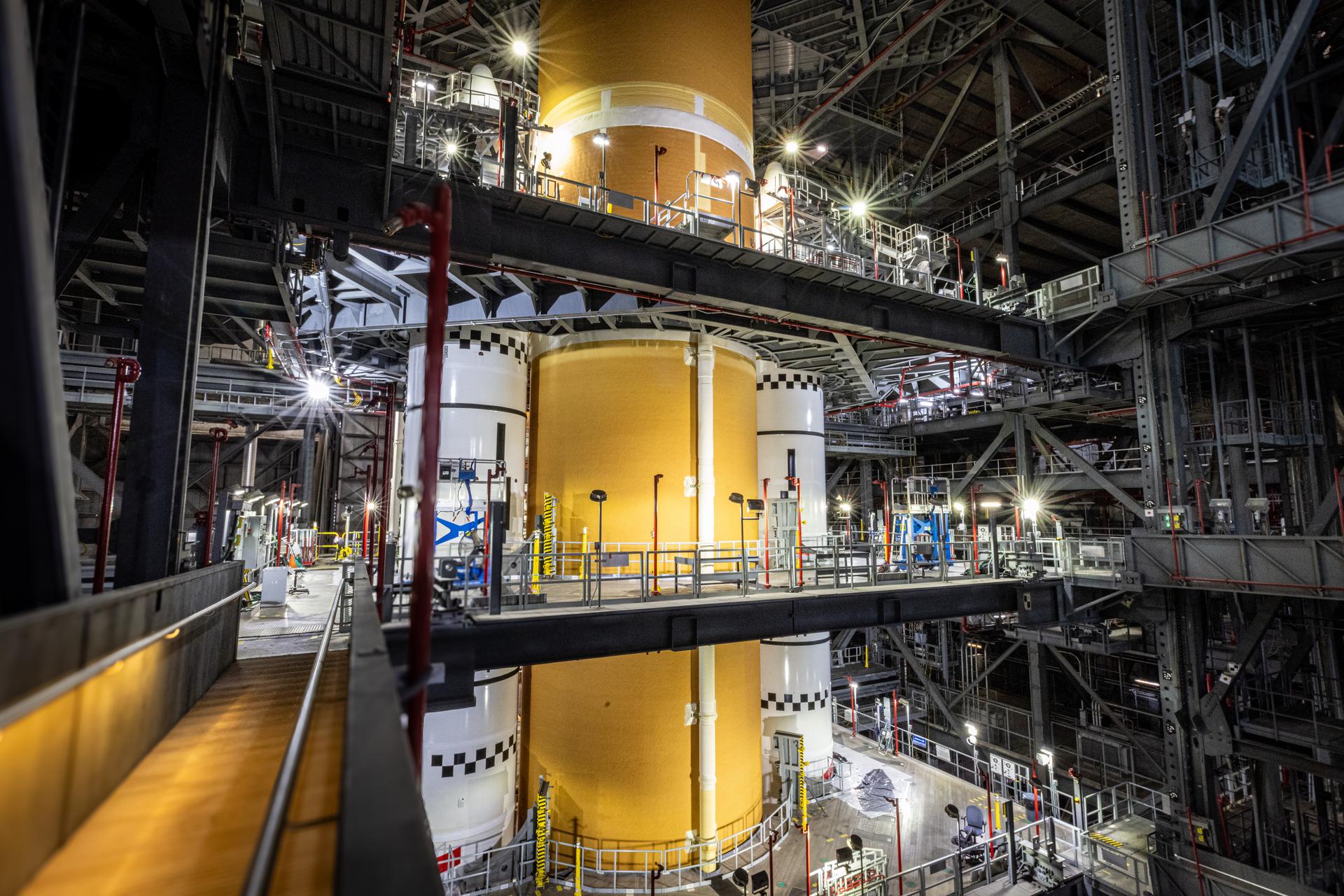
- October 28, 2026: Successful vertical lifting and structural integration of the Artemis III core stage alongside the twin solid rocket boosters inside VAB High Bay 3.
This measured, methodical timeline reflects NASA’s commitment to safety and engineering rigor, particularly as the agency prepares to send humans deeper into space than they have traveled since the conclusion of the Apollo program in 1972.
Official Perspectives and Inter-Agency Collaboration
While NASA serves as the primary architect and operator of the Space Launch System, the success of the Artemis campaign relies on a vast, interconnected web of aerospace contractors, international space agencies, and commercial partners.
Speaking on the broader implications of the program, senior NASA leadership has consistently emphasized that Artemis is not merely a repeat of Apollo, but a sustained, cooperative endeavor designed to build a permanent economic and scientific presence in the solar system. The inclusion of ESA astronaut Luca Parmitano on the Artemis III flight highlights the deepening ties between NASA and European space authorities, ensuring that scientific objectives and technological developments are shared across allied nations.
Furthermore, the involvement of commercial heavyweights like SpaceX and Blue Origin represents a fundamental shift in how NASA conducts deep-space exploration. By outsourcing the development of human landing systems to private industry while retaining authority over the foundational launch architecture (SLS and Orion), NASA is fostering a competitive commercial space economy.
Industry analysts and contractor representatives have noted that the integration of the Artemis III core stage validates the scalability of the VAB infrastructure. Upgrades made to High Bay 3—originally constructed for the Apollo-Saturn V program and later modified for the Space Shuttle—have proven adaptable enough to accommodate the unique physical dimensions and propulsion requirements of the SLS, ensuring that Kennedy Space Center remains the premier gateway for human deep-space flight.
Strategic Implications and the Broader Future of Deep-Space Exploration
The completion of the Artemis III core stage integration carries profound strategic and geopolitical implications for the global space race of the 21st century. As multiple spacefaring nations set their sights on the Moon—particularly the permanently shadowed regions of the lunar south pole where water ice reserves are concentrated—establishing a reliable, heavy-lift transportation pipeline is paramount.
The Space Launch System remains the only human-rated vehicle currently capable of launching the Orion spacecraft, its crew, and heavy trans-lunar injection payloads in a single launch configuration. By successfully stacking the Artemis III hardware, NASA demonstrates ongoing momentum in its lunar roadmap, providing strategic reassurance to international partners and lawmakers who fund the multi-billion-dollar initiative.
Beyond immediate lunar exploration objectives, the technological and operational lessons learned during the integration and testing of the Artemis III core stage will directly inform future architectures designed for crewed missions to Mars. The cryogenic management systems, avionics redundancies, and heavy-lift logistics practiced at Kennedy Space Center serve as a foundational template for the next generation of interplanetary exploration.
As teams at the Kennedy Space Center prepare the integrated vehicle for its upcoming tanking test at Launch Pad 39B, the aerospace community watches with anticipation. Each bolted flange, connected umbilical, and verified sensor brings humanity one step closer to the launchpad, reaffirming a collective commitment to expanding the boundaries of human presence in the cosmos.