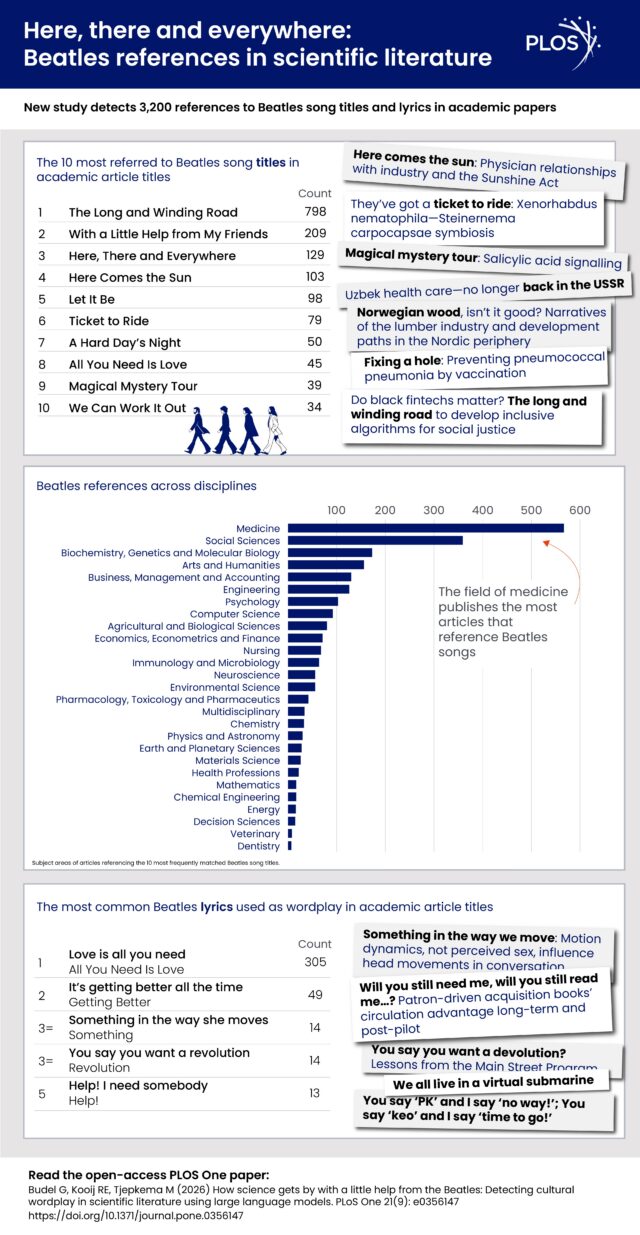
Here, there, and everywhere: New study detects 3,200 references to Beatles song titles and lyrics in academic papers.

The intersection of rigorous scientific inquiry and pop culture has long been a subject of curiosity, but a comprehensive new study published in the journal PLoS ONE has quantified the extent to which the legacy of the Fab Four has permeated the global corpus of academic literature. Researchers at the Delft University of Technology in the Netherlands have identified over 3,200 instances where Beatles song titles and lyrics were woven into the titles of scientific publications. This research highlights a burgeoning trend in academic communication: the use of familiar cultural touchstones to make highly specialized, technical research more accessible and memorable.
The Methodology of a Musical Audit
To arrive at these findings, co-authors Gabriel Budel and Robert E. Kooij, alongside their colleagues, employed a large language model (LLM) to scan two of the world’s most extensive academic databases: Scopus and Google Scholar. Unlike previous, smaller-scale investigations that relied on manual searching or limited keyword matching, this study utilized advanced natural language processing to detect not only exact matches of song titles but also lyrical fragments and clever, context-aware wordplay.
The scope of the project was deliberately broad, encompassing all scientific disciplines rather than focusing solely on the biomedical fields that had dominated earlier, more anecdotal research. By doing so, the authors were able to map a cross-disciplinary phenomenon that transcends the traditional silos of academia. The researchers categorized these findings, distinguishing between direct title citations and those that utilized linguistic puns—such as the transformation of "The Long and Winding Road" into "The Lung and Winding Road" for a study concerning post-viral respiratory complications.
A Chronology of Academic Allusion
The practice of referencing popular culture in scholarly work is not entirely new, though its frequency has accelerated significantly over the last three decades. The modern history of this trend can be traced back to the mid-1990s. In 1997, a review in the journal Nature titled "Nitric Oxide and inflammation: The answer is blowing in the wind" marked a significant moment in the normalization of such titles.
This trend gained notoriety in 2014 when researchers at the Karolinska Institute in Sweden publicly admitted to a long-running, informal competition to insert Bob Dylan lyrics into their papers. That revelation sparked a series of academic investigations, starting with a 2015 study in the BMJ that sought to quantify the prevalence of Dylan’s discography in biomedical literature. These initial studies established a template for academic "Easter egg" hunting, leading to a 2017 study that compared Dylan’s footprint against that of The Beatles. Even then, the evidence suggested that The Beatles held a more prominent position in the collective consciousness of researchers.
The trend saw a marked surge between 1995 and 2005. Analysts attribute this timing to the release of The Beatles’ Anthology project, which reintroduced the band’s catalog to a new generation of academics who were then beginning their professional careers. The subsequent rise of digital streaming platforms, such as Spotify in 2015, further solidified the band’s presence, ensuring that their lyrics remained ubiquitous in the background of modern life—and, by extension, the background of modern research.
Quantifying the "Beatles Effect" in Research
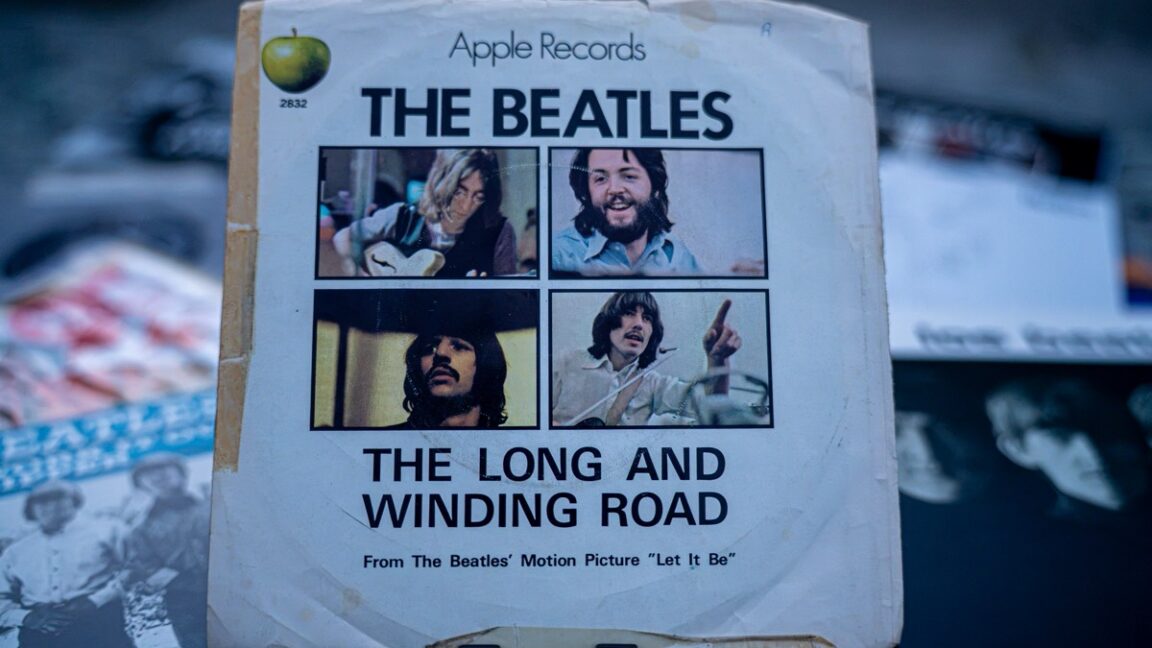
The study found that "The Long and Winding Road" stands as the most frequently referenced title, appearing 798 times. This total significantly outpaces other popular cultural references in science, such as The Clash’s "Should I Stay or Should I Go," which has seen 561 references.
The researchers noted that the distribution of these citations follows a power law, commonly known as Zipf’s law. In this context, it means that while a small subset of the band’s most famous songs are cited with high frequency, the vast majority of their discography appears only once or twice. This statistical distribution mirrors many natural phenomena, from the frequency of words in a language to the distribution of wealth in a population.
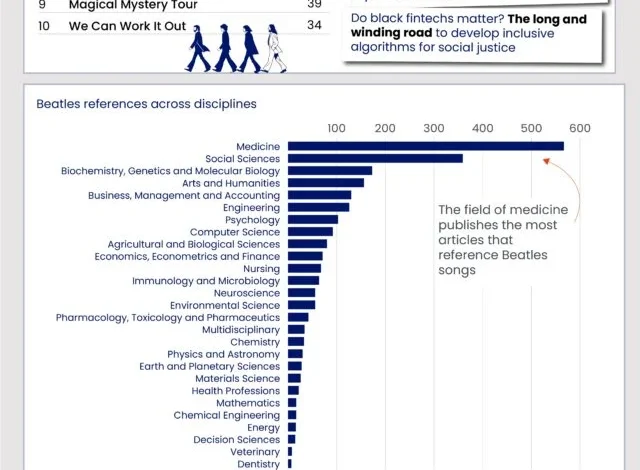
Furthermore, the study indicates that these references are not distributed randomly across the sciences. Medicine and the social sciences are the most frequent users of Beatles-themed titling. In the specialized field of drug discovery, the "better than The Beatles" problem—referring to the difficulty of creating a new treatment that outperforms the current gold standard—has become a common industry shorthand.
The Strategic Value of the "Catchy" Title
Beyond the simple joy of paying homage to a favorite artist, there is a growing body of evidence to suggest that "catchy" titles serve a strategic function in the digital age. As academic publishing has moved entirely online, the sheer volume of new papers released daily has created a "noise" problem for researchers trying to reach their peers.
A 2023 study published in Research Square suggested that using song references or pop culture allusions can significantly increase the visibility of a paper. By avoiding overly technical jargon in the initial title, authors can grab the attention of a broader audience, potentially leading to higher citation counts and greater impact. This aligns with the authors’ conclusion that modern academic writing is becoming increasingly informal and attentive to the reader experience.
However, the authors warn that this strategy is not without its risks. As the pool of available titles becomes saturated, the novelty effect begins to wane. While "The Long and Winding Road" may have been an innovative choice decades ago, its frequent reuse in medical literature has arguably diminished its impact. The researchers argue that the most successful allusions are those that demonstrate high-level wordplay, such as "Happiness is a warm theorem" or titles that cleverly integrate specific patent law jargon with lyrics from the White Album.
Official and Academic Responses
The response from the scientific community has been largely positive, viewing the study as a legitimate exploration of the sociology of science. Experts point out that the willingness of scientists to engage in this form of play reflects a necessary humanization of the field.
"The scientific process often progresses through trial and error toward results that are meaningful, albeit temporary," noted co-author Gabriel Budel. "Paul McCartney once described his song as being about the unattainable—the door you never quite reach. This serves as a particularly apt metaphor for the nature of scientific inquiry itself."

NASA, which has utilized references like "Pingo STARR" (SubTerranean Aquifer Reconnaissance and Reconstruction) for its own geological research projects, represents a broader institutional acceptance of this trend. It is no longer viewed merely as an act of rebellion by bored academics, but as a recognized rhetorical tool in the arsenal of science communication.
Broader Implications and Future Trends
The findings of this study have broader implications for how we view the intersection of culture and academia. The transition toward more creative titling is indicative of a shift in the academic publishing model. As the pressure to "publish or perish" intensifies, authors are increasingly looking for ways to distinguish their work in a crowded digital landscape.
However, the study also prompts questions about the limits of this trend. While a clever title may increase the number of clicks, it does not necessarily correlate with the quality or long-term scientific value of the research itself. The most cited paper in history—the 2017 work that introduced the architecture behind ChatGPT—is titled "Attention is all you need." While this is a common phrase, its resonance in a field obsessed with neural network "attention" mechanisms helped it become a foundational text with nearly 90,000 citations.
In conclusion, the prevalence of The Beatles in academic literature is a testament to both the enduring popularity of the band and the evolving nature of scientific discourse. Whether through the direct appropriation of a title or the subtle, clever pun that rewards the observant reader, these references act as a bridge between the sterile, technical world of research and the shared cultural experience of the public. As the academic landscape continues to evolve in a digital-first environment, it is likely that such creative naming conventions will continue to rise, keeping the music of The Beatles alive in the most unexpected of places: the footnotes and journals of modern science.