For over a millennium, the Lycurgus Cup has stood as one of the most enigmatic artifacts of the Roman Empire. Housed in the British Museum, this fourth-century cage cup possesses a remarkable, almost supernatural, optical property: it appears jade-green when illuminated from the front but shifts to a vibrant, glowing blood-red when lit from behind. This dichroic effect, which puzzled historians and chemists for generations, has finally been replicated by researchers at the University of Sheffield, marking a significant milestone in both historical preservation and modern materials science.
The Science of Ancient Nanotechnology
The secret behind the Lycurgus Cup lies not in the skill of glassblowing alone, but in the sophisticated use of nanotechnology by Roman artisans. Analysis has revealed that the glass is embedded with minuscule amounts of silver and gold nanoparticles, ground down to approximately 50 nanometers in diameter—less than one-thousandth the size of a grain of table salt. These particles are dispersed throughout the glass matrix in precise ratios. When light hits these particles, the electrons oscillate, scattering specific wavelengths of light based on the size and shape of the metal clusters.
While researchers have understood the composition of the glass since the late 20th century, creating a consistent, replicable recipe for this "dichroic glass" remained elusive. In 2020, Dutch scientists successfully reproduced the effect using 3D-printable nanocomposites, but their method relied on modern synthetic polymers rather than the traditional furnace-based glassmaking techniques of antiquity. The challenge for the University of Sheffield team was to bridge the gap between ancient Roman metallurgical mastery and modern laboratory precision.
A Chronology of Discovery and Replication
The path to solving this mystery began with an interdisciplinary collaboration between Lisa Hollands, a glass technician with over 25 years of experience, and Professor Caroline Jackson, a leading authority on Roman glass production.
The team’s experimental phase was arduous. They had to navigate variables that ancient Roman glassmakers would have controlled through intuition and generations of inherited practice. The researchers experimented with varied furnace temperatures, fluctuating oxygen levels, and different raw material compositions. At one stage, the team even introduced sugar into the chemical mix, testing whether organic compounds could act as reducing agents to help stabilize the metallic nanoparticles within the molten glass.
By late 2023, the team’s persistence culminated in a breakthrough. Hollands successfully formulated a mixture that yielded the desired dichroic shift. The glass produced was visually indistinguishable from the color-changing phenomena observed in the original artifact. This success was not merely a laboratory curiosity; it served as the foundation for a broader project known as "Molecular Photonic Breadboards," a UK-led initiative aimed at developing sustainable, light-responsive materials for the next generation of technological devices.
Bridging History and Contemporary Art
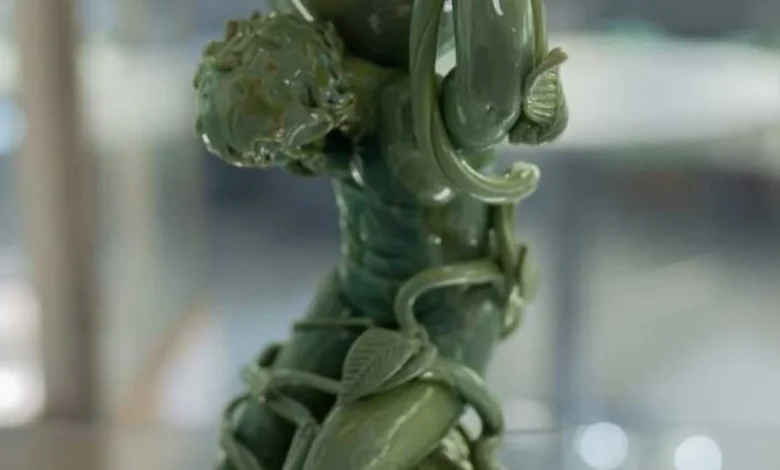
Following the successful replication of the material, project leads sought to honor the achievement by bridging the gap between historical discovery and contemporary artistic expression. They commissioned Elliott Walker, a renowned glass artist and the winner of the second season of the Netflix series Blown Away, to create a sculpture utilizing this newly synthesized dichroic glass.
Walker’s task was to pay homage to the original story depicted on the Lycurgus Cup—the mythical death of King Lycurgus of Thrace—while integrating the technical, modern nature of the new glass. The resulting sculpture is a fusion of classical themes and modern aesthetic sensibilities. Walker incorporated the "Farnese Atlas" motif, replacing the celestial globe of the original sculpture with a cup crafted from the dichroic material.
"It is a very rare thing to have the opportunity to work with glass developed from ancient mixtures and recipes," Walker noted during the unveiling of the project. "It feels like shaking the hands of the glassmakers of the past. You gain a visceral understanding of how they must have adapted their methods, their frustration, and their eventual mastery."
Implications for Modern Material Science
The successful replication of the Lycurgus Cup’s optical properties has implications that extend far beyond museum curation. The ability to control light at the nanoscale using embedded metallic particles is a cornerstone of plasmonics—a field of science that studies the interaction between electromagnetic fields and free electrons in a metal.
By understanding how the Romans achieved this level of control without the aid of electron microscopes or computer modeling, researchers can gain insights into "passive" nanotechnology. The goal of the Molecular Photonic Breadboards project is to harness these ancient principles to create "smart" windows, energy-efficient sensors, and advanced displays that react to ambient light without the need for external power sources.
Public Exhibition and Legacy
The scientific and artistic journey of this project will be presented to the public at the University of Sheffield’s "Festival of the Mind" next month. The centerpiece of the exhibit, Walker’s sculpture, will be unveiled at the Millennium Gallery. Following the conclusion of the festival, the piece will be permanently installed at the University of Sheffield’s Turner Museum of Glass, providing a permanent home for a work that links the ingenuity of the fourth century with the scientific potential of the twenty-first.
From a historical perspective, the success of the Sheffield team provides a sobering reminder of the technological capabilities of the ancient world. Experts have long debated whether Roman glassmakers understood the science behind their creations or if they were the beneficiaries of a "happy accident" that was standardized over time. Hollands’ own reflection on the process highlights this irony: "I’ve used my knowledge and experience, coupled with modern scientific understanding, to achieve this. If the Romans could see me experimenting, they’d likely laugh and ask why I don’t already know how to make this."
Analysis of the "Roman Secret"
Data gathered during the replication process suggests that the Roman glassmakers likely possessed a sophisticated, albeit empirical, understanding of redox chemistry. To prevent the gold and silver from clumping into large, opaque flakes, the glass must be cooled and reheated in very specific cycles. This process, known as "striking," requires a level of control over the kiln atmosphere that implies the existence of a highly specialized glassmaking industry in the late Roman period.
The fact that so few artifacts like the Lycurgus Cup exist suggests that such items were intended for a very elite audience, likely used during state banquets to impress guests with the "magic" of the changing colors. The replication of this process confirms that the ancients were not merely lucky; they were master material scientists who were able to manipulate the very building blocks of matter to create beauty that would endure for nearly two millennia.
As the scientific community continues to analyze the implications of this breakthrough, the Lycurgus Cup remains a testament to the fact that innovation is a continuum. Whether through the fire-stoked kilns of antiquity or the precision-controlled labs of today, the human drive to master light and matter remains a constant force in the evolution of technology. The Sheffield project does more than just replicate a piece of art; it reclaims a lost chapter of human achievement and sets the stage for future applications in sustainable photonics.