
DeFi Under the Microscope: Examining DEX Architectural Vulnerabilities Amid Recent Security Breaches and Oracle Exploits


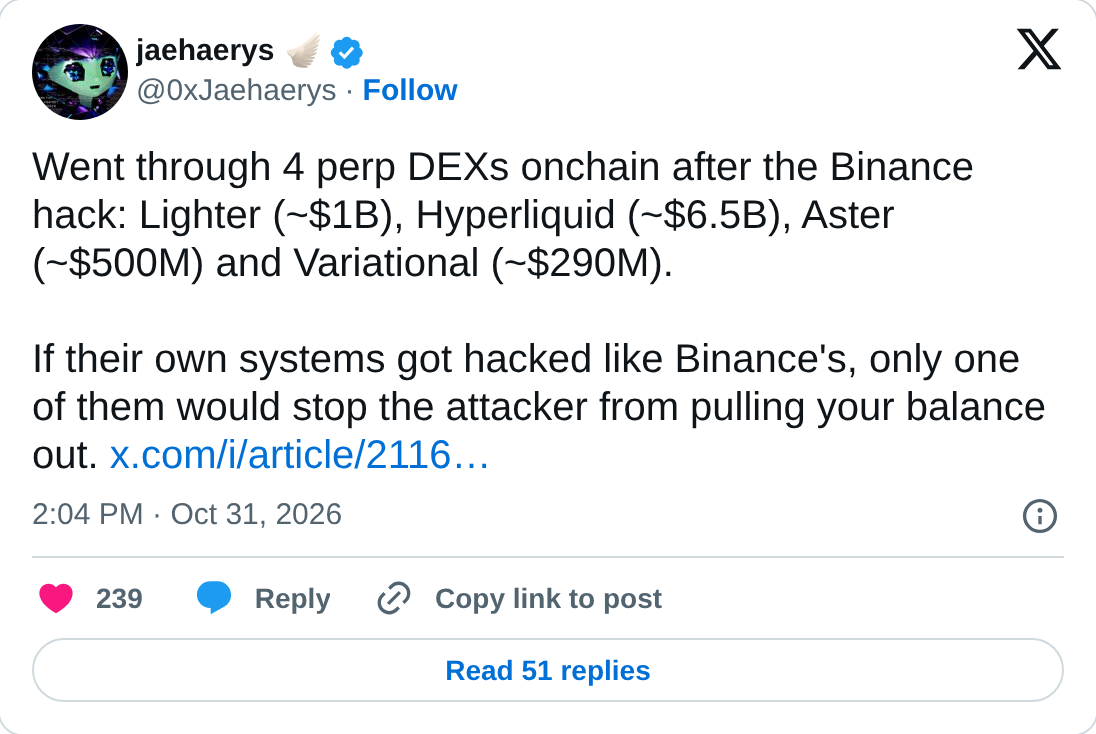
Following a series of high-profile security incidents that have shaken the decentralized finance (DeFi) landscape—most notably a massive exploit involving compromised exchange hot wallets—crypto researchers have intensified their scrutiny of decentralized exchanges (DEXs). Industry analysts are taking a closer look at the operational mechanics, collateral setups, and asset custody models of prominent derivatives platforms. Among those examining these vulnerabilities is crypto researcher jaehaerys, who recently published an extensive breakdown on X (formerly Twitter) evaluating four leading perpetual DEXs: Lighter, Hyperliquid, Aster, and Variational. The analysis highlights critical structural differences in how these platforms handle user funds, oracle reliance, and backend resilience when faced with sophisticated infrastructure attacks.
Decentralized Derivatives Under the Microscope: A Comparative Architectural Overview
The recent wave of security breaches across various digital asset sectors has served as a harsh reminder that infrastructure vulnerabilities can manifest in unexpected ways. In response, security researchers have begun dissecting the foundational frameworks of top-tier decentralized trading venues to determine their level of resilience. Jaehaerys’s recent evaluation focuses on four key derivatives protocols, estimating their Total Value Locked (TVL) and risk exposure profiles: Lighter with approximately $10 million in TVL, Hyperliquid holding roughly $65 million, Aster with $5 million, and Variational at $2.9 million.

While these platforms are commonly grouped under the broader umbrella of decentralized finance, their underlying technical designs vary significantly. The core of the security debate lies in a fundamental compromise that many decentralized applications face: balancing the user experience and speed of centralized systems with the self-custodial and trustless guarantees of blockchain technology. As market participants increasingly migrate toward derivatives DEXs for higher leverage and yield, understanding the structural differences between these platforms has become paramount for risk management.
Lighter: Pursuing Near-Decentralized Contract Design
Among the platforms analyzed, Lighter stands out for its commitment to decentralized execution models. The platform leverages Zero-Knowledge (ZK) validity proofs to ensure that state transitions are mathematically verified before being settled on-chain. According to jaehaerys’s assessment, this cryptographic approach significantly limits the attack surface for bad actors, as trading logic and state updates must adhere to strict mathematical rules.
However, achieving this level of decentralization comes with operational trade-offs. The protocol experienced a notable testing phase involving a 14-day delay before withdrawals were processed, illustrating the deliberate friction introduced to prioritize security over instant finality. Rather than relying on traditional hot wallet setups or single points of failure, Lighter’s architecture incorporates multi-signature validation schemes and time-locks designed to prevent unauthorized drains. While this structure offers robust defense-in-depth characteristics, it also requires users to adapt to different liquidity and execution timeframes compared to centralized alternatives.

Hyperliquid: Heavy Reliance on Traditional Custody Infrastructure
Hyperliquid commands the largest TVL among the group, sitting at approximately $65 million. However, a significant portion of its operational structure relies on traditional institutional rails. Data indicates that roughly 86% of the platform’s underlying USDC collateral is held directly within Coinbase institutional custody accounts.
Jaehaerys’s analysis points out that this setup creates a hybrid security model. While the trading protocol itself utilizes custom-built Layer 1 architecture designed for high throughput and low latency, its solvency heavily depends on the security practices of a centralized third-party custodian. The verification process relies on the Hyper Foundation and associated validators holding multisig control, creating a centralized point of failure regarding collateral management. While this model allows Hyperliquid to offer a seamless user experience that rivals centralized exchanges, it introduces counterparty risks that diverge from pure decentralization ethos.
Aster and Variational: Evaluating Custodial Models in Hybrid Trading Environments
Both Aster and Variational represent alternative approaches to derivatives trading, each operating with distinct trust assumptions regarding user funds and trade execution. Aster’s architecture relies on cross-margin systems integrated with external liquidity pools, prompting researchers to scrutinize its margin requirement calculations and oracle dependencies. While the protocol implements mechanisms to update positions and margin levels dynamically, its reliance on external data feeds introduces potential vulnerabilities during periods of extreme market volatility.
Variational takes a different approach by utilizing peer-to-peer and peer-to-pool mechanisms designed to optimize capital efficiency. However, jaehaerys notes that its collateral management model still involves degrees of custodial delegation. When traders interact with Variational’s margin accounts, a substantial portion of the underlying assets remains tied to centralized or semi-centralized settlement layers. This hybrid design allows the platform to maintain high capital efficiency, but it also means that users must trust the underlying bridge and settlement smart contracts to safeguard their deposited funds against sophisticated exploit vectors.
The Broader Implications: Why the "DEX" Label Does Not Guarantee Security
The comprehensive evaluation provided by industry researchers underscores a critical takeaway for the broader cryptocurrency ecosystem: the label "DEX" does not automatically equate to foolproof security. While decentralized exchanges have made immense strides in offering transparent, non-custodial trading environments, the underlying infrastructure often relies on a complex web of centralized or hybrid components.
When market participants evaluate decentralized derivatives platforms, they must look beyond marketing claims and examine the technical specifics of asset custody, oracle integration, and validator distribution. If an exploit targets the backend infrastructure of a protocol, the location of the collateral—whether it resides in a smart contract, a multi-signature wallet, or a traditional institutional custodian—dictates whether user funds can be recovered. As the DeFi sector continues to mature, establishing standardized security frameworks and rigorous architectural audits will remain essential to protecting user capital and maintaining market confidence.