Earth Overshoot Day 2025: Humanity Reaches Ecological Bankruptcy Earlier Than Ever Before

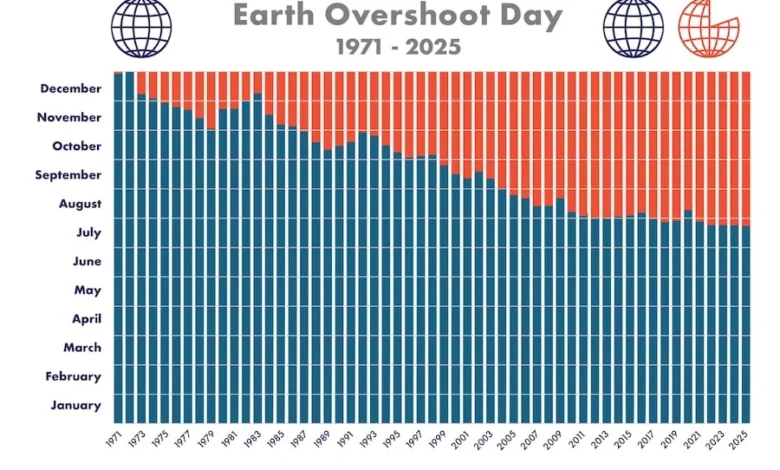
On July 24, 2025, humanity reached Earth Overshoot Day, the sobering annual milestone marking the moment when global demand for natural resources exceeds what the Earth’s ecosystems can regenerate within the entire year. This year’s date represents the earliest arrival since the Global Footprint Network began calculating the metric in 2006, signaling an accelerating trajectory of ecological deficit that threatens the long-term stability of the planet’s biological systems. By the end of July, the global population had effectively utilized a full year’s worth of nature’s budget, leaving the remainder of the calendar year to be sustained by the depletion of essential stocks and the accumulation of waste, most notably atmospheric carbon dioxide.
The Mechanics of Ecological Deficit
Earth Overshoot Day is calculated by comparing the planet’s biocapacity—the amount of ecological resources the Earth is able to generate that year—with humanity’s ecological footprint, which measures the total demand for land, water, and atmosphere to produce food, timber, and fiber, and to absorb carbon emissions. The Global Footprint Network, which spearheads the annual analysis, estimates that humanity is currently operating at a deficit of 1.8 Earths. This means that at current consumption rates, it would take nearly two planets to sustain the global population without further degrading the environment.
The implications of this deficit are not merely abstract; they manifest as tangible ecological degradation. Key drivers include the overfishing of marine stocks, the rapid depletion of freshwater aquifers, the conversion of forests into industrial land, and a carbon footprint that far exceeds the capacity of the world’s forests and oceans to sequester. When these resources are consumed faster than they can replenish, the result is a cumulative erosion of natural capital. This creates a feedback loop where the ecosystems themselves become less productive over time, further narrowing the margin for human survival.
A Chronology of Consumption: From Stability to Overshoot
To understand the severity of the 2025 milestone, one must examine the historical shift in human resource consumption. Global Footprint Network recently updated its historical data to ensure higher accuracy, revealing a stark transition over the past half-century.
In 1972, humanity lived within the means of the planet, with the "overshoot" date falling on December 31. By 1979, the date had crept forward to November 3. Throughout the 1980s, the date fluctuated, reaching October 12 by 1989. The 1990s marked a period of accelerated consumption, with the date moving from October into late September. By the time the Global Footprint Network formally launched the Earth Overshoot Day concept in 2006, the date had shifted to August 22.
The trend has remained relentlessly forward-moving, with only rare, brief deviations caused by global economic crises. For instance, the 2020 pandemic caused a momentary dip in consumption, shifting the date back toward August. However, the recovery was rapid, and the date has remained in July for the last several years. The previous record of July 25, held by 2022 and 2023, has now been surpassed by the July 24 date in 2025, confirming that structural consumption patterns have not shifted despite heightened international awareness.

The Planetary Boundaries Perspective
The urgency of the current overshoot is underscored by its relationship to the "planetary boundaries" framework—a scientific concept identifying nine environmental thresholds that, if crossed, could trigger irreversible damage to the Earth’s life-support systems. Humanity has already breached seven of these nine boundaries, including climate change, biosphere integrity, and land-system change.
The exhaustion of resources by July 24 acts as a force multiplier for these boundaries. As the world approaches the limits of its ecological capacity, the resilience of the biosphere to recover from shocks like extreme weather, drought, and disease is severely compromised. Lewis Akenji, a board member of the Global Footprint Network, emphasized the gravity of the situation in a recent statement: "We are stretching the limits of how much ecological damage we can get away with. It is now a quarter into the 21st century and we owe the planet at least 22 years of ecological regeneration, even if we stop any further damage now."
Strategic Pathways for Correction
Despite the somber data, the Global Footprint Network maintains that the trend is not an inevitability but a result of policy and behavioral choices. The organization’s "Power of Possibility" campaign identifies specific, high-impact levers that could reverse the date of overshoot, effectively buying humanity time to transition to a circular and regenerative economy.
The most significant potential impact lies in the decarbonization of the global energy sector. Reducing carbon emissions by 50%—a target consistent with many international climate agreements—could shift the overshoot date by three months. This alone would move the date back into October, providing a massive buffer for the planet’s ecosystems.
Other actionable measures include:
- Food Systems Reform: Reducing global food waste by 50% would push the date back by 13 days. Given that approximately one-third of all food produced for human consumption is lost or wasted, this represents a highly efficient area for policy intervention.
- Renewable Energy Expansion: Generating at least 75% of global electricity from renewable sources would push the date back by 26 days. This transition is already underway in many nations but requires a massive acceleration in infrastructure investment.
- Systemic Policy Frameworks: Implementing a comprehensive "Green New Deal" at a global scale, incorporating circular economic principles and sustainable urban planning, could shift the date by as much as 42 days.
The Binary Choice: Design or Disaster
The rhetoric from environmental scientists and economists has become increasingly stark. Mathis Wackernagel, co-founder of the Global Footprint Network, recently framed the transition in binary terms: "Because of the nature of physics, overshoot cannot last. It will end either by deliberate design or dumped-on disaster."
The concept of "deliberate design" involves a coordinated global shift toward resource efficiency, population stabilization, and the protection of biodiversity. This would necessitate moving beyond GDP as the primary metric of national success and adopting indicators that account for natural capital and ecosystem health. Conversely, "dumped-on disaster" refers to the chaotic, involuntary contraction of consumption caused by systemic collapse—such as the failure of agricultural systems, mass migration due to climate change, or the total depletion of critical resources.

Implications for Global Policy and Economics
The 2025 Earth Overshoot Day serves as a critical indicator for policymakers. While economic growth is often pursued as a primary goal for nations, the ecological data suggests that growth at the expense of biocapacity is fundamentally self-defeating. The current model of "take-make-waste" is increasingly incompatible with a finite planet.
International cooperation will be essential to bridge the gap. Developing nations often argue for their right to industrialize, while developed nations are tasked with the historical responsibility of decarbonizing. The "Power of Possibility" framework suggests that the solution is not a singular action, but a mosaic of localized and global efforts. Urban planning that emphasizes density and public transport, agriculture that prioritizes soil health and efficiency, and energy sectors that move entirely away from fossil fuels are the pillars of a potential recovery.
Furthermore, the private sector is beginning to recognize the risks associated with ecological overshoot. Supply chain disruptions, resource scarcity, and the increasing costs of climate-related disasters are forcing businesses to evaluate their own ecological footprints. However, voluntary corporate action is widely viewed by experts as insufficient without robust regulatory frameworks that hold industries accountable for their resource usage.
Conclusion: A Call for Ambition
As the global community reflects on the July 24 date, the message from the Global Footprint Network is clear: the current level of overshoot calls for a scale of ambition that dwarfs previous historical investments in environmental protection. The data is not a prediction of inevitable doom, but a measurement of current choices.
The task for the remainder of 2025 and beyond is to align global economic activity with the biological reality of the planet. Moving the date back toward December 31 will require more than just technological innovation; it requires a fundamental shift in the societal perception of value. Whether humanity chooses to pursue this path through intentional policy design or is forced to face the consequences of inaction remains the defining challenge of the 21st century. The window to choose, however, is closing.