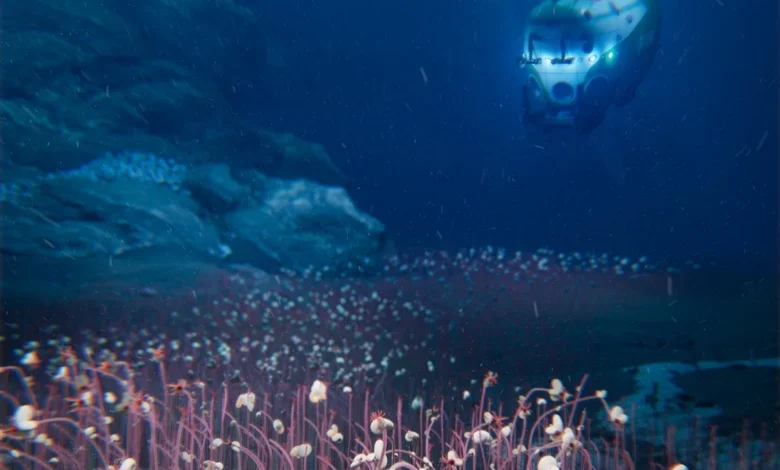
A monumental discovery in the deep ocean has fundamentally altered our understanding of biological limits, as researchers utilizing the Chinese manned submersible Fendouzhe have identified extensive, thriving communities of mollusks, tubeworms, and crustaceans nearly six miles below the surface of the Pacific Ocean. Published in the journal Nature, the study details how these complex ecosystems persist in the Hadal trenches—the deepest parts of the Earth’s oceans—where pressure exceeds 1,000 times that of sea level and sunlight is entirely absent. This finding marks the deepest and most expansive chemosynthesis-based community ever documented, suggesting that the "barren" abyssal plains of our planet may actually be teeming with life.
The Mechanics of Hadal Survival
For decades, the prevailing scientific consensus suggested that life at such extreme depths would be limited to sparse, opportunistic scavenging. However, the expedition led by the Institute of Deep-sea Science and Engineering (IDSSE) at the Chinese Academy of Sciences revealed a different reality. These creatures do not rely on the sun for energy, a process known as photosynthesis, which is the foundation of life on the surface. Instead, they harness energy through chemosynthesis, a process where organisms convert chemical compounds—specifically hydrogen sulfide and methane—into biological energy.
The research indicates that these fluids are transported via geological faults that traverse deep sediment layers. Isotopic analysis performed by the team confirmed that methane is produced microbially from organic matter deposited on the seafloor, providing a steady "fuel" source for these communities. The discovery spans a distance of over 1,500 miles across the Kuril-Kamchatka and western Aleutian trenches, demonstrating that these "oases" are not merely isolated anomalies but a widespread biological phenomenon.
A Chronology of Exploration
The journey to understand the Hadal zone has been a centuries-long endeavor characterized by rapid technological advancement.
- 1960: Don Walsh and Jacques Piccard became the first humans to reach the Challenger Deep, the lowest point of the Mariana Trench, aboard the bathyscaphe Trieste. Their observations were brief and limited by the technology of the time.
- 2012: Film director James Cameron completed the first solo dive to the bottom of the Mariana Trench, famously describing the landscape as a desolate, alien environment.
- 2020: The Chinese submersible Fendouzhe (Striver) successfully completed a series of record-breaking dives, officially reaching a depth of 10,909 meters (approximately 6.78 miles), solidifying its role as a premier tool for deep-sea exploration.
- 2024–2025: The Fendouzhe conducted a series of 23 systematic dives in the western Pacific, specifically targeting tectonic faults and methane-rich zones, which led to the recent documentation of these complex biological communities.
Supporting Data and Biological Diversity
The diversity of the observed life forms has surprised even the most seasoned marine biologists. Video evidence captured by the Fendouzhe’s high-definition cameras revealed fields of siboglinid tubeworms reaching lengths of up to 30 centimeters (roughly one foot). These tubeworms were frequently clustered around snow-like microbial mats, indicating a symbiotic relationship where bacteria provide the necessary nutrients for the larger organisms.
Alongside the tubeworms, the submersible documented dense mounds of Bivalvia (clams and mussels), free-floating marine worms, spiky crustaceans, and sea lilies. The sheer density of these populations contradicts the "desert" hypothesis that has dominated oceanographic textbooks for years. Researchers noted that the distribution of these organisms appears to follow the pathways of tectonic activity, suggesting that the Earth’s internal geological processes are the primary drivers of deep-sea biological distribution.
Scientific and Geological Implications
The findings published in Nature have sent ripples through the oceanographic community, specifically regarding the "deep-ocean carbon cycle." Current models of how carbon is sequestered and utilized at the seafloor are largely based on the assumption that most organic matter comes from "marine snow"—the steady rain of detritus falling from the upper layers of the ocean. The discovery of high-density, localized chemosynthetic production suggests that these trenches act as carbon sinks and biological processors on a scale previously ignored.

"What makes our discovery groundbreaking is not just its greater depth—it’s the astonishing abundance and diversity of chemosynthetic life we observed," stated Mengran Du, a marine geochemist with the IDSSE and co-author of the study. "Unlike isolated pockets of organisms, this community thrives like a vibrant oasis in the vast desert of the deep sea."
Environmental and Policy Concerns
The timing of this discovery is critical, as it coincides with intense international debates regarding the legalization and regulation of deep-sea mining. Several nations and private corporations are currently seeking to extract minerals, such as manganese nodules and cobalt, from the deep ocean floor to support the transition to green energy technologies like electric vehicle batteries.
Marine scientists have voiced significant concerns that mining activities could cause irreversible damage to these fragile, slow-growing ecosystems. The International Seabed Authority (ISA) is currently tasked with drafting a "Mining Code," yet progress has been slow due to conflicting interests between economic development and environmental preservation. Critics argue that we are attempting to industrialize an environment that we have barely begun to map or understand. By proving that the deep ocean is not a barren wasteland but a complex, interconnected web of life, the recent findings provide a powerful argument for increased protections for these remote marine zones.
Broader Impact on Planetary Science
The implications of the Fendouzhe expedition extend beyond Earth. Astrobiologists are particularly interested in these findings as they provide a terrestrial model for potential life on other celestial bodies. Moons such as Jupiter’s Europa or Saturn’s Enceladus are believed to harbor subsurface oceans that may also be driven by chemical energy rather than solar radiation. The ability of life to thrive in the Mariana Trench under extreme pressure and cold provides a blueprint for what to look for in the search for extraterrestrial life within our own solar system.
Furthermore, the study highlights the necessity of continued investment in manned submersible technology. While remotely operated vehicles (ROVs) have been the standard for deep-sea exploration for decades, the human presence—as noted by the researchers—offers a unique perspective that sensors alone cannot replicate. The "time-travel" experience described by the researchers during their dives emphasizes the human element in scientific discovery: the capacity for observation, nuance, and the ability to interpret complex environments in real-time.
As the scientific community continues to analyze the data gathered during these 23 dives, the focus will likely shift toward mapping other Hadal trenches. If the geological conditions found in the Mariana Trench are present elsewhere—as many geologists suspect—it is highly probable that similar oases exist throughout the global network of deep-ocean trenches. The era of seeing the deep ocean as an empty void has effectively come to an end, replaced by a new, more complex understanding of a planet that is far more vibrant than we ever dared to imagine.
The research concludes that the Hadal trenches, once considered the "final frontier" of the planet, represent a vital component of the global ecosystem. Future expeditions are already being planned to sample these microbial mats and further investigate the symbiotic relationships that allow life to flourish where, by all traditional metrics, it should be impossible. For now, the discovery stands as a testament to the resilience of life and the critical importance of protecting the most extreme corners of our world.