General Motors Reintroduces Apple CarPlay and Android Auto Support in New Vehicle Interface

General Motors is charting a new course for its in-vehicle infotainment strategy, effectively walking back its controversial 2023 decision to phase out Apple CarPlay and Android Auto support. In a strategic pivot, the automaker has announced that its upcoming 2027 Chevrolet Silverado and 2027 GMC Sierra models will feature a sophisticated new user interface that integrates smartphone mirroring alongside the company’s proprietary software. This development marks a significant shift for the Detroit-based automotive giant, which previously sought to transition entirely to a subscription-based, native infotainment ecosystem powered by Google Automotive Services.
The Timeline of a Contentious Strategy
The controversy began in March 2023, when General Motors stunned the automotive industry by declaring that it would cease offering Apple CarPlay and Android Auto in its future electric vehicles. The move was framed as a long-term technological evolution, with executives arguing that a proprietary, deeply integrated system would offer a more cohesive experience—one where navigation, charge planning, and vehicle health monitoring were unified under a single, seamless digital architecture.
The public reaction was swift and largely negative. For millions of drivers, smartphone mirroring via Apple and Google has become a fundamental expectation, serving as the primary interface for music streaming, navigation, and real-time communication. By removing these features, GM faced widespread criticism from consumers and industry analysts who argued that the automaker was prioritizing data collection and potential subscription revenue over user convenience and safety.
Throughout 2023 and 2024, the company held firm, even as competitors like Ford, Hyundai, and Toyota doubled down on their commitment to keep smartphone mirroring as a standard feature. The situation remained a point of friction for potential EV buyers, who often cited the lack of smartphone integration as a deterrent. The announcement regarding the 2027 Silverado and Sierra signals a fundamental realization within GM: that forced technological vertical integration may not align with current consumer behavior.
Architectural Evolution: The New Interface
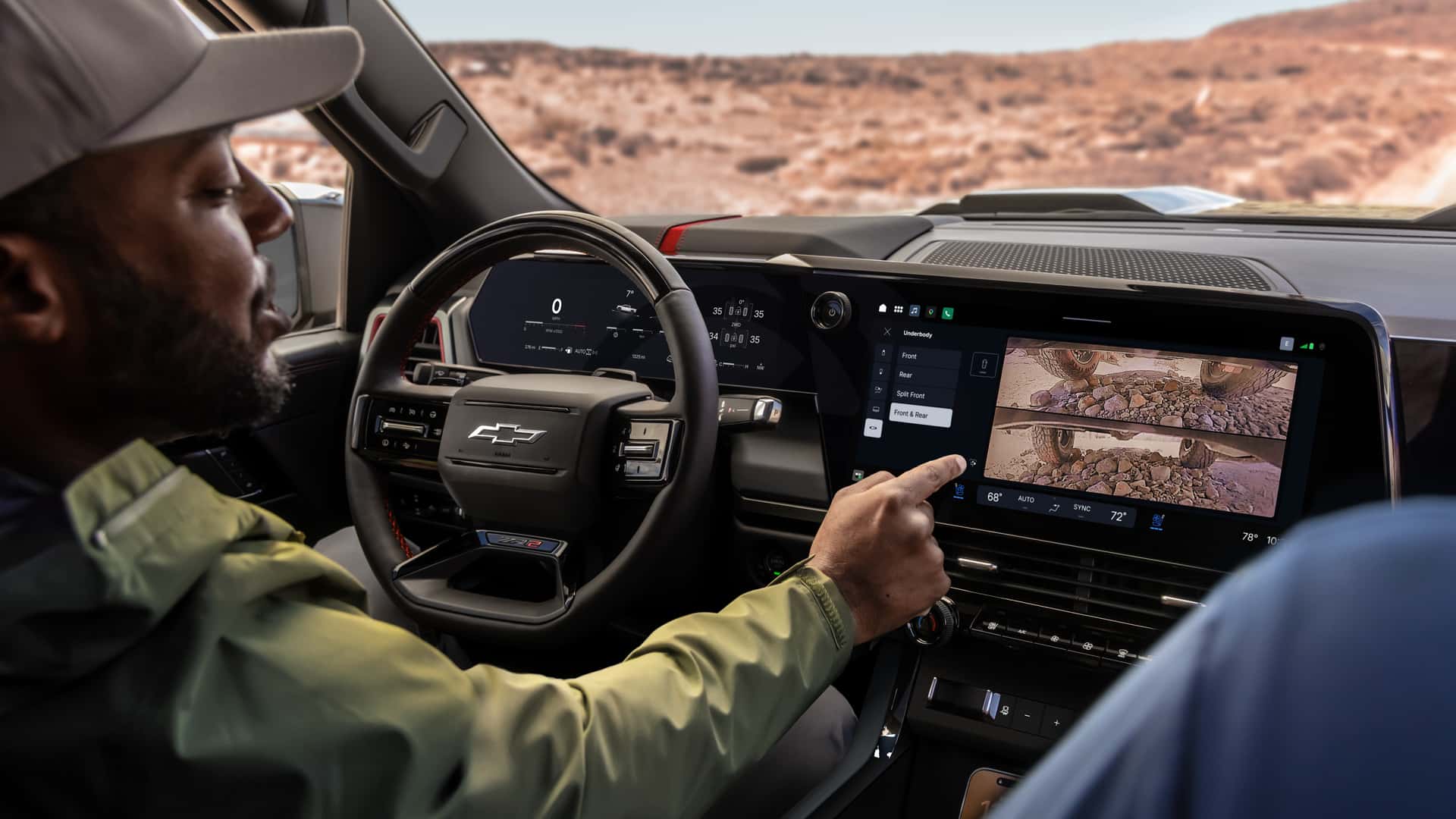
The core of this new development is a reimagined, high-contrast user interface designed to balance proprietary GM functionality with the familiar environment of Apple CarPlay and Android Auto. Rather than forcing a binary choice between the two, the new system employs a side-by-side display architecture.
In this configuration, the infotainment screen is effectively split. The system projects the smartphone interface into a large, prominent window that occupies the majority of the display area, while the secondary portion of the screen provides constant access to the vehicle’s native controls. This design addresses the primary technical grievance cited by GM engineers—the "context switching" that often required drivers to exit their phone environment to perform basic climate, radio, or vehicle settings adjustments. By keeping both interfaces active, the driver can maintain navigation via their phone while simultaneously adjusting vehicle performance modes or monitoring off-road metrics on the adjacent panel.
The hardware supporting this interface is also receiving a significant update. The system utilizes high-contrast visuals to improve legibility in varying lighting conditions, a critical requirement for trucks that frequently operate in both commercial and recreational environments. Furthermore, the instrument cluster is now "mode-aware," meaning it dynamically updates its layout to match the driver’s current intent, whether that is high-speed highway driving with Super Cruise engaged or low-speed technical off-roading.
Deep Integration and Super Cruise Enhancements
The new interface is not merely a cosmetic update; it represents a more robust integration of General Motors’ advanced driver-assistance systems (ADAS). Specifically, the 2027 truck lineup will feature enhanced 3D visualizations for the Super Cruise hands-free driving system.
As the vehicle processes environmental data, the dashboard will display a real-time rendering of the surrounding traffic, lane markings, and obstacles. By moving away from a simplified UI to this more transparent data visualization, GM aims to increase user trust in its autonomous features. This allows the driver to confirm exactly what the vehicle’s sensor suite—comprising cameras, radar, and LiDAR—is detecting at any given moment. This granular level of feedback is part of a broader industry push to make ADAS feel less like a "black box" and more like an intuitive partner in the driving experience.
Official Stance and Clarification
Following the initial reports, there was widespread speculation regarding whether this change in direction would apply to the entirety of GM’s future lineup, including its EV portfolio. To clarify the scope of this rollout, a spokesperson for General Motors issued a formal statement to the press.
The spokesperson emphasized that the term "scalable foundation" refers to the flexibility of the software architecture rather than a mandate for future implementation across every vehicle class. "The 2027 light-duty pickups are our highest-volume vehicles and among the most important in our portfolio, so that is where the team’s focus is," the statement noted. The company further clarified that because these specific models are gas-powered, they were always slated to support smartphone mirroring. The new UI, therefore, is an optimization of that existing support rather than a total reversal for all product lines.
This nuance is crucial. It suggests that while GM is acknowledging the demand for CarPlay in its high-volume trucks, the company may still maintain a different, more restrictive software strategy for its pure electric vehicles, where data monetization and proprietary ecosystem control remain central to its business model.
Industry Implications and Market Analysis
The decision to retain smartphone mirroring in its flagship trucks carries significant implications for the automotive sector. For years, the industry has been locked in a "tug-of-war" for the dashboard. Tech giants like Apple and Google have sought to make their software the primary OS of the car, while automakers have feared losing their direct relationship with the customer—and the associated revenue streams—to Silicon Valley.
Data from recent consumer surveys indicates that nearly 80% of new car buyers prioritize Apple CarPlay or Android Auto support as a "must-have" feature. In the luxury and high-performance segments, this preference is even higher. By attempting to force customers into a proprietary system, GM risked alienating a demographic that is increasingly comfortable with "Bring Your Own Device" (BYOD) connectivity.
The shift also highlights a growing divide between traditional automakers and new entrants like Tesla or Rivian. While Tesla has successfully maintained a closed, proprietary ecosystem that many customers find intuitive, other manufacturers have struggled to replicate that level of software polish. The failure to match the speed, accuracy, and ease of use found in Apple Maps or Waze has led many legacy manufacturers to conclude that, for now, "cooperation" is a more profitable path than "competition."
Future Outlook
As General Motors prepares for the 2027 model year, the industry will be watching closely to see if this "integrated" approach proves successful enough to justify a broader rollout. If the new UI experiences high satisfaction ratings among Silverado and Sierra owners, the pressure on GM to re-implement similar support across its electric vehicle lineup will likely become insurmountable.
The broader lesson for the automotive industry is that software is no longer a peripheral component of vehicle design; it is the primary interface through which the customer experiences the brand. In an era where hardware parity is common, the ability to seamlessly integrate the digital lives of consumers into their vehicles has become the new frontier of brand loyalty. For now, GM has chosen to bridge the gap, recognizing that in the modern automotive landscape, the customer’s preference for their own software is a force that even the largest automakers must respect.