UK government downgrades aviation decarbonization expectations as Heathrow expansion looms


The British government has significantly revised its long-term outlook for aviation emissions, slashing expectations for the efficacy of sustainable aviation fuels (SAFs) and electric aircraft technologies. These updated projections, released quietly in June 2026, arrive at a critical juncture as the Labour administration prepares to grant final approval for a controversial third runway at Heathrow Airport by 2029. The new data reveals that even under a high-ambition scenario for technological adoption, the aviation sector is set to produce nearly 50% more carbon emissions by 2050 than previously envisioned under the previous Conservative government’s “Jet Zero” strategy. This widening gap between climate targets and industry reality presents a profound challenge to the United Kingdom’s legal commitment to achieving net-zero emissions by the middle of the century.
A Chronology of Ambition and Adjustment
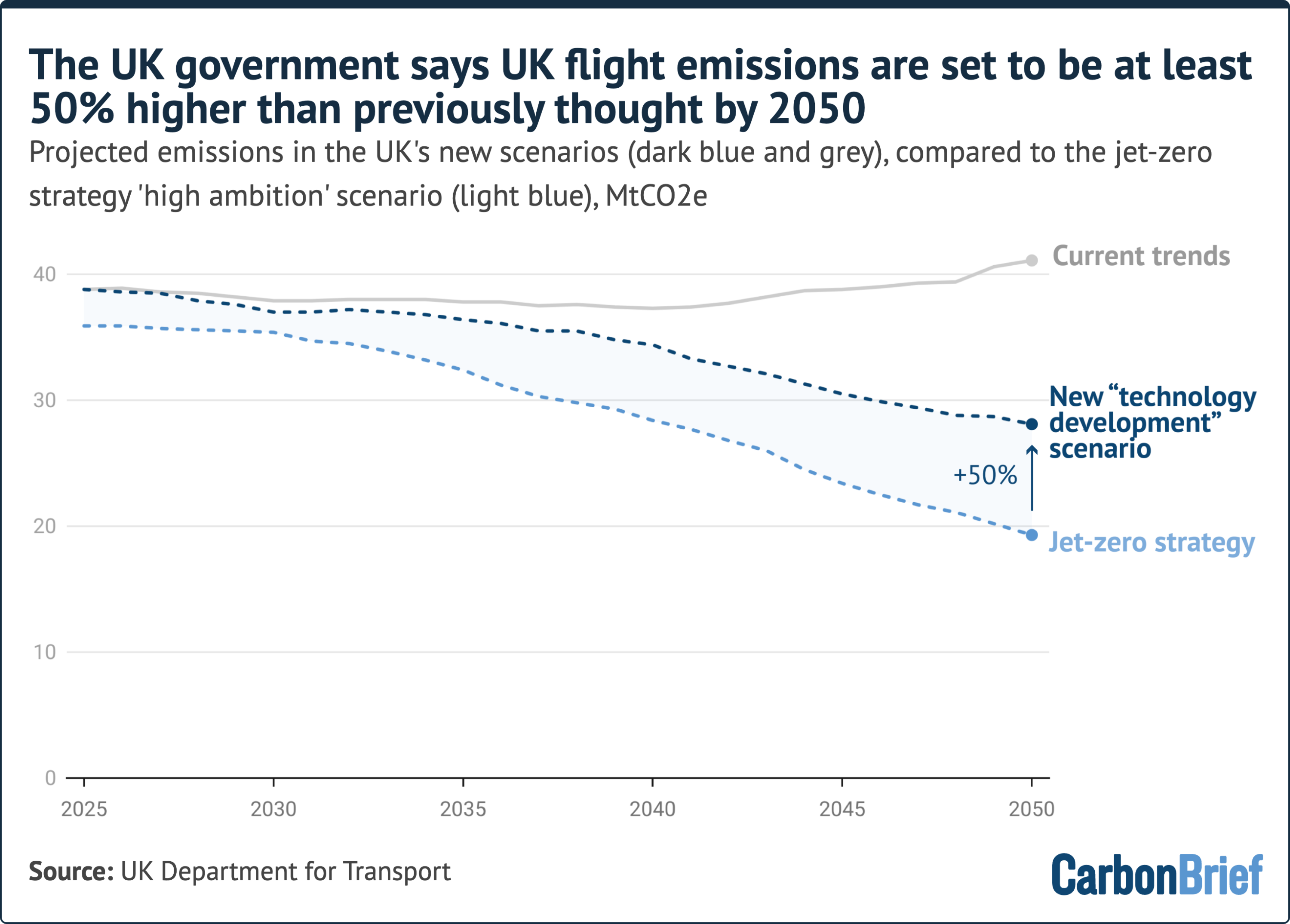
To understand the current impasse, one must look at the evolution of UK aviation policy over the last decade. In 2022, the Conservative government launched the Jet Zero strategy, a policy framework that sought to reconcile the expansion of airport capacity with aggressive climate goals. The strategy relied on an optimistic "high ambition" pathway, which projected that aviation emissions would peak at 38.2 million tonnes of carbon dioxide equivalent (MtCO2e) in 2019 before plummeting to 19.3MtCO2e by 2050. Ministers at the time argued that a combination of synthetic fuels, hydrogen, and battery-powered short-haul flight would allow the industry to grow without compromising environmental obligations.
However, the reality of the intervening years has been more sobering. By 2026, the Department for Transport’s updated forecasting models have been forced to retreat from these aggressive targets. The revised "technology development" pathway now suggests that even with significant investment in green innovation, emissions will likely only reach 28.1MtCO2e by 2050. This figure is roughly 9MtCO2e higher than the original Jet Zero target, representing a substantial deviation from the path to net-zero. If the government fails to implement these measures—or if technological rollouts continue to encounter the delays seen in the early 2020s—a "current trends" scenario suggests emissions could remain as high as 41.1MtCO2e, effectively doubling the original 2050 target.
The Technological Mirage: Why Forecasts Have Shifted
The primary driver for this downward revision is a more realistic assessment of so-called "techno-fixes." The government’s previous reliance on SAFs—fuels derived from waste products or synthetic processes—has been dampened by concerns over supply chain viability and lifecycle emissions. The original 2022 strategy envisioned SAFs accounting for 50% of the total aviation fuel mix by 2050. The current 2026 forecast has cut this expectation to 30%, acknowledging that the feedstock required to produce such massive quantities of sustainable fuel is, at present, largely unattainable at scale.
Furthermore, fuel-efficiency gains have been recalibrated. Collaborating with the Aviation Impact Accelerator, the Department for Transport revised the projected annual fuel-efficiency improvement from 2% down to 1.3%. This adjustment reflects the engineering reality that modern aircraft engines are approaching their theoretical limits for thermal efficiency, and breakthroughs in radical airframe design have been slower to materialize than policymakers previously hoped.
Similarly, the role of electric and hydrogen-powered flight has been curtailed in the latest forecasts. While small, battery-operated aircraft are beginning to see limited use in short-haul test routes, the prospect of medium-to-long-haul zero-emission flight remains decades away from commercial viability. The government’s new model now only assumes the presence of small, zero-emission craft for niche operations by 2035, effectively removing these technologies as a panacea for the mass-market aviation sector within the current net-zero window.
Economic and Environmental Implications of Heathrow Expansion
The looming decision on the third runway at Heathrow has become the focal point of this debate. The government has consistently justified the expansion by pointing to the promise of "clean aviation," arguing that by the time the runway is operational, the industry will have moved into a new era of low-carbon flight. However, critics argue that the new data exposes this logic as fundamentally flawed.
Dr. Lois Pennington of the University of Manchester, who has extensively analyzed the climate impact of airport expansion, suggests that the government’s own data proves the industry is already on track to exceed its share of the national carbon budget before a single brick is laid for the new runway. "Expansion can no longer be waved through on the promise of technology," Dr. Pennington stated. "Any approvals granted now are done in the full knowledge that they will likely break the UK’s legally binding carbon budgets."
The economic argument for expansion—centered on global connectivity and trade—is now directly pitted against the environmental cost. Because aviation is a "hard-to-abate" sector, every tonne of CO2 produced by increased flight capacity must be removed from the atmosphere elsewhere to maintain net-zero status. This creates a reliance on Carbon Dioxide Removal (CDR) technologies or large-scale land-use changes, such as the creation of vast new forests. Estimates suggest that to offset the emissions from a fully expanded Heathrow, the UK would need to dedicate thousands of hectares of land to carbon sequestration—an undertaking that creates its own competing pressures for agricultural land and biodiversity.
Official Responses and Industry Perspectives
The government maintains that its aviation strategy remains robust, though it admits the trajectory is more challenging than initially predicted. A spokesperson for the Department for Transport noted that the new forecasts reflect an "honest appraisal of global market conditions and technological maturity." Ministers have indicated that they are exploring a range of policy levers, including stricter international carbon pricing and potential demand-management strategies, to ensure that the aviation sector remains within its sectoral carbon caps.
The Aviation Environment Federation (AEF), a leading voice on the environmental impacts of air travel, has welcomed the transparency of the 2026 data. Tim Johnson, director of the AEF, argued that while the new numbers are "more honest and realistic," they also force a necessary conversation about the scale of air travel. "Less reliance on cleaner technology and fuels reopens the debate about the role and scale of greenhouse gas removals and ways to tackle the projected 50% growth in demand for air travel," Johnson remarked.

The Climate Change Committee (CCC), the independent body that advises the UK government on climate policy, has been consistent in its warning that technological improvements alone are insufficient to meet net-zero targets. The CCC has previously recommended that the government consider measures to limit the growth of passenger numbers, a suggestion that has historically met with resistance from both major political parties.
Looking Ahead: The 2029 Decision
As the clock ticks toward the 2029 deadline for the Heathrow planning decision, the government faces a precarious balancing act. The new data serves as a mathematical roadblock for the "techno-optimism" that has underpinned aviation policy for the last several years. The disparity between the 19.3MtCO2e target and the projected 28.1MtCO2e (in the best-case scenario) creates a 9MtCO2e deficit that must be resolved through either draconian emission cuts in other industries, a massive expansion of carbon removal infrastructure, or a fundamental reassessment of the government’s aviation growth strategy.
The decision on the third runway will likely be the most significant test of the UK’s climate policy framework to date. If the government proceeds with the expansion while simultaneously acknowledging that its decarbonization tools are underperforming, it risks setting a precedent that the UK’s net-zero targets are flexible rather than absolute. Conversely, a decision to block the expansion would signal a major shift in industrial strategy, prioritizing long-term climate integrity over immediate economic growth in the aviation sector.
For now, the aviation industry, investors, and climate advocates remain in a state of heightened scrutiny. The 2026 forecasts have stripped away the veneer of easy solutions, revealing a sector that requires not just better fuel and better engines, but perhaps a fundamental change in how the UK manages the demand for international travel in a warming world. The debate is no longer about whether technology will save the sector, but about how much the nation is willing to sacrifice in the pursuit of a flight-path that, for the moment, remains firmly grounded in high-carbon reality.