A Historic Selfie from Deep Space: Looking Back at the European Space Agency Rosetta Mission and Its Iconic Encounter with Comet 67P

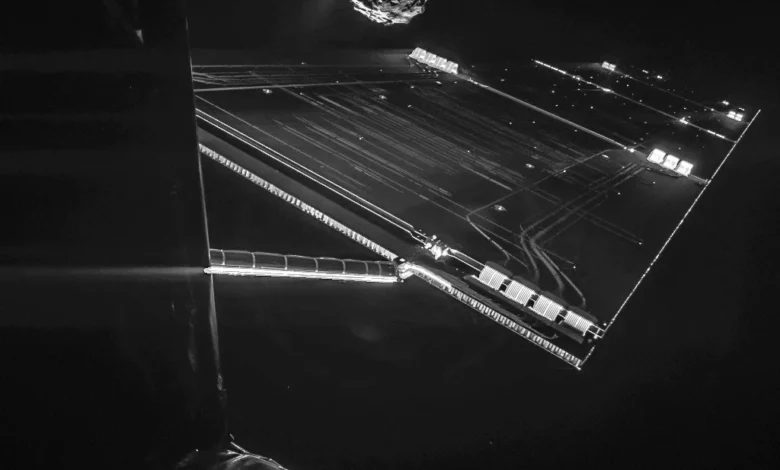
On October 7, 2014, the European Space Agency comet-chasing spacecraft Rosetta captured a historic, high-contrast self-portrait from deep space that would forever symbolize humanity’s first successful orbital rendezvous with a comet. Snapped while the spacecraft was situated approximately 472 million kilometers away from Earth, the image showcased a prominent 14-meter-long solar array of the Rosetta orbiter in the foreground, glistening brightly under unfiltered direct sunlight. Looming ominously and majestically in the background was the rugged, alien terrain of the nucleus of comet 67P/Churyumov-Gerasimenko, from which delicate streams of primordial dust and gas were actively venting into the vacuum of space.
Captured from a remarkably close vantage point just 16 kilometers above the surface of the comet, this photograph was not merely a mechanical novelty or a simple space selfie. It represented a technological triumph born of decades of scientific planning, international collaboration, and unprecedented engineering ingenuity. The image was recorded using the CIVA camera system—a micro-imaging suite mounted on the Philae lander, which was still physically attached to the Rosetta orbiter at the time of the exposure. Because of the extreme lighting conditions inherent to deep-space photography—where dark, light-absorbing celestial bodies exist side-by-side with blinding solar reflections—the final image was meticulously synthesized by combining two distinct exposures: a short exposure to preserve the brilliant glint on the solar panel, and a long exposure to capture the subtle, dark details of the comet’s double-lobed nucleus.
This striking visual artifact would ultimately serve as the final parting gift from the CIVA camera system while it was still docked to its mothership. Just over a month later, on November 12, 2014, the Philae lander would detach from Rosetta, embarking on a perilous, historic descent toward a targeted primary landing site on the visible hemisphere of the smaller lobe of comet 67P’s bizarre, duck-like nucleus. As Philae drifted away, it captured a final backward glance toward the orbiter before executing the first-ever soft landing on a comet’s surface, etching a legendary chapter into the annals of planetary science.
Chronology of the Rosetta and Philae Encounter with Comet 67P
To fully appreciate the significance of the October 7, 2014, self-portrait, it is essential to examine the arduous, multi-decade chronology that brought humanity to the doorstep of comet 67P/Churyumov-Gerasimenko. The origins of the Rosetta mission trace back to the late 1980s and early 1990s, when the European Space Agency initially conceived a daring flagship mission to land on a comet and accompany it as it traveled inward toward the inner solar system.
Originally slated to launch in January 2003 with a target destination of comet 46P/Wirtanen, the mission suffered a major setback when an Ariane 5 rocket failure in late 2002 forced a grounding and redesign of the launch schedule. Consequently, ESA scientists were forced to select a new target: comet 67P/Churyumov-Gerasimenko. Because the orbital mechanics required a completely new trajectory, the launch date was shifted to March 2, 2004, setting into motion an epic, decade-long interplanetary voyage.
To reach its target, which orbited far beyond the asteroid belt, Rosetta could not travel in a straight line. Instead, the spacecraft executed a complex series of gravity-assist maneuvers, swinging past Earth three times (in 2005, 2007, and 2009) and Mars once (in 2007) to build up the necessary velocity to catch up with the fast-moving comet. During its long trek through the inner solar system, Rosetta also took advantage of its trajectory to perform historic flybys of main-belt asteroids 28519 Šteins in 2008 and 21 Lutetia in 2010, gathering valuable scientific data along the way.
By mid-2011, having ventured far from the warmth of the Sun where solar power became critically scarce, Rosetta was placed into a deep-space hibernation mode. For 31 months, the spacecraft drifted silently through the dark expanse of the solar system, its systems shut down to conserve energy, with only an onboard clock ticking away the time until its scheduled wakeup.
That critical wakeup call occurred on January 20, 2014. Ground control stations at the European Space Operations Centre (ESOC) in Darmstadt, Germany, tensely awaited a signal from the spacecraft. Hours later, Rosetta successfully phoned home, breaking its long silence and confirming that its critical systems had survived the deep-freeze.
Following its awakening, Rosetta spent the spring and early summer of 2014 gradually closing the distance to comet 67P. By August 2014, the spacecraft achieved its historic rendezvous, entering orbit around the comet from a distance of just 100 kilometers. Over the subsequent weeks, scientists mapped the bizarre, double-lobed nucleus of 67P, evaluated potential landing sites, and maneuvered the spacecraft closer and closer to the surface. It was during this intense mapping and positioning phase, on October 7, 2014, that the iconic spacecraft selfie was captured from an altitude of only 16 kilometers.
Supporting Data and Technical Specifications
The technical parameters of the Rosetta mission underscore the immense scale and precision required to execute a rendezvous with a moving target millions of kilometers from Earth. Comet 67P/Churyumov-Gerasimenko orbits the Sun on an elliptical path that ranges from an aphelion (farthest point) beyond the orbit of Jupiter to a perihelion (closest point) situated between the orbits of Earth and Mars. Its orbital period is approximately 6.5 years.

The Rosetta orbiter itself measured 2.8 by 2.1 by 2.0 meters at launch, excluding its massive solar wings. Most notably, its two giant gallium arsenide solar arrays spanned an incredible 32 meters from tip to tip, making Rosetta the largest interplanetary spacecraft ever powered by solar panels up to that time. These massive arrays were necessary because, as the spacecraft traveled further from the Sun toward the outer reaches of the solar system, solar illumination dropped to a mere fraction of what it is at Earth. At the comet’s distance, the solar panels generated only a few hundred watts of power, requiring exhaustive energy management protocols.
The Philae lander, which hosted the CIVA (Comet Infrared and Visible Analyzer) camera system used to take the October 2014 selfie, weighed approximately 100 kilograms and was equipped with a suite of ten specialized scientific instruments designed to analyze the composition, structure, and magnetic properties of the comet’s surface. The CIVA system itself comprised a set of seven micro-cameras designed primarily to take panoramic stereoscopic images of the landing site, as well as a spectrometer to analyze the mineralogical composition of surface samples collected by the lander’s drill.
Official Responses and Scientific Perspectives
The release of the October 7 selfie, along with the continuous stream of data pouring back from the Rosetta mission, generated widespread enthusiasm within the global scientific community and the general public alike. Project scientists lauded the mission not only for its technological achievements but for the profound paradigm shifts it triggered in our understanding of cometary formation and the early solar system.
Speaking at various mission debriefs, members of the ESA Rosetta Science Operations team emphasized that the unexpected shape of comet 67P—resembling a rubber duck with a distinct body and head—challenged existing planetary formation theories. Rather than being a monolithic, pristine chunk of primordial ice, data indicated that the comet was likely formed through the gentle, low-velocity collision of two separate cometary bodies earlier in the history of the solar system.
Dr. Matt Taylor, former ESA Rosetta Project Scientist, frequently highlighted the cooperative nature of the endeavor, noting that the success of the mission was a testament to the dedication of thousands of engineers, scientists, and administrative personnel across Europe and the United States who spent decades bringing the concept to reality. The imagery captured by Philae’s CIVA cameras provided an unprecedented, boots-on-the-ground perspective that transformed comets from abstract astronomical phenomena into tangible, physical worlds with complex topography, dust-covered plains, and towering cliffs.
Broader Impact, Legacy, and Future Implications
The legacy of the Rosetta mission extends far beyond the stunning visual imagery it produced. By escorting comet 67P through its closest approach to the Sun (perihelion) in August 2015 and continuing operations until its controlled descent and landing on the comet’s surface on September 30, 2016, Rosetta provided scientists with a multi-year, continuous dataset of cometary activity.
One of the most significant scientific findings yielded by the mission involved the isotopic composition of water vapor detected escaping from comet 67P. By measuring the ratio of deuterium to hydrogen in the comet’s water, scientists discovered that the water on 67P possessed a significantly higher concentration of deuterium than Earth’s oceans. This crucial empirical data injected new vigor into scientific debates concerning the origin of Earth’s water, suggesting that comets of the Jupiter-family type may not have been the primary source of our planet’s oceans, thereby shifting focus toward asteroids and other primordial reservoirs.
Furthermore, the mission detected an abundance of complex organic molecules—the chemical building blocks of life—in the comet’s coma and dust envelope. Amino acids, such as glycine, and phosphorus were identified by Rosetta’s instruments, reinforcing the hypothesis that comets may have played a critical role in seeding the early Earth with the molecular precursors necessary for the emergence of biological life.
The technical and operational achievements of Rosetta and Philae have laid a permanent foundation for future deep-space exploration. The lessons learned in autonomous navigation around irregularly shaped small bodies, low-gravity orbital mechanics, and long-duration hibernation strategies continue to inform modern planetary defense initiatives, asteroid-retrieval concepts, and upcoming missions targeting the outer solar system.
As generations of astronomers and space enthusiasts continue to explore the vast archives of the ESA Astronomy Picture of the Day and related scientific repositories, images like the October 7, 2014, spacecraft selfie remain enduring monuments to human curiosity. They capture a fleeting moment when a tiny emissary from Earth stared back across the void, framing its solar panels against the ancient, gas-venting nucleus of a wandering comet—a silent witness to the majestic, interconnected clockwork of our cosmic neighborhood.