The First Glimpse of Earth from Space: How a 1946 V-2 Rocket Changed Our Perspective Forever

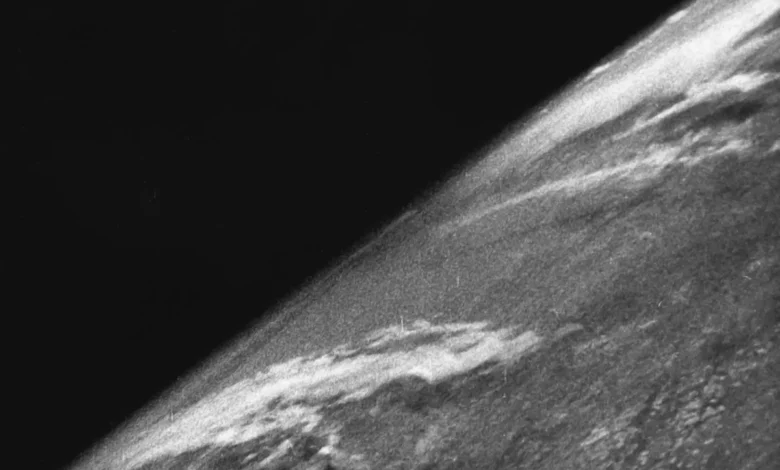
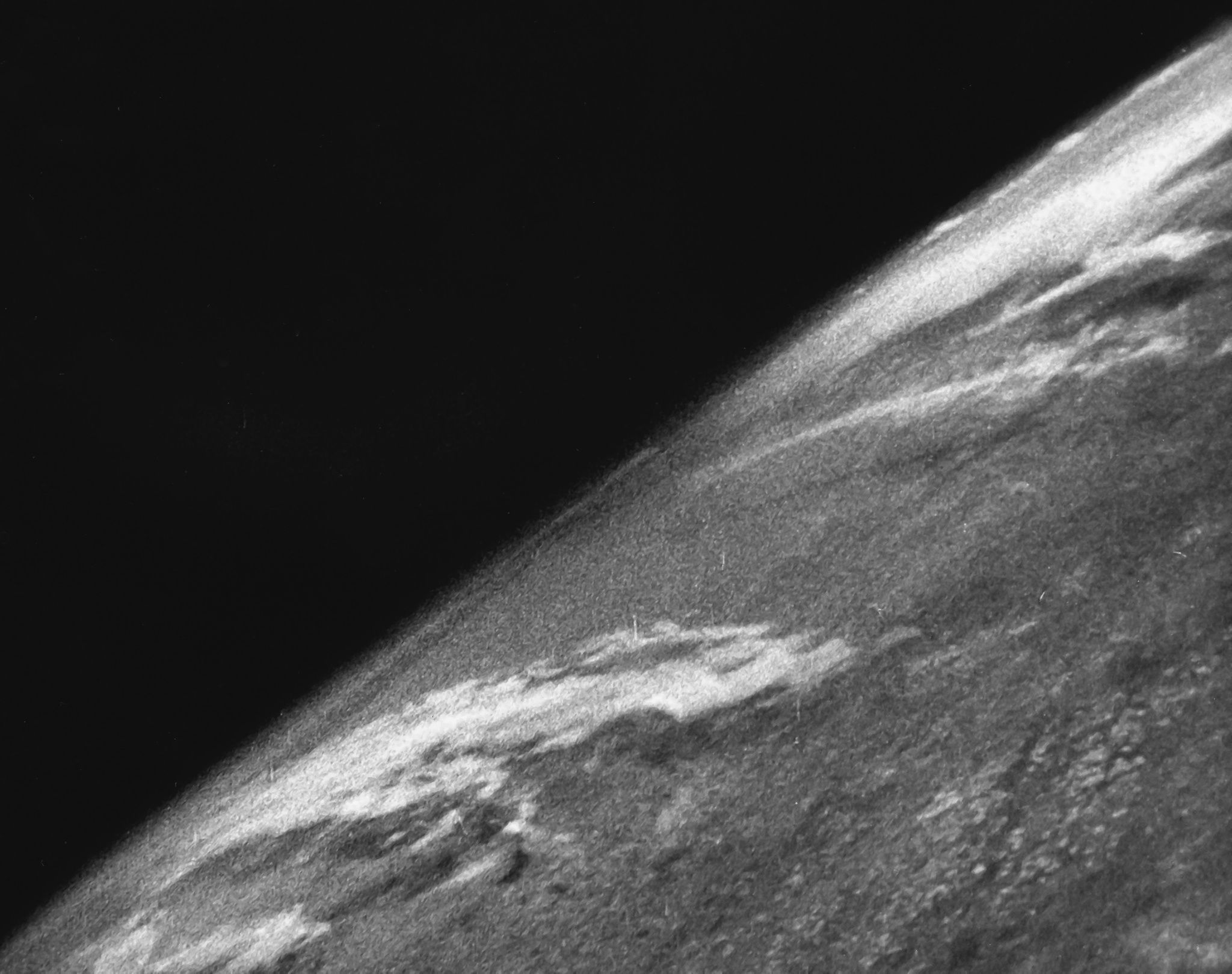
On October 24, 1946, a converted German V-2 rocket roared into the skies above the White Sands Missile Range in New Mexico, carrying a 35-millimeter motion picture camera that would fundamentally alter humanity’s relationship with the cosmos. This mission, conducted by the United States Army, successfully reached an altitude of approximately 65 miles—well beyond the Kármán line, the internationally recognized boundary of space at 62 miles. As the rocket ascended, the camera captured a series of grainy, black-and-white frames, providing the first-ever photographic evidence of what our planet looked like from the vantage point of the void.
While the images today appear rudimentary compared to the high-definition feeds transmitted from the International Space Station, their historical significance cannot be overstated. At that moment in 1946, the world was in the nascent stages of the Cold War, and the technology utilized was a direct evolution of the V-2 rockets developed by Wernher von Braun’s team in Nazi Germany. By capturing these images, researchers not only proved that high-altitude photography was possible but also sparked an era of scientific exploration that would eventually lead to the satellite-driven world of the 21st century.
A Technological Feat in the Desert
The success of the mission was by no means guaranteed. The V-2 rocket, repurposed for suborbital research, was a volatile piece of machinery. The camera, a standard 35mm motion picture device, was mounted in a specialized compartment designed to withstand the immense G-forces of launch. It was programmed to snap a new frame every 1.5 seconds, documenting the curvature of the Earth as the rocket climbed through the thin, dark atmosphere.
Upon completing its arc, the rocket returned to Earth, impacting the desert floor at a velocity of roughly 340 miles per hour. The violence of the crash pulverized the rocket and destroyed the camera mechanism. However, the film itself remained protected within a reinforced steel casing. When the recovery team finally retrieved the canister from the debris field in the New Mexico desert, the atmosphere among the scientists was electric. According to accounts from those present, the researchers were jubilant, fully aware that they were the first human beings to look upon the Earth as a celestial body rather than a flat horizon.
Chronology of the Early Space Age
The October 24, 1946, mission was not an isolated event but rather part of a structured series of tests aimed at utilizing captured V-2 technology for atmospheric research.
- 1945: Following the end of World War II, Operation Paperclip brought German rocket scientists and hardware to the United States. The U.S. military began testing V-2 rockets at White Sands, New Mexico.
- 1946 (Early): The V-2 Upper Atmosphere Research Panel was formed, bringing together scientists from the Naval Research Laboratory, universities, and the military.
- October 24, 1946: The mission achieved the first photographic documentation of the Earth from space.
- 1947–1950: Subsequent launches continued to refine the altitude and quality of onboard instrumentation, moving from 35mm film to more advanced sensors.
- 1957: The launch of Sputnik 1 by the Soviet Union marked the transition from suborbital rocket tests to full-scale orbital satellite deployment, a direct progression from the foundational work done at White Sands.
The Scientific and Military Context
The V-2 rocket program was originally designed for long-range ballistic warfare, but in the hands of American scientists, it became a laboratory for high-altitude physics. Before these flights, our knowledge of the upper atmosphere, solar radiation, and the appearance of the Earth from space was largely theoretical.
The military implications of this research were immediately apparent. During the late 1940s, the U.S. government realized that if a camera could be placed on a rocket, then reconnaissance sensors could eventually be placed on orbital platforms. This was the birth of the "eye in the sky" concept. Intelligence agencies recognized that high-altitude photography offered a strategic advantage that traditional aircraft could not match, as rockets could bypass the reach of conventional anti-aircraft defenses.
Beyond intelligence, the scientific community leveraged these flights to study cosmic rays and the composition of the ionosphere. These studies provided the essential data required to design future spacecraft capable of carrying human life safely through the harsh environment of space.
Societal and Environmental Implications
Perhaps the most profound impact of that 1946 photograph was its role in shaping the modern environmental movement. Before the "Blue Marble" era—a term later coined after the 1972 Apollo 17 mission—humanity viewed Earth as an infinite expanse. The 1946 V-2 images were the first to show the stark contrast between the bright, cloud-streaked Earth and the profound, absolute darkness of space.
This perspective helped foster the realization that Earth is a fragile, isolated system. As space exploration progressed, the public and scientific communities began to perceive the planet not as an inexhaustible resource, but as a limited "spaceship" with finite supplies and a delicate biosphere. This shift in consciousness paved the way for modern climate science and international agreements focused on planetary protection.
Analyzing the Legacy of the White Sands Missions
From an engineering standpoint, the 1946 mission proved that sophisticated instrumentation could survive the transition from the atmosphere to the vacuum of space. The use of a steel-encased, ruggedized camera paved the way for the robust engineering standards required for the later Mercury, Gemini, and Apollo programs.

The logistical challenges faced by the team—driving into the remote desert to recover a steel box from a smoking crater—highlight the grit of the early space pioneers. Their methodology was simple: build it, launch it, break it, and learn from the pieces. While today’s missions, such as the James Webb Space Telescope or the Perseverance Mars Rover, rely on autonomous, long-term operations, the "shot-in-the-dark" approach of the 1940s established the essential proof-of-concept that enabled everything that followed.
A Foundation for Future Exploration
The success of the October 24, 1946, mission demonstrated that space was accessible to human technology. It transformed space from a realm of fiction and astronomy into a domain of practical activity. The transition from suborbital photography to orbital reconnaissance, and finally to human spaceflight, follows a direct line of development from that initial New Mexico launch.
Today, Earth observation is a multi-billion-dollar industry, supporting global agriculture, meteorological forecasting, disaster management, and telecommunications. Every satellite that monitors deforestation, tracks hurricanes, or provides GPS coordinates is a descendant of the 35mm camera that clicked away on a V-2 rocket nearly 80 years ago.
The individuals who stood in the New Mexico desert in 1946, jumping with excitement as they processed the first images of our home planet, were witnessing more than just a photo; they were witnessing the birth of a new era. They were the first to see the world as a unified whole, a perspective that continues to define our scientific, strategic, and philosophical understanding of the Earth today. As we look toward future missions to the Moon, Mars, and beyond, the legacy of that initial, grainy image remains a constant reminder of how far we have traveled—and how much there is still to discover from the silence of space.