Bitcoin Miners Transform Into AI Power Houses Amid Texas Data Center Moratorium Debates


The intersection of artificial intelligence infrastructure and energy markets has reached a critical juncture in the state of Texas, where regulatory pushback, soaring energy demands, and shifting corporate strategies are dramatically reshaping the valuation of publicly traded Bitcoin mining companies. As tech conglomerates aggressively secure power capacity to fuel large-scale data centers, traditional cryptocurrency miners have increasingly pivoted toward high-performance computing (HPC) and artificial intelligence hosting. However, this transition has triggered intense political friction, underscored by Texas Representative Gina Hinojosa calling for a legislative moratorium on new data centers, and major financial institutions like Bernstein issuing a sweeping reassessment of the sector’s market targets.
The debate over energy consumption, grid reliability, and the rapid expansion of digital infrastructure highlights a growing tension between technological innovation and public resource management. While Wall Street continues to re-rate Bitcoin miners based on their access to robust electrical power networks, local communities and lawmakers are increasingly pushing back against the strain placed on local power grids. The evolving landscape reflects a fundamental shift in how energy assets are valued, moving away from purely cryptographic operations toward the broader, high-demand ecosystem of artificial intelligence.
The Texas Regulatory Flashpoint: Balancing Innovation and Grid Stability
Texas has long been a haven for cryptocurrency miners due to its deregulated energy market, abundant land, and competitive power rates. However, the exponential rise of generative artificial intelligence has fundamentally altered the state’s energy dynamics. The immense power requirements needed to run advanced machine learning clusters have led to a surge in data center development, frequently competing directly with traditional grid consumers for electrical capacity.

State Representative Gina Hinojosa’s recent push for a legislative moratorium on new data centers underscores growing legislative anxiety regarding grid reliability. Hinojosa has formally urged Governor Greg Abbott to implement a temporary halt on approving new data center projects until a comprehensive legislative framework can be established to protect everyday Texans. The proposed moratorium aims to address concerns that the rapid influx of high-consumption facilities could drive up consumer electricity costs and strain the Electric Reliability Council of Texas (ERCOT) grid beyond safe operating limits.
The debate is not isolated to Texas. Across the United States, states with high concentrations of data centers are grappling with the environmental and economic fallout of rapid industrial expansion. Power grids originally built to support residential and light commercial loads are now facing unprecedented demand spikes, forcing utility regulators to rethink long-term planning, interconnection queues, and infrastructure funding.
Wall Street Re-evaluates Bitcoin Mining Valuations
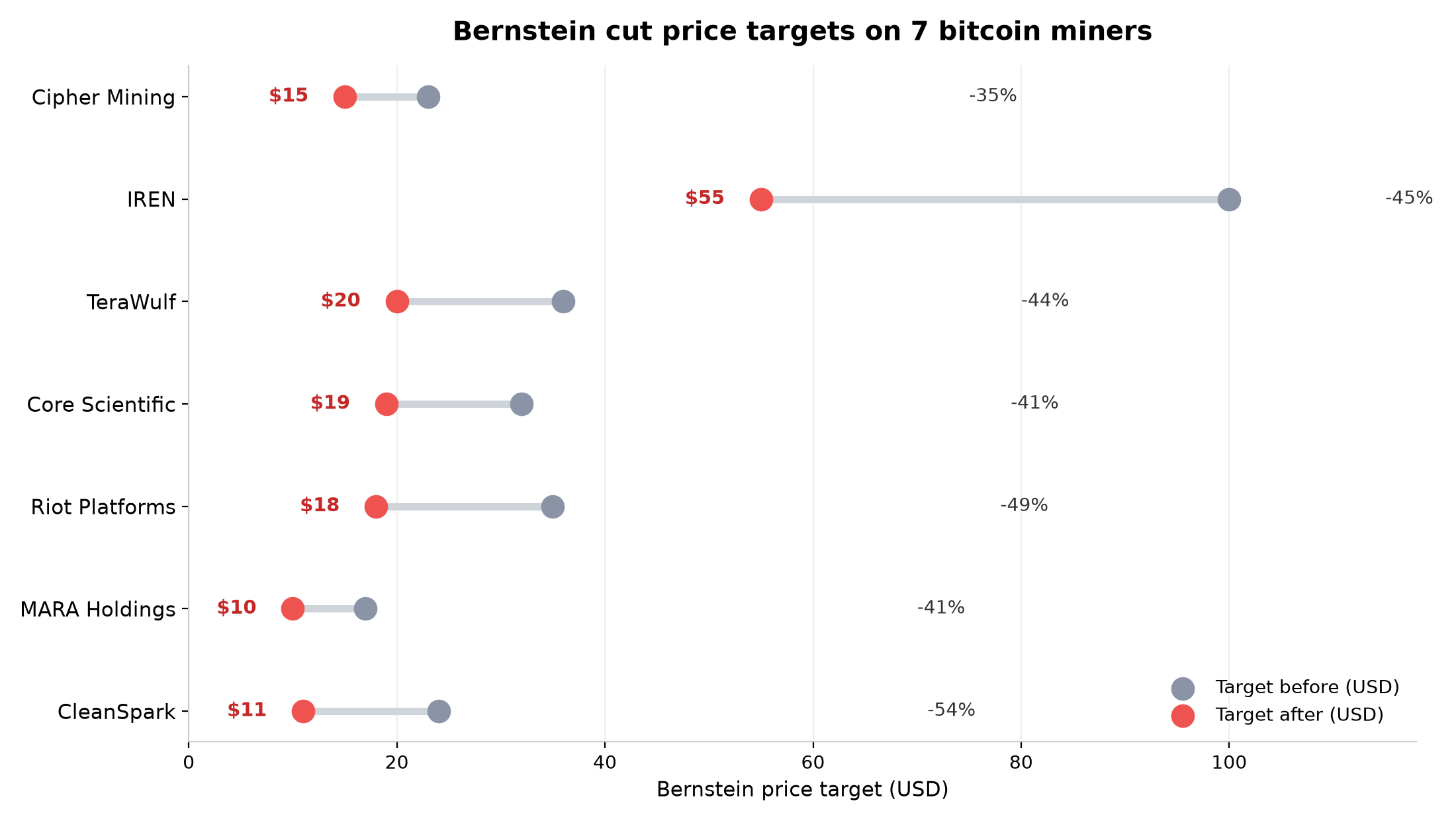
Despite regulatory headwinds at the state level, major financial institutions view the pivot toward AI infrastructure as a transformative catalyst for the Bitcoin mining sector. In a comprehensive research note released by Bernstein, analyst Gautam Chhugani and his team adjusted their target prices for several prominent crypto-mining companies, slashing targets by 35% to 54% while maintaining an overall bullish outlook on the sector’s strategic repositioning.
Bernstein’s updated valuations reflect a nuanced view of the market. While near-term regulatory hurdles and grid interconnection delays have created temporary headwinds, the long-term thesis remains intact: Bitcoin miners sitting on substantial power capacity represent the primary bottleneck solution for the artificial intelligence industry. Major firms such as Cipher Mining, IREN, TeraWulf, Core Scientific, Riot Platforms, MARA Holdings, and CleanSpark are increasingly leveraging their existing electrical infrastructure to secure lucrative hosting contracts with hyperscalers.
According to Bernstein’s revised metrics, target prices across the sector saw significant downward adjustments:
- Cipher Mining: Adjusted from $23 down to $15
- IREN: Adjusted from $100 down to $55
- TeraWulf: Adjusted from $36 down to $20
- Core Scientific: Adjusted from $32 down to $19
- Riot Platforms: Adjusted from $35 down to $18
- MARA Holdings: Adjusted from $17 down to $10
- CleanSpark: Adjusted from $24 down to $11
Despite these lowered share price targets, Bernstein emphasizes that the structural shift of miners into AI infrastructure providers represents a generational valuation re-rating. Rather than relying solely on the volatile economics of Bitcoin block rewards, these companies have secured multi-gigawatt power portfolios that are now critical assets for major technology companies scrambling to secure data center space.
Industry Pivots and Corporate Strategy Adjustments
The strategic pivot toward artificial intelligence has driven a wave of infrastructure investments and partnership agreements across the industry. Companies like Cipher Mining, MARA Holdings, and Galaxy Digital have actively pursued joint ventures and long-term lease agreements to monetize their power assets. For instance, Cipher’s Colchis project, Galaxy’s Helios II facility, and MARA’s expanding operational footprint illustrate how traditional mining sites are being retrofitted to support high-density HPC racks.
Concurrently, firms like TeraWulf, Hut 8, and Applied Digital have positioned themselves at the forefront of the AI infrastructure boom. TeraWulf has successfully diversified its operations to support high-performance computing, while Hut 8 has expanded its energy advisory services to help prospective tech clients navigate complex grid interconnections. Meanwhile, Riot Platforms continues to develop major operational hubs such as its Corsicana and Rockdale sites, ensuring that they retain long-term flexibility to switch between Bitcoin mining and AI hosting depending on market profitability.
Institutional support for the sector remains robust, supported by macroeconomic trends and institutional capital inflows. Financial institutions and private equity firms continue to inject capital into digital infrastructure assets, recognizing that traditional energy markets are struggling to keep pace with the computational demands of generative AI. According to industry reports, major tech firms including Microsoft, Meta, Amazon, and Google have collectively committed tens of billions of dollars toward energy procurement and data center expansion through 2027.
Broader Economic Implications and Grid Challenges
The rapid integration of AI workloads into energy grids presents both opportunities and systemic risks for regional economies. While the expansion of data centers generates substantial tax revenue, local employment, and infrastructure development, it also introduces significant challenges related to water usage, carbon emissions, and grid stability.
Energy analysts have repeatedly warned that unchecked power consumption by data centers could accelerate fossil fuel dependency if renewable energy deployment fails to keep pace. Furthermore, local communities frequently push back against the noise pollution and visual impact of large industrial facilities, leading to increased local pushback and legislative scrutiny.
In Texas, the ongoing debate over ERCOT’s interconnection queue and the Public Utility Commission’s (PUC) oversight policies highlights the complexity of managing gigawatt-scale power demands. Whether Governor Abbott and state legislators will implement formal restrictions remains an open question, but the pressure from local officials is unmistakable. As market participants navigate these regulatory uncertainties, the ability of Bitcoin miners to successfully execute their AI pivots will depend heavily on their capacity to secure reliable power, maintain community relations, and adapt to evolving energy policies.
Related posts: