Tesla Rolls Out Full Self-Driving Version 15 With Claims of Massive Safety Upgrades and Advanced Reality View Visualization

Tesla has officially initiated the rollout of its long-awaited Full Self-Driving (FSD) version 15 software update to consumer vehicles equipped with compatible hardware. Touted by company executives as a monumental step forward in autonomous vehicle development, the latest software iteration directly addresses several of the most persistent operational criticisms leveled against previous versions. These include erratic handling in school zones, failure to recognize changing speed limit signs, an inability to dodge roadway hazards such as potholes, and inconsistent management of speed cameras.
Alongside these functional patches, Tesla claims that FSD v15 delivers a twenty-five-fold improvement in the handling of safety-critical edge cases. The update also introduces a new graphical interface dubbed "Tesla Reality View" or "Tesla Augmented Reality," designed to offer drivers a clearer, real-time look into the vehicle’s decision-making architecture. While the promise of enhanced safety metrics and advanced visualization tools has generated considerable excitement within the electric vehicle community, industry analysts and safety watchdogs remain cautious, demanding verifiable data to substantiate the company’s bold performance assertions.
Chronology of Development: From V12 to V15
The trajectory of Tesla’s Full Self-Driving software has been characterized by aggressive developmental milestones, iterative updates, and frequently missed timelines for achieving fully unsupervised autonomy. The architecture shifted dramatically with the widespread deployment of end-to-end neural networks in version 12, which replaced hundreds of thousands of lines of hard-coded C++ programming with neural net weights trained on vast fleets of driving video data.
Despite the architectural pivot, subsequent iterations struggled with distinct operational anomalies. When FSD version 14 debuted in October 2025, early adopters reported a frustrating array of phantom braking instances, visual hallucinations, and unnecessary speed fluctuations. Crowdsourced data from late 2025 indicated that version 14 vehicles averaged roughly 732 miles between critical disengagements—a performance metric well short of the reliability threshold required for commercial robotaxi deployment.
Throughout early and mid-2026, Tesla issued a sequence of point updates attempting to stabilize the platform. In April 2026, CEO Elon Musk asserted that the impending version 15 would "far exceed human levels of safety, even in completely unsupervised and complex situations." By August 2026, presentations given to financial institutions like JPMorgan indicated that v15 would operate as a "step-change" built on seven core technologies, roughly 40 percent of which were already being tested within the company’s limited Austin robotaxi fleet. Now, following the formal release notes published on social media channels by Tesla Super Intelligence, the company is attempting to prove that its end-to-end driving network has finally matured.

Deconstructing the Release Notes: Key Technical Additions
According to official release documentation, FSD v15 upgrades every foundational component of Tesla’s end-to-end driving network. The scope of the improvements is wide-ranging, targeting specific traffic scenarios that have historically challenged automated driving systems.
Speed management represents a major focal point. European road tests conducted earlier in 2026 by advocacy and nonprofit organizations highlighted significant vulnerabilities in how Tesla vehicles process regional speed limitations. For instance, testing in Brussels revealed that vehicles running older FSD builds exceeded limits in over half of the designated 30 km/h zones encountered, frequently failing to register roadside regulatory signage and maintaining speeds closer to 50 km/h. Version 15 explicitly seeks to correct these deficiencies through enhanced sign detection models and newly integrated logic for slowing down in the vicinity of speed cameras.
Furthermore, the update introduces a dedicated "Bike Rack Mode," accommodating drivers who utilize hitch-mounted accessories without disabling critical rear-facing safety features. Navigation learning has also been updated, though functionality is currently limited to the commencement and termination points of a given route, with route-wide learning scheduled for subsequent point releases.
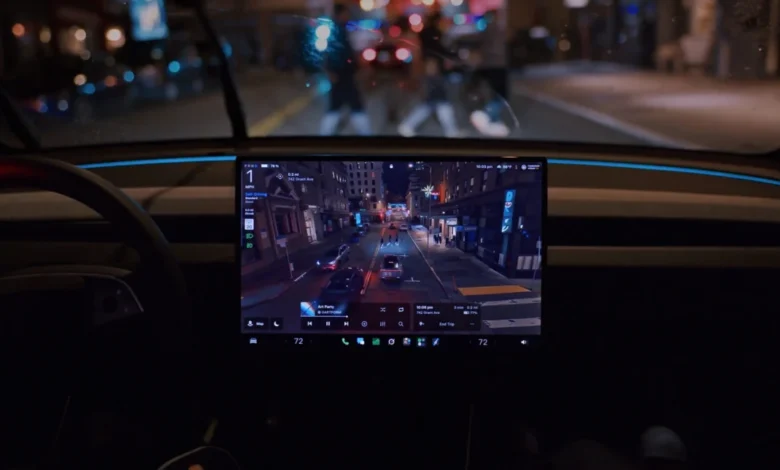
Perhaps the most visually striking alteration is the implementation of Tesla Reality View. Consolidating multiple disparate model signals into a unified end-to-end visualization running on the central touchscreen, Reality View renders a highly detailed, real-time graphical representation of the surrounding road environment. Tesla asserts that this streamlined visualization requires less onboard compute power while simultaneously offering drivers unprecedented transparency regarding the vehicle’s immediate operational intentions.
Scrutinizing the Claims: The 25x Critical Intervention Metric
The most heavily debated element of the FSD v15 release is Tesla’s assertion of a "25x better handling of safety critical cases." Release notes clarify that this multiplier specifically describes an improvement in the system’s critical intervention rate, achieved via a newly optimized vision encoder.
While intervention rate is universally recognized by autonomous vehicle engineers as a vital benchmark for measuring progress toward unsupervised operation, Tesla has once again declined to publish the underlying baseline and absolute figures. Independent automotive data suggests that previous software iterations achieved a critical intervention rate roughly once every couple of thousand miles. A twenty-five-fold amplification of that metric would theoretically project the vehicle’s reliability into the tens of thousands of miles between necessary human takeovers—approaching the milestones traditionally cited by regulators and autonomous developers as viable for limited commercial deployment.

However, independent validation remains elusive. Industry watchdogs note a historical pattern wherein major version releases introduce significant advancements alongside regressive bugs, requiring subsequent minor patches to restore baseline stability. Furthermore, public skepticism persists regarding safety claims made by executive leadership, given that similar assertions accompanied the rollouts of both version 12 and version 14.
Regulatory Pressure and Driver Monitoring Controversies
The deployment of FSD v15 occurs under an intensifying regulatory spotlight. Safety agencies, including the National Highway Traffic Safety Administration (NHTSA), have scrutinized Tesla’s driver-assist technologies following a series of investigations into traffic-law compliance, red-light running incidents, and complaints regarding automated vehicle behavior in active school zones.
Complicating the regulatory narrative further is a notable policy shift embedded within the v15 update. Tesla has confirmed it is "decreasing strictness" regarding driver monitoring systems when vehicles operate under higher-speed driver profiles. This adjustment arrives at a time when viral videos of sleeping or distracted drivers utilizing autonomous driving modes continue to generate intense public controversy. It also contrasts sharply with regulatory trends in international markets, such as Europe, where transport authorities have actively pressured the automaker to strengthen driver attentiveness checks rather than relax them.
Broader Industry Implications and Market Impact
The commercial implications of a successful FSD v15 rollout extend far beyond consumer convenience. Tesla’s valuation and long-term strategic pivot heavily depend on the successful commercialization of unsupervised robotaxis and autonomous transport networks. If the technological leap claimed by the twenty-five-fold intervention improvement proves accurate in diverse, real-world driving environments, Tesla could accelerate its timeline for deploying commercial autonomous fleets without safety drivers.
Conversely, should v15 suffer from the historical cycle of "two steps forward, one step back"—where localized improvements in pothole avoidance or sign detection are offset by unexpected behavioral regressions—the company will face renewed pressure from shareholders, consumers, and federal regulators alike. As early adopters begin installing the software and generating independent telemetry data over the coming weeks, the true capabilities of FSD v15 will be rigorously tested against the lofty expectations set by its creators.