The Origins and Evolution of the Ken Wharton Memorial
The event is named in honor of Ken Wharton, a versatile British racing driver who competed in Formula One, sports car racing, and rallying during the 1950s. Wharton’s career was defined by his adaptability, a trait that remains the core requirement for those participating in the competition that bears his name. Organized annually by the Hagley & District Light Car Club—a cornerstone of the British grassroots racing scene—the event serves as a memorial to a driver who excelled in all forms of motorsport.
The competition has evolved significantly since its inception in the early 1960s. Originally conceived as a test of driving skill rather than vehicle speed, the event was designed to allow enthusiasts to compete on a level playing field without the need for massive financial investment. While modern motorsports often prioritize aerodynamic efficiency and high-speed cornering, the Ken Wharton Autotest remains rooted in the philosophy that a driver should be able to place their car within inches of a pylon while under immense time pressure.
The Mechanics of the Autotest
An autotest is a unique hybrid of gymkhana, motorkhana, and autocross. Unlike traditional racing, where drivers follow a static track layout, an autotest requires competitors to memorize a complex, labyrinthine course delineated by traffic cones. The layout demands constant changes in direction, including 180-degree spins, J-turns, and rapid transitions between forward and reverse gears.
The technical specifications of the vehicles are as varied as the drivers themselves. While some competitors utilize factory-stock small cars, others field purpose-built "specials." These are lightweight, stripped-down machines often powered by high-revving motorcycle engines or tuned four-cylinder powerplants. The chassis are engineered specifically for the Autotest, featuring extreme steering racks that allow for near-instantaneous lock-to-lock transitions. The emphasis is entirely on grip and agility; a car with 500 horsepower is useless here if it cannot navigate a tight cone box without understeering.
The 2026 Competition and the Lamont Performance
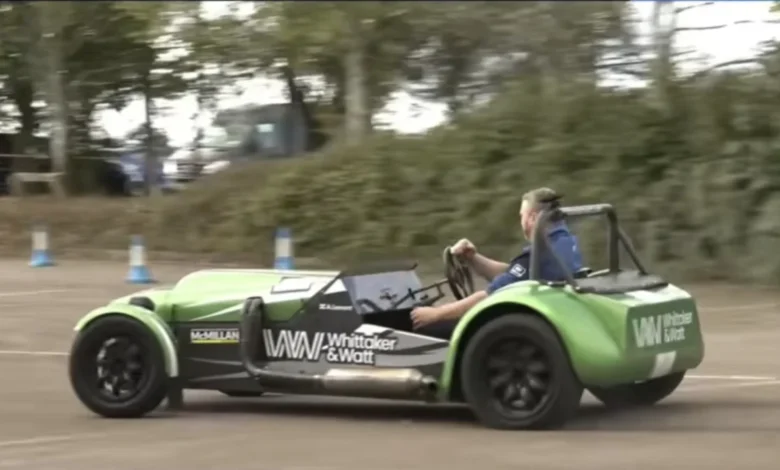
The 2026 iteration of the Ken Wharton Autotest saw a dominant display by the Northern Ireland team, headlined by Ashley Lamont. In a sport where even a two-second penalty for hitting a cone can cost a team the championship, Lamont’s performance was statistically and visually remarkable. Completing his course in a blistering 71.3 seconds, Lamont piloted his bright green Caterham—a vehicle renowned for its go-kart-like handling—with a level of fluidity rarely seen in the discipline.
In professional autotesting, the "flow state" is the ultimate goal. Most drivers exhibit a rhythmic stop-start style, pausing momentarily to rotate the car before accelerating again. Lamont, however, demonstrated a technique characterized by constant momentum. By balancing the weight of the Caterham on the edge of its traction limit, he was able to link turns together, effectively shortening his path through the course. This efficiency not only secured the victory for Northern Ireland but also provided a masterclass in vehicle dynamics for spectators and fellow competitors alike.
Comparative Analysis: Autotest vs. Traditional Motorsport
When analyzing the impact of autotesting on the broader automotive world, it is necessary to contrast it with traditional circuit racing. In Formula One or endurance racing, the objective is to maintain speed through sweeping corners. In autotesting, the objective is to maintain control while constantly disrupting the vehicle’s balance.
The transmission and drivetrain components of an autotest vehicle endure stresses far greater than those seen in standard track days. The constant shifting between first gear and reverse, combined with the high-torque maneuvers required to whip the car around a cone, necessitates specialized gearboxes and reinforced drive shafts. Industry experts often point to autotesting as the most rigorous form of stress testing for a vehicle’s steering and suspension geometry. Data gathered from these events often informs the development of road-going sports cars, particularly regarding steering rack ratios and chassis balance.
Chronology of the Ken Wharton Memorial
- 1962: The inaugural memorial driving tests are organized by the Hagley & District Light Car Club to honor the legacy of Ken Wharton.
- 1980s–1990s: The competition shifts from informal club gatherings to a formalized regional championship, attracting specialized "special" builds.
- 2010s: The advent of high-definition video documentation brings international attention to the event, with YouTube clips of the competition garnering millions of views.
- 2026: Northern Ireland secures a historic victory, with Ashley Lamont setting a benchmark for speed and technical precision that recalibrates expectations for the sport.
The Role of Technology and Spectatorship
The rise of digital media has fundamentally changed the landscape of the Ken Wharton Autotest. Historically, the event was a localized affair, known only to those within the British motorsport community. Today, it serves as a viral sensation. High-speed, high-resolution cameras allow viewers to study the minute adjustments made by drivers, from the twitch of the steering wheel to the precise modulation of the brake pedal.
This shift has also benefited the event’s organizers. Increased viewership has attracted interest from niche automotive manufacturers and technical sponsors, providing the financial support necessary to maintain the high standards of the course layouts. Furthermore, the role of the camera operators has become an integral part of the event’s success, as they must anticipate the driver’s movements to capture the nuance of a maneuver that occurs in a fraction of a second.
Implications for the Future of Grassroots Racing
The success of the 2026 competition highlights a growing trend in global motorsport: a return to "low-cost, high-skill" events. As the costs associated with traditional circuit racing continue to climb, grassroots disciplines like the Ken Wharton Autotest offer a sustainable alternative that rewards talent over budget.
Representatives from the Hagley & District Light Car Club have noted that the influx of younger drivers—many of whom grew up watching professional gymkhana videos online—has injected new energy into the sport. These younger competitors bring a different perspective on vehicle control, often pushing the limits of the machines further than their predecessors.
The implications for the automotive industry are equally significant. As the transition to electric vehicles (EVs) accelerates, the Ken Wharton Autotest provides a unique laboratory for testing the torque-vectoring capabilities of electric motors. An electric drivetrain, with its ability to provide instant, precise power to individual wheels, is theoretically ideal for the tight, technical requirements of an autotest course. It is likely that the next decade will see a shift in the "specials" category, with electric motors replacing the traditional internal combustion engines, potentially changing the physics of the sport once again.
Final Assessment
The Ken Wharton Autotest remains a singular entity in the world of competitive driving. It is a sport that strips away the vanity of high-speed aerodynamics and long straights, forcing the driver to engage in a raw, intimate conversation with their machine. The victory of Ashley Lamont in 2026 serves as a testament to the fact that, regardless of the era, the combination of driver talent, mechanical sympathy, and the quest for the perfect line will always remain the heartbeat of motorsport. As the sport looks toward a future defined by new technologies and a growing global audience, the principles established by the Hagley & District Light Car Club nearly 65 years ago—precision, consistency, and the mastery of the machine—remain as relevant as ever. Whether in a quiet parking lot in the English countryside or on a global digital stage, the autotest proves that true performance is not measured by the top speed on a dashboard, but by the grace with which a driver navigates the chaos of the course.