The 1953 Cadillac Elegante One-Off Concept Car Smashes Auction Records With A $1,275,000 Sale

The landscape of American automotive collecting shifted significantly this week as Kruse Auctions finalized the sale of a singular, gold-plated masterpiece: the 1953 Cadillac Elegante. Hammering at a staggering $1,275,000, the sale established a new high-water mark for the Cadillac brand at public auction. This transaction not only eclipsed the previous record of $940,000—held by a 1934 V16 Fleetwood Aerodynamic Coupe since 2023—but also signaled a robust, growing appetite among high-end collectors for bespoke, coachbuilt American history that has remained sequestered from the public eye for generations.
The Elegante is not merely a vehicle; it is a profound testament to the post-war era of automotive excess and craftsmanship. Constructed on a Series 62 chassis, the car represents a collaborative bridge between Detroit’s mechanical prowess and Italian design sensibilities. The bodywork was masterfully shaped by the renowned Carrozzeria Motto in Turin, Italy. Unlike mass-produced luxury vehicles of the era, the Elegante was a singular, hand-formed work of art, a "dream car" intended to showcase the zenith of Cadillac’s potential. Having spent roughly 73 years largely out of the public view, its appearance at the Auburn, Indiana auction block served as a major event for historians and enthusiasts alike.
A Chronology of Craftsmanship and Restoration
The story of the Elegante began in the early 1950s, a period defined by the ambition of American manufacturers to compete with European design houses. The project was spearheaded by the legendary designer Albrecht von Goertz. Early in his career, von Goertz sought to create a vehicle that balanced American power with European grace. This project acted as a cornerstone in his professional ascent, eventually leading to his iconic work on the BMW 507.
The production process was an exercise in extreme dedication. Carrozzeria Motto required 30 months of intensive labor to sculpt the aluminum body. In the currency of the 1950s, the development cost reached approximately $30,000—a figure that, when adjusted for inflation, highlights why this project remained a one-off rather than a production line model. The intention had been to produce a limited run of ten vehicles, but economic realities and the extreme technical demands of the construction rendered further iterations impossible.
The vehicle’s history was not without tragedy. Decades after its debut at the 1955 New York International Auto Show, the car suffered significant damage during Hurricane Andrew. This event marked a turning point in the vehicle’s provenance. Rather than succumbing to the elements, the car underwent a painstaking 16-year restoration process. The project, which concluded in 2014, was designed to return the Elegante to its exact factory-original specification. With only 4,331 documented miles on the odometer, the car offered prospective buyers a rare combination of mechanical integrity and historical preservation.
Engineering and Aesthetic Specifications
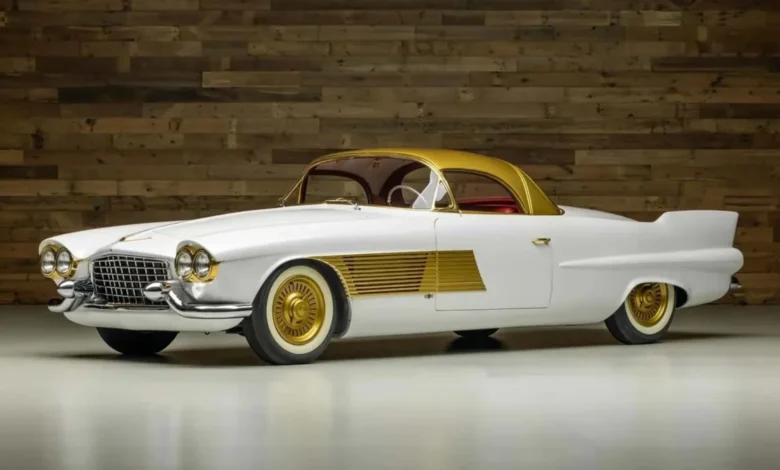
The Elegante is defined by a design language that Kruse Auctions characterized as "inconspicuous luxury, exclusivity, and theatrics." The exterior is finished in a pearlescent white, serving as a clean canvas for the extensive use of 24-karat gold plating. The gold accents are not merely superficial; they are integrated into the door handles, the windshield frame, and various custom bronze components. This gold-on-white aesthetic is balanced by a gold-colored roof, creating a cohesive visual identity that was considered daring in the mid-1950s.
Under the hood lies a 5.4-liter overhead-valve V8 engine. Capable of producing approximately 210 horsepower, the powertrain was intended to provide a refined, smooth driving experience commensurate with the car’s visual opulence. The car also features an advanced-for-the-time electro-hydraulic retractable hardtop, a feature that further underscored the experimental nature of the build.

The interior is equally luxurious, featuring deep burgundy Italian leather that contrasts sharply with the exterior palette. Perhaps the most distinct feature is the Lucite steering wheel, which houses an illuminated Saint Christopher medallion—a hallmark of bespoke design from that era. These small, intricate details demonstrate the level of attention paid to the vehicle’s occupants, prioritizing tactile and visual refinement.
Market Implications and Collector Sentiment
The $1.275 million sale price carries significant implications for the broader classic car market. While many collectors have historically focused on European marques like Ferrari, Bugatti, or Mercedes-Benz for seven-figure investments, the success of the Elegante suggests a recalibration of value for American coachbuilt customs.
Market analysts observe that the appetite for "one-off" vehicles has seen a notable uptick. As the inventory of historically significant production cars becomes increasingly concentrated in private collections or museums, investors are turning toward unique, documented projects with clear provenance. The Elegante’s record-breaking price serves as a benchmark, indicating that provenance—the ability to trace a car’s history from the initial design sketches to its most recent restoration—is now a primary driver of valuation.
The fact that the Elegante had not been offered for public sale in seven decades added an element of scarcity that drove competitive bidding. In the world of high-end auctions, the "freshness" of an item—its absence from previous auction cycles—is a critical factor in achieving premium results. By centering their event around this singular lot, Kruse Auctions successfully tapped into a niche segment of the market that values historical narrative as much as physical performance.
Expert Perspectives and Future Outlook
Industry observers note that the Elegante’s success provides a "trickle-down" effect for the rest of the classic car hobby. Owners of secondary or tertiary custom projects, which might have previously been dismissed as "old Cadillacs" or forgotten shop relics, may now find renewed interest in conducting thorough research on their vehicle’s origins. The sale highlights the importance of documentation; without the detailed history of the car’s construction and the meticulous records of its 16-year restoration, the Elegante would likely not have commanded such a high valuation.
Furthermore, the sale validates the work of independent designers and Italian coachbuilders who worked with American firms during the mid-20th century. By bringing the car to the auction block, the organizers provided a rare opportunity for both the public and private collectors to witness a bridge between two distinct automotive worlds.
Looking forward, the auction of the 1953 Cadillac Elegante may influence how auction houses curate their high-profile sales. There is a demonstrable shift away from standard production models—even rare ones—toward vehicles that represent singular expressions of automotive engineering. As collectors look for assets that offer both aesthetic beauty and historical rarity, the Elegante stands as a definitive case study in the power of the "one-off" custom.
The final price paid for the Elegante is not just a reflection of its gold-plated trim or its mechanical specifications; it is a reflection of its status as an irreplaceable piece of industrial art. For the collector who secured the winning bid, the acquisition is an entry into an elite tier of ownership, one that preserves a unique moment in 1950s design. As the dust settles on the Auburn auction, the legacy of the Elegante is firmly secured, setting a new standard for what it means to possess a piece of American luxury history. Whether this record will be broken again in the near future remains a matter of market volatility, but for now, the 1953 Cadillac Elegante remains the undisputed king of the auction block.
Related posts: