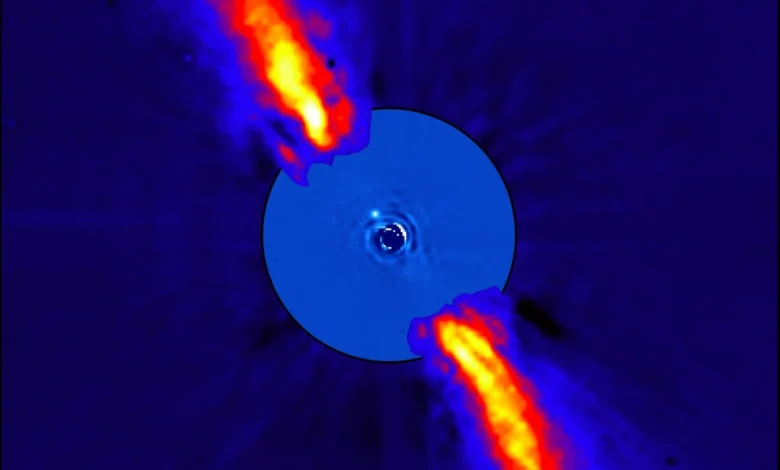
The discovery of predominantly amorphous water ice within the debris disk of Beta Pictoris, a young and iconic planetary system located approximately 64 light-years from Earth, has provided astronomers with a new window into the chemical origins of planetary formation. By analyzing spectral data, a research team led by scientists at the University of Bologna has concluded that the composition of this distant disk is largely composed of disordered, glass-like water ice rather than the orderly crystalline structures previously predicted by theoretical models. This finding suggests that the icy building blocks of this system—and potentially many others—may have originated in the cold, vast expanse of the interstellar medium long before the star itself coalesced.
The Mystery of the Missing Crystalline Peak
In standard astrophysical models of planetary formation, water ice existing in debris disks is expected to undergo a phase transition. As temperatures rise during the collapse of a stellar nebula or through exposure to stellar radiation, amorphous ice—which forms when water molecules freeze rapidly in extreme cold—should rearrange into a structured crystal lattice. Crystalline ice leaves a distinct spectroscopic signature, specifically a sharp, identifiable peak just above the 3-micrometer wavelength.
When researchers turned the instruments of the James Webb Space Telescope (JWST) toward Beta Pictoris, they were looking for this specific signal. Instead, the data revealed an almost total absence of the expected peak. The team estimates that less than 7 percent of the water ice in the system is crystalline. This deviation from established models indicates that the environment within the Beta Pictoris disk is either significantly colder than anticipated, maintaining temperatures below 100 Kelvin (minus 173 degrees Celsius), or that the ice is being constantly processed and replenished in a way that prevents the transition to a crystalline state.
Chronology of Observations and the Beta Pictoris Context
Beta Pictoris has long been a primary subject of study for exoplanetary science. As a relatively young star, roughly 20 to 25 million years old, it represents a critical stage of planetary development—the era when the "leftover" material from the star’s birth is being organized into planets, asteroids, and comets.
The history of research into this system is a record of increasingly granular observation:
- 1984: Beta Pictoris becomes the first star discovered to have a circumstellar debris disk, providing the first direct evidence that planetary systems are common throughout the galaxy.
- 2000s: Ground-based and early space-based infrared telescopes begin to identify the presence of gas and dust within the disk, suggesting a high rate of collisions between larger bodies.
- 2023-2024: The JWST initiates a series of high-resolution observations targeting the chemical composition of the disk, specifically focusing on volatile compounds like water and carbon monoxide.
- 2026: The publication of findings in the journal Science (DOI: 10.1126/science.adw7770) formally characterizes the amorphous nature of the disk’s ice, shifting the paradigm for how we interpret the chemical history of young solar systems.
Constant Collisions: The Mechanics of Persistence
One of the central challenges in explaining this discovery is the durability of amorphous ice. If the disk is subjected to high-energy ultraviolet radiation, cosmic rays, and stellar winds—all of which are present in a system with a young, active star—the amorphous structure should be destabilized. The research team posits that the only way to maintain such a high proportion of amorphous ice is through a constant cycle of destruction and replenishment.
The model proposed suggests that the disk is a "collision factory." Frequent impacts between larger icy planetesimals shatter these bodies, exposing fresh, pristine ice that had been shielded from the harsh radiation environment of the disk’s outer edges. This mechanism not only explains the presence of the amorphous ice but also provides a source for the carbon monoxide gas detected in the system, which would otherwise be depleted by stellar radiation over time.
Evidence for this violent process is not merely theoretical. Previous infrared imaging of the southwestern arm of the disk revealed a curved, lopsided streak of dust. Astronomers interpret this feature as the "smoking gun" of a major collision between planetesimals occurring roughly halfway between the star and the edge of the disk. These events are not anomalous; they are fundamental to the evolution of the system.
Implications for Planetary Habitable Zones
The findings at Beta Pictoris carry significant weight for the broader search for life. If the ice found in this system is indeed "primordial"—meaning it was inherited from the interstellar cloud that gave birth to the star—then the chemical ingredients for water-rich worlds are likely a standard feature of star formation.
Interstellar ice is known to be a rich substrate for complex organic chemistry. If these same icy grains are being incorporated into forming planets across the galaxy, the raw materials necessary for potential habitability may be much more common than previously assumed. This discovery links the microscopic structure of ice in a distant debris disk to the macro-level potential for life on rocky, terrestrial planets.
Limitations and Future Directions
While the research provides a compelling narrative, the team acknowledges several limitations. The current spectroscopic resolution does not allow for a precise quantification of every volatile compound present. There remains a possibility that other, unidentified molecules are mixed within the icy dust, which could alter the interpretation of the thermal environment.
Furthermore, the team cannot yet rule out specific localized effects that might prevent crystallization in ways not accounted for in current models. Future observations, perhaps using instruments with even higher sensitivity in the mid-infrared range, will be required to map the spatial distribution of these different ice phases more accurately.
Analysis of the Scientific Consensus
The scientific community has reacted with cautious optimism to the findings. By bridging the gap between interstellar chemistry and planetary formation, the work conducted by Betti and colleagues provides a necessary update to the "Standard Model" of debris disks. The realization that these systems are highly dynamic—subject to constant collisional processing—shifts the focus from static snapshots of planetary systems to a more fluid, evolutionary view.
"We are essentially looking at the recycling process of a planetary system," noted an independent observer in the field of exoplanetary science. "The fact that this ice is ‘old’—older than the planets themselves—tells us that the chemical history of a star system is written in its earliest days and preserved through the violence of its own maturation."
Conclusion
As the investigation into Beta Pictoris continues, the implications of this study extend far beyond the specific characteristics of one star system. By confirming that amorphous ice is a dominant component of the debris disk, researchers have confirmed that the materials that populate our own solar system are not necessarily unique. Instead, they appear to be part of a universal distribution of primordial matter. Whether these icy grains eventually coalesce into oceans on habitable planets remains a question for future exploration, but the path toward answering it has become significantly clearer. The data from the 2026 study serves as a foundational reference point for the next generation of planetary science, ensuring that as we look further into the cosmos, we understand the chemical heritage that binds distant stars to our own.
Related posts: