
Crypto Giants Coinbase, Robinhood, and Circle Release Divergent Q3 2026 Earnings Amid Rising Interest Rate Pressures and Evolving Market Dynamics


The release of third-quarter financial results for 2026 by leading cryptocurrency and fintech infrastructure giants Coinbase, Robinhood, and Circle has laid bare the complex realities of operating within a rapidly maturing digital asset economy. As macroeconomic shifts—most notably the anticipated trajectory of global interest rate cuts—begin to ripple through the financial sector, these three prominent institutions have charted notably distinct operational paths. While net revenues and profitability metrics experienced divergent shifts, the overarching theme points to a strategic transition from high-beta trading-fee reliance toward diversified, recurring revenue models.
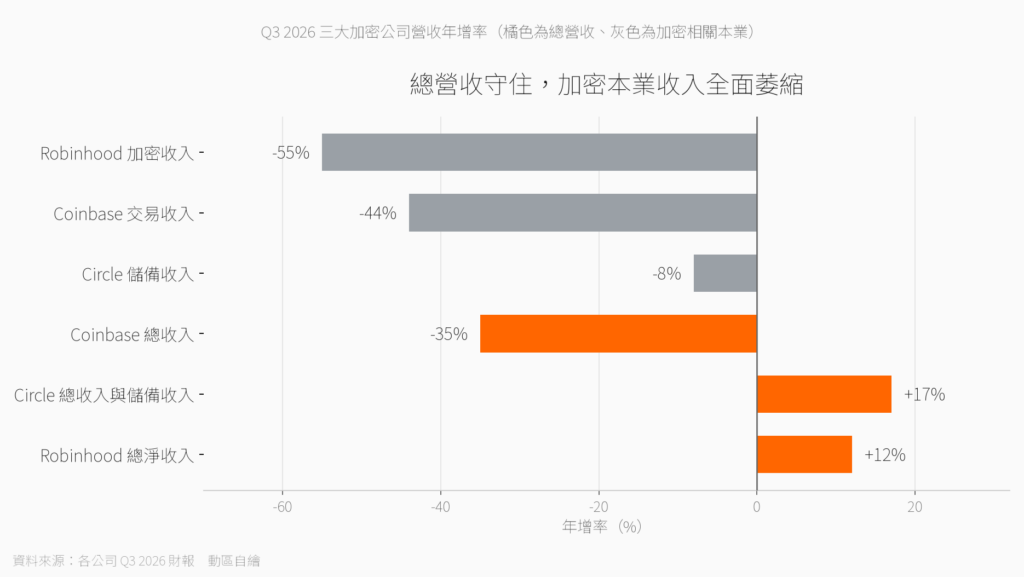
According to regulatory filings and official financial disclosures, Coinbase reported total net revenues of $1.216 billion for the quarter ending September 30, 2026, marking a 35% year-over-year decline. Within this figure, transaction revenue stood at $590 million, down 1% quarter-over-quarter but sliding 44% compared to the same period last year. Subscription and services revenue continued to provide a crucial stabilizing buffer, coming in at $570 million, up 3% quarter-over-quarter and 49% higher than the previous year. Meanwhile, custodial fee revenue reached $307 million, up 5% sequentially, supported by roughly 8,600 institutional clients and crypto-backed corporate financing programs generating $69 million in revenue. Despite a net loss under GAAP accounting rules of $719 million—heavily impacted by a $251 million impairment charge on crypto asset holdings and a $715 million tax valuation allowance adjustment—Coinbase’s adjusted EBITDA told a more resilient story, surging 99% year-over-year to $780 million. Adjusted EBITDA margin for the quarter reached 60%, amounting to $3.33 billion over the trailing twelve months.
Robinhood, meanwhile, posted a robust growth narrative across its quarterly metrics. Total net revenues climbed to $1.42 billion, representing a 12% year-over-year increase. Transaction-based revenues reached $867 million, up 19% from the previous year, while options trading revenue contributed $1.73 billion, up 6% over the same period. Cryptocurrency trading revenue hit $399 million, surging 31% year-over-year, and net interest revenues came in at $1.21 billion, up 41%. Custody and other related fee lines experienced a 55% year-over-year contraction down to $1.2 billion, while net deposit inflows remained strong at $4.15 billion for the quarter, lifting total platform assets under custody to a record high of $39.6 billion, up 19% year-over-year.
Circle’s Q3 2026 earnings statement similarly captured a transitional phase. Total net revenues and reserve income reached $865 million, marking a 17% increase year-over-year. Adjusted EBITDA stood at $317 million, reflecting an 85% surge, while net income rose 5% to $226 million. However, net interest revenue on USDC reserves dropped 8% sequentially to $658 million, reflecting the ongoing pressure from central bank interest rate cuts enacted over the prior 61 business days. Despite this headwind, total USDC circulation rose by 8% year-over-year to $73.9 billion, while stablecoin-powered transaction volume across its ecosystem climbed 27% to 183 billion transactions.

Macroeconomic Pressures and the Changing Stablecoin Landscape
The underlying catalyst connecting the Q3 2026 performance of these major industry players is the shifting monetary policy environment. Following years of aggressive central bank tightening to combat persistent inflation, global monetary authorities have shifted toward a loosening cycle. For stablecoin issuers and crypto-native platforms alike, this structural shift poses a direct challenge to the high-yield interest revenue models that characterized the previous bull market cycle.
Circle, whose primary business model relies on the yield generated from reserves backing its flagship stablecoin USDC, has experienced the direct impact of declining interest rates. Although USDC circulation experienced strong quarter-over-quarter growth, rising to nearly $74 billion, the yield compression has squeezed net interest margins. In response, Circle has accelerated its strategic diversification efforts, expanding payment rails globally through initiatives such as the Tazapay acquisition framework and the continued scaling of its programmable wallet infrastructure.
Coinbase has faced similar headwinds regarding its transaction-driven business model, which historically thrived during periods of heightened retail market volatility and speculative trading mania. In response, the exchange has pursued an "Everything Exchange" strategy, integrating prediction markets via partnerships with platforms like Kalshi, expanding derivatives trading capabilities, and enhancing institutional custody offerings. By positioning itself as a comprehensive financial infrastructure provider rather than a pure-play retail exchange, Coinbase aims to smooth out the cyclical revenue volatility that has historically plagued the digital asset sector.
Robinhood’s diversified product ecosystem has insulated it somewhat from pure crypto market volatility. By successfully blending traditional equities trading, options, cryptocurrency brokerage, and cash management services, the fintech giant has maintained consistent top-line growth. Nevertheless, its expanding focus on digital assets—highlighted by increased crypto trading volumes and native wallet integrations—underscores the growing convergence between traditional brokerages and decentralized finance infrastructure.
Chronology of Strategic Developments Leading into Q3 2026
The trajectory leading up to the third-quarter earnings reports was shaped by several critical milestones across the industry. Throughout mid-2025 and 2026, the regulatory landscape in major Western jurisdictions began to provide clearer compliance frameworks for digital asset custodians and stablecoin issuers. This regulatory clarity encouraged broader institutional participation, even as macroeconomic volatility challenged traditional revenue streams.

In late 2025, Circle navigated significant market speculation surrounding Federal Reserve rate cut trajectories, which analysts estimated could compress USDC reserve yields by up to 1% for every 100-basis-point reduction in the federal funds rate. Despite these concerns, Circle continued to scale its enterprise payments division, launching cross-border settlement solutions and partnering with major fintech providers to drive utility.
Simultaneously, Coinbase expanded its product suite aggressively. By integrating prediction markets through a strategic partnership with Kalshi and scaling its derivatives and layer-2 solutions, the company positioned itself to capture diverse revenue streams. Institutional adoption remained a key growth driver, with corporate treasury allocations and institutional custody mandates hitting record highs by mid-2026.
Robinhood’s operational chronology featured sustained international expansion and product diversification. The successful rollout of its desktop trading platform, expansion into international markets, and introduction of advanced options trading tools helped drive consistent net deposit inflows, solidifying its position as a preferred gateway for both retail and emerging professional traders.
Supporting Financial Data and Comparative Metrics
A granular examination of the Q3 2026 financial disclosures reveals distinct operational efficiencies across the three firms:
- Coinbase: Total net revenues of $1.216 billion (-35% YoY); Transaction revenue of $590 million (-44% YoY); Subscription and services revenue of $570 million (+49% YoY); Custodial fee revenue of $307 million (+5% YoY); Adjusted EBITDA of $780 million; GAAP net loss of $719 million.
- Robinhood: Total net revenues of $1.42 billion (+12% YoY); Transaction-based revenues of $867 million (+19% YoY); Crypto trading revenue of $399 million (+31% YoY); Net interest revenues of $1.21 billion (+41% YoY); Net deposits of $4.15 billion; Platform assets under custody at $39.6 billion (+19% YoY).
- Circle: Total net revenues and reserve income of $865 million (+17% YoY); Net interest revenue on reserves of $658 million (-8% QoQ); Adjusted EBITDA of $317 million (+85% YoY); Net income of $226 million (+5% YoY); USDC circulation at $73.9 billion (+8% YoY).
Institutional investor reactions to these reports varied across Wall Street. Following the earnings announcements, several major financial institutions adjusted their price targets for Coinbase and related crypto equities. Oppenheimer, for instance, maintained an optimistic outlook on crypto-native financial infrastructure, adjusting Coinbase’s price target upward to reflect long-term growth in institutional custody and recurring service revenues, even as short-term trading volumes experienced cyclical compression.
Broader Market Impact and Future Outlook
The Q3 2026 financial disclosures from Coinbase, Robinhood, and Circle illustrate an industry undergoing structural maturation. While declining interest rates and fluctuating retail trading volumes present ongoing challenges, the diversification of revenue streams toward recurring software, subscription, custody, and enterprise payment services has provided a robust cushion against cyclical downturns.
As central banks globally navigate monetary policy adjustments, the long-term outlook for digital asset infrastructure providers hinges on their ability to innovate beyond speculative trading fees. For stablecoin issuers like Circle, scaling transaction utility and expanding cross-border payment rails will remain paramount. For multi-asset platforms like Coinbase and Robinhood, capturing institutional market share while maintaining retail engagement will dictate their trajectory through the remainder of the decade.