ISpring Water Systems Launches BRO900: A Professional Marine Desalination System Set to Transform Off-Grid Cruising


For seasoned mariners, commercial crews, and coastal residents navigating the unpredictable expanses of the open ocean, the availability of fresh, potable water has always been a critical operational priority. Long considered as precious as gold, an independent and reliable source of drinking water dictates the length, safety, and comfort of any maritime voyage. Historically, sailors have had to meticulously calculate payload limits, weigh fuel efficiency against massive freshwater storage capacities, and frequently ration their supplies during extended offshore expeditions. To alleviate these perennial maritime challenges, iSpring Water Systems, an established industry leader in advanced water filtration and treatment, has officially announced its strategic expansion into marine-grade applications. The centerpiece of this industrial pivot is the introduction of the BRO900, a high-capacity, professional-grade seawater desalination system engineered specifically to convert harsh, saline ocean water into clean, safe, and great-tasting drinking water for vessels of all sizes.
The debut of the BRO900 marks a significant milestone in the evolution of onboard water management technology. Scheduled for an official global launch on October 20, 2026, the system represents years of research and development aimed at scaling domestic and industrial filtration expertise into a compact, ruggedized unit capable of withstanding the punishing realities of the marine environment. As commercial shipping, private yachting, and off-grid living continue to grow in popularity, the demand for decentralized, highly efficient utility systems has never been higher. By providing an on-demand purification solution that operates seamlessly while a vessel is underway, iSpring aims to redefine the boundaries of modern navigation, offering mariners the freedom to extend their cruising ranges without the traditional burden of massive water storage tanks.
Engineering Excellence: The 5-Stage Purification Architecture
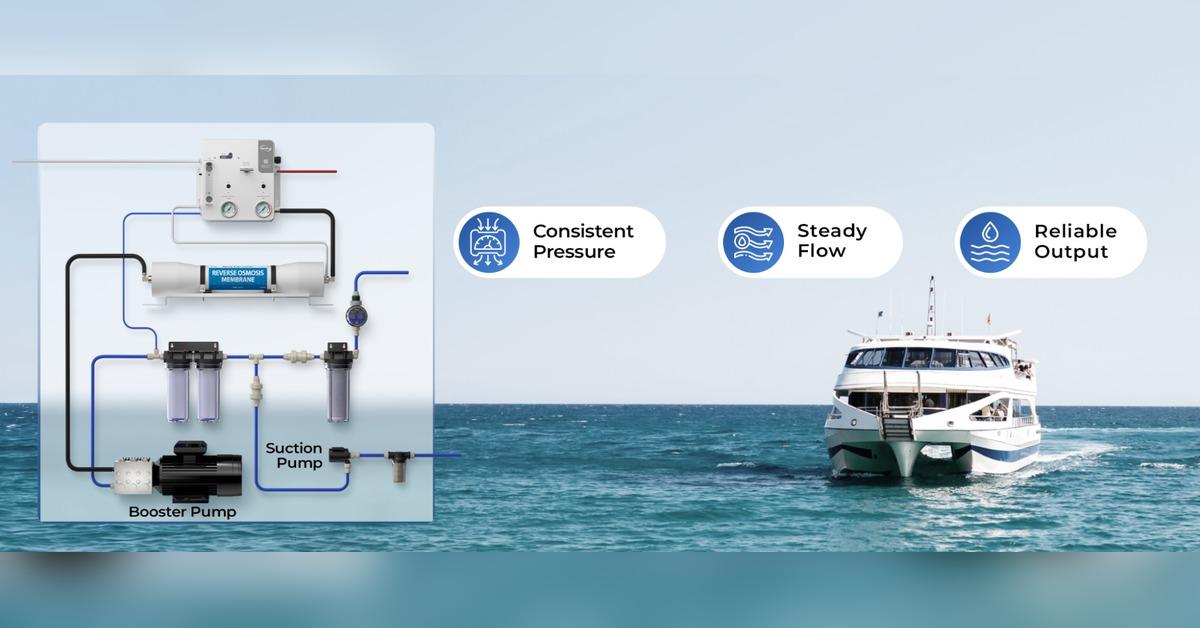
At the core of the iSpring BRO900’s superior performance is a sophisticated, multi-tiered filtration architecture designed to systematically dismantle and remove the complex array of impurities found in natural seawater. The system utilizes a rigorous 5-stage purification process, beginning with an industrial-grade stainless-steel mesh filter that intercepts large suspended solids, marine debris, and particulate matter. Following this initial physical barrier, the water passes through a 20-micron polypropylene (PP) filter and subsequently a 5-micron PP filter, progressively capturing finer sediments, sand, and microscopic biological matter that could otherwise compromise downstream components.
The cornerstone of the desalination process is the integration of an advanced reverse osmosis (RO) membrane. Operating under intense pressure, this specialized semi-permeable membrane acts as an impenetrable barrier against up to 99% of dissolved salts, total dissolved solids (TDS), heavy metals, and emerging chemical contaminants such as per- and polyfluoroalkyl substances (PFAS). However, iSpring’s engineering team recognized that physical and chemical filtration alone is insufficient for complete biological safety in marine environments. To address this, the BRO900 incorporates a built-in ultraviolet (UV) LED module housed securely within the primary control box. This final germicidal stage neutralizes lingering bacteria, viruses, and residual microorganisms, ensuring that the output water meets the highest standards of public health and potable safety.

Overcoming Marine Dynamics: Dual-Pump Innovation and Pressure Management
One of the most persistent engineering hurdles in marine desalination is maintaining a consistent water feed while a vessel is actively navigating. Changing sea states, vessel speed, and the natural rolling and pitching of a hull cause continuous draft fluctuations, which frequently disrupt raw water intake and destabilize traditional filtration systems. If left unmanaged, these fluctuations lead to pressure drops, membrane fouling, and inconsistent water production.
To counteract these dynamic environmental variables, the iSpring BRO900 is equipped with a dual-pump configuration consisting of a dedicated suction pump and a high-performance booster pump. The initial suction pump is engineered to draw a steady, uninterrupted volume of seawater into the system, ensuring an optimal flow rate regardless of whether the vessel is anchored in a calm cove or battling rough offshore swells. Once the intake is stabilized, the high-pressure booster pump elevates the internal operating pressure to between 600 and 900 psi—with a standard operational sweet spot around 800 psi. This immense pressure is necessary to overcome the natural osmotic pressure of seawater, forcefully driving the fluid through the RO membrane and initiating the rapid production of purified freshwater.
Smart Control Interface and Automated Maintenance Protocols
Operating complex machinery in a marine environment requires intuitive interfaces that allow crew members to monitor system health at a glance without requiring specialized engineering degrees. The BRO900 features a centralized, smart control box equipped with a comprehensive suite of analog and digital diagnostic tools. Operators have real-time visibility over critical performance metrics via a live Total Dissolved Solids (TDS) display, an integrated RO flow meter, and dual pressure gauges that independently track intake pressure and reverse osmosis operating pressure. Furthermore, dedicated suction and RO pressure regulators grant crew members the precision needed to adjust system parameters dynamically in response to varying water temperatures, salinity levels, and coastal versus deep-sea environments.
Beyond operational monitoring, long-term maintenance remains a central focus of the BRO900’s design philosophy. Seawater is notoriously corrosive and mineral-rich; over time, retained salts, calcium scaling, and organic biofoulants inevitably accumulate on the surface of the RO membrane, drastically reducing filtration efficiency and accelerating wear. To mitigate this, iSpring has integrated an automated membrane flushing protocol into the BRO900 system. Users can easily program the unit to conduct an automated freshwater flush once a week, specifying exact duration parameters to scour away salt crystals and biological residues. For instances where unexpected heavy usage occurs, a manual override switch allows operators to initiate a deep flush cycle on demand, significantly extending the operational lifespan of the core membrane and minimizing the need for manual component replacements while at sea.

Durability and Material Science in Corrosive Marine Climates
The marine atmosphere is one of the most aggressive and destructive environments known to industrial material science. The combination of high ambient humidity, airborne salt spray, constant temperature fluctuations, and direct exposure to saline water accelerates metallic oxidation and structural degradation at rates exponentially higher than land-based applications. Recognizing these severe operating conditions, iSpring constructed the BRO900 using strictly marine-grade, corrosion-resistant materials designed to endure years of continuous exposure to salt water without compromising structural integrity.
In addition to chemical corrosion, onboard equipment must endure intense mechanical stress. Navigating rough seas subjects every component to relentless vibrations, sudden shocks, and physical impacts. The internal framework and external housing of the BRO900 are engineered with heavy-duty, impact-resistant mountings and stabilized internal plumbing. This robust construction safeguards sensitive sensors, high-pressure pumps, and electrical modules against the physical tumult of deep-water navigation, providing ship captains and private vessel owners with absolute peace of mind during extended offshore passages.
Broader Economic and Logistical Implications for the Marine Industry
The introduction of the iSpring BRO900 arrives at a time when the maritime industry is placing heightened emphasis on operational efficiency, weight reduction, and self-sufficiency. Historically, provisioning a vessel for a multi-week or transoceanic voyage required dedicating substantial cargo space and deadweight capacity to massive freshwater storage tanks. Water weighs approximately 8.34 pounds per gallon; carrying hundreds or thousands of gallons of freshwater drastically increases a vessel’s displacement, leading to measurably higher fuel consumption, increased carbon emissions, and severely restricted cruising ranges.
By delivering up to 900 gallons of pure, potable water per day on demand, the BRO900 effectively liberates vessels from the logistical tyranny of static water storage. The system’s compact, modular footprint allows it to be installed efficiently within tight engine rooms or utility lockers, freeing up valuable onboard space for essential navigation electronics, safety gear, spare parts, and extended provisions. From a broader economic perspective, the ability to generate fresh water locally reduces reliance on shoreside marinas—where freshwater hookup fees continue to rise—and empowers commercial fleets and private explorers to venture further into remote, off-grid waters with absolute autonomy. Furthermore, the availability of abundant, high-quality water transforms daily life onboard, eliminating the strict water-rationing protocols that traditionally plague long passages and facilitating seamless execution of essential tasks such as cooking, laundry, vessel cleaning, and personal hygiene.
Launch Timeline, Promotional Details, and Market Availability
As iSpring Water Systems prepares for the global commercial rollout of the BRO900, industry analysts and marine outfitters are closely monitoring the product’s market reception. Scheduled to officially launch on October 20, 2026, the system represents a calculated diversification for a brand traditionally recognized for residential and light-commercial under-sink filtration systems, whole-house water softeners, and UV disinfection units. By pivoting into the professional maritime sector, iSpring is positioning itself as a comprehensive water treatment authority capable of solving complex purification challenges across diverse environments.
To commemorate the launch and incentivize early adoption among boat owners, commercial operators, and marine contractors, iSpring has announced a limited-time promotional campaign. Beginning on launch day, October 20, and running through November 20, 2026, the company will offer a substantial $1,000 discount on the purchase price of the BRO900 through its official sales channels and authorized marine distributors. This introductory pricing strategy is expected to drive strong initial demand, encouraging maritime professionals to upgrade their aging onboard systems and adopt next-generation desalination technology ahead of the upcoming cruising seasons. As off-grid exploration and maritime tourism continue to expand, innovations like the iSpring BRO900 are poised to set a new benchmark for safety, reliability, and independence on the world’s oceans.