Tesla Deploys Mobile Superchargers and Speeds Up Permanent Stalls to Tackle Thanksgiving Travel Crush

As millions of Americans prepare to take to the highways for the Thanksgiving holiday, electric vehicle infrastructure is facing one of its most rigorous annual stress tests. Tesla has implemented a comprehensive, multi-layered holiday readiness strategy, deploying a fleet of mobile Supercharger stalls to notorious bottleneck locations while accelerating its permanent network expansion across the United States. This proactive approach marks a significant evolution in how the automaker manages predictable holiday traffic surges, combining temporary physical infrastructure, on-site personnel management, and advanced digital queueing systems.
The Foundation of the Holiday Strategy: Mobile Deployment
To mitigate anticipated congestion along critical travel corridors, Tesla has strategically positioned 29 temporary mobile Supercharger stalls across high-traffic routes in California and Arizona. While a modest figure in the context of a nationwide charging network, these mobile units are deployed with surgical precision at locations historically plagued by severe holiday bottlenecks.

The deployment is concentrated primarily within California’s Central Valley, a vital geographic bridge connecting the San Francisco Bay Area and the Greater Los Angeles metropolitan area. Over the past decade, this corridor has frequently witnessed multi-hour waiting times during major holiday weekends as drivers transit the state. According to data shared by Tesla’s official charging division, the mobile stalls are distributed across four key sites:
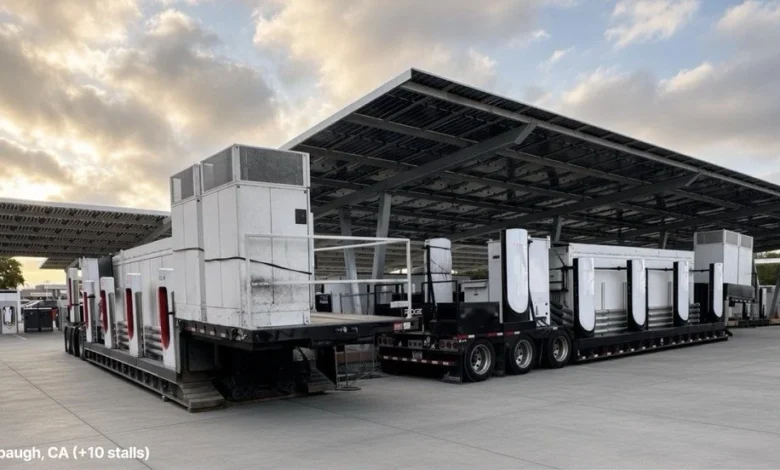
- Firebaugh, California: The largest recipient of the temporary expansion, receiving two flatbed trailers equipped with Supercharger posts and tall power cabinets, which collectively add 10 stalls beneath the station’s existing solar canopy.
- Bakersfield (Olive Drive), California: Receiving an additional eight stalls via a mobile trailer configuration.
- Bakersfield (Copus Road), California: Augmented by four temporary stalls placed directly on the pavement rather than on a trailer. This specific location has historically been a focal point for holiday traffic management; notably, Tesla offered free off-peak charging at this site during the 2021 Thanksgiving holiday to incentivize temporal shifting of demand.
- Holbrook, Arizona: The lone non-California site, receiving seven temporary stalls placed directly on the pavement. Located along Interstate 40, Holbrook serves as a crucial lifeline in northern Arizona for motorists traveling between Southern California and Albuquerque, where alternative fast-charging infrastructure is sparse.
Tesla has not officially disclosed whether these specific mobile units operate independently via onboard battery energy storage systems—similar to the Megapack-based mobile chargers deployed during previous holiday seasons—or if they tap directly into local grid infrastructure. Past deployments of battery-buffered trailers have occasionally encountered technical hurdles, most notably an incident involving a Megapack-based mobile charger catching fire at a station in Baker, California, on New Year’s Day in 2023. By refining these deployments, Tesla aims to harness the flexibility of mobile units while minimizing operational vulnerabilities.
Chronology of Infrastructure Growth and Recovery
The deployment of temporary stalls represents only a fraction of Tesla’s broader infrastructure push. The core of the company’s preparation relies on a robust acceleration of permanent Supercharger installations nationwide.

In the 56 days leading up to the late-November holiday travel window, Tesla reported the activation of 1,027 permanent Supercharger stalls across 91 sites throughout the United States. This represents an average deployment rate of approximately 18 stalls per day, with individual new sites averaging more than 11 stalls each.
This velocity indicates a notable rebound in deployment efficiency following a turbulent period in the company’s charging division. Earlier in the year, sweeping structural changes and workforce reductions—including the initial dismissal and subsequent restructuring of Tesla’s dedicated Supercharger development team—led to a noticeable deceleration in network growth. Industry analysts and market data from firms like Paren indicated that while Tesla maintained its leadership position in U.S. fast-charging deployment—adding 1,287 ports in the third quarter alone—the pace of expansion had temporarily slowed.
The recent surge to 18 stalls per day demonstrates that the restructured charging division has successfully scaled back up to, and potentially exceeded, historical deployment rates. When contextualized against competitors in the American charging ecosystem—such as IONNA and major retail partners like Walmart, which added 378 and 344 ports respectively in the third quarter—Tesla’s recent output highlights its continued dominance in raw infrastructural scaling.
Operational Enhancements: Attendants, Uptime, and Virtual Queues

Beyond physical hardware, Tesla’s Thanksgiving mitigation strategy incorporates advanced software solutions and human capital management to streamline the charging experience.
For the holiday travel window, the company has bolstered network uptime monitoring and accelerated service dispatch protocols to ensure malfunctioning stalls are swiftly repaired. Furthermore, Tesla has deployed on-site attendants at its historically busiest stations. These personnel are tasked with actively managing physical queues, directing incoming vehicles to available stalls, and maintaining orderly traffic flow to prevent gridlock at retail and highway plazas.
Complementing the physical attendants is the wider rollout of Tesla’s virtual queue system. First piloted in May at a selective group of five Supercharger locations—following increased consumer friction and reported altercations at crowded stations—the virtual waitlist has now been scaled to 300 sites nationwide. The system allows drivers to secure their place in line digitally via the vehicle’s navigation system or mobile app without needing to idle haphazardly in physical bottlenecks, thereby reducing driver stress and improving site efficiency.
Historical Context and Operational Scale

To fully appreciate the scope of Tesla’s current holiday preparations, it is necessary to examine the evolution of EV road-tripping over the past decade. During the early adoption phases of long-range electric vehicles—particularly around 2018 and 2019—holiday travel periods frequently resulted in severe bottlenecks. Motorists routinely reported waiting hours in Central California and along major interstate arteries simply to plug in, exposing the fragility of early charging networks.
Data from recent holiday travel periods underscores the sheer volume of energy distributed by the network. During the Wednesday-to-Sunday Thanksgiving window in 2025, Tesla’s U.S. network facilitated more than 2 million individual charging sessions and delivered in excess of 70 gigawatt-hours (GWh) of electricity. Crucially, the company reported that only 0.76% of those sessions involved a physical wait, a testament to the increasing density of the network.
Broader Implications for the EV Ecosystem
The aggressive ramp-up of permanent stalls and the tactical deployment of mobile infrastructure carry significant implications for the broader transition to electric mobility. Range anxiety and infrastructure reliability remain two of the primary psychological and logistical barriers for prospective EV buyers. By demonstrating a proactive, data-driven capacity to manage extreme demand spikes, network operators can foster greater consumer confidence in long-distance electric travel.

Furthermore, Tesla’s strategy of opening its proprietary Supercharger network to non-Tesla electric vehicles under various interoperability agreements increases the pressure on the network. As more automakers adopt the North American Charging Standard (NACS) and integrate into the Supercharger ecosystem, managing peak demand events like Thanksgiving and the winter holidays will require even higher densities of stalls and more sophisticated queue-management software.
The rapid deployment cadence observed in the final quarter of the year suggests that Tesla has re-established its infrastructural momentum. While 29 mobile stalls across four specific locations will not single-handedly transform national charging dynamics, they symbolize a shift from reactive crisis management to predictive logistics. As the electric vehicle market continues its maturation, the ability of charging network operators to seamlessly absorb massive, predictable surges in travel demand will serve as a key benchmark of industry success.