James Webb Space Telescope Captures the Cosmic Feline: Inside the Mid-Infrared Depiction of the Cat’s Head Nebula

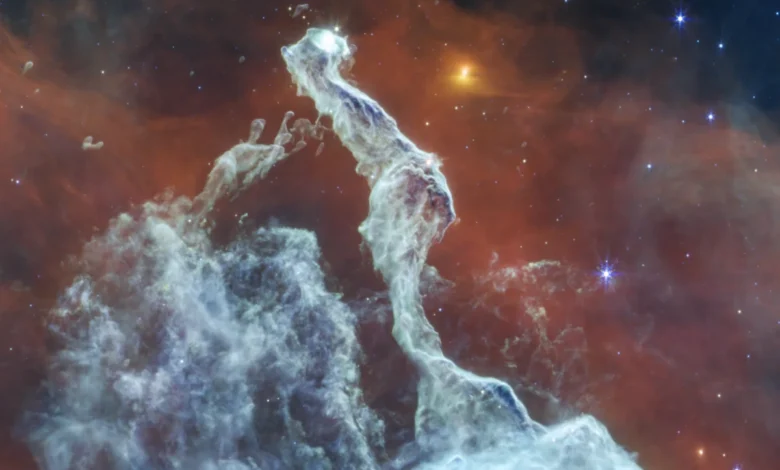
The James Webb Space Telescope (JWST) has once again expanded our understanding of stellar nurseries, returning a breathtaking mid-infrared portrait of the Cat’s Head Nebula. Released by NASA on October 29, 2026, the image provides unprecedented detail of the complex interplay between massive stars and the interstellar medium. Captured by Webb’s Mid-Infrared Instrument (MIRI), the data reveals intricate dust structures and glowing filaments that have long been obscured in optical wavelengths. Jointly operated by NASA, the European Space Agency (ESA), and the Canadian Space Agency (CSA), the observatory continues to redefine how astronomers study cosmic evolution, stellar feedback, and the lifecycle of nebulae located within the broader Carina complex.
Main Facts and Visual Anatomy of the Nebula
At the heart of the newly released JWST capture is a striking, bluish-gray filament of cosmic dust that stretches from the lower third of the frame nearly to the top. This dense structure possesses a narrow, irregular morphology that bears a remarkable resemblance to a cat sitting with its back turned toward the viewer. A distinct tail extends downward, widening into a triangular peak of dust, while the "head" turns toward the right to reveal a brilliant, white-glowing eye.
Flanking this feline-shaped pillar is a dome-shaped grouping of fainter dust filaments, set against a predominantly red backdrop that highlights the warm, glowing gas of the region. Scattered throughout the celestial canvas are numerous yellow and blue stars, many of which display Webb’s signature eight-point diffraction spikes.
According to astrophysicists, the distinctive shape of the Cat’s Head Nebula is not a random occurrence. Rather, it is the product of aggressive stellar erosion. Intense ultraviolet radiation and high-velocity stellar winds emanating from massive stars within the greater Carina Nebula have spent millions of years sculpting the surrounding gas and dust. While lighter, less dense material has been stripped away or vaporized by this stellar feedback, the denser pockets of gas—forming the cat-like silhouette—have successfully resisted the erosive forces, at least for the present epoch of stellar evolution.
Chronology and Observational History
The journey to understanding the Cat’s Head Nebula spans decades of technological advancement in space-based astronomy. While the region has been a subject of astronomical interest for years due to its proximity to the hyperactive Carina star-forming complex, earlier instruments lacked the sensitivity and wavelength coverage to pierce the thick dust veils hiding its inner mechanics.
In previous decades, NASA’s Hubble Space Telescope provided stunning optical and near-infrared views of the nebula, outlining its ghostly, translucent appearance against the cosmic background. Hubble’s observations were crucial in identifying the initial outlines of the feline structure and documenting the broader environment of the Carina region. However, optical telescopes are often limited by interstellar dust, which scatters and absorbs visible light, leaving the densest interiors opaque.
The deployment and subsequent commissioning of the James Webb Space Telescope in 2022 marked a paradigm shift. Operating primarily in the infrared spectrum, JWST was purposefully designed to peer through dense cosmic dust. By utilizing MIRI, scientists can now observe thermal emissions from cooler dust grains and embedded protostars that remain completely invisible to optical observatories. The October 2026 data release represents the culmination of targeted observational campaigns aimed at mapping stellar feedback loops, transforming a familiar celestial curiosity into a high-definition laboratory for plasma and dust physics.
Supporting Data and Technical Specifications
The technical prowess behind the Cat’s Head Nebula image relies on the sophisticated engineering of the James Webb Space Telescope and its instrument suite. MIRI, which captured the data, operates at cryogenic temperatures—keeping near absolute zero using a specialized helium closed-cycle mechanical cooler—to detect mid-infrared light ranging from 5 to 28 microns.
This wavelength range is critical for studying the thermal radiation emitted by polycyclic aromatic hydrocarbons (PAHs) and warm interstellar dust. In the Webb image, these complex carbon-based molecules trace the boundaries where stellar radiation interacts with cold molecular clouds.
Image processing played an equally vital role in translating raw digital telemetry into a scientifically rich and visually accessible portrait. Processed by Joseph DePasquale of the Space Telescope Science Institute (STScI), the dataset was assigned specific color filters to map different infrared wavelengths to visible color channels. This translation allows researchers and the public alike to visualize variations in temperature, density, and chemical composition across the nebula. The final composite integrates high-resolution data that underscores JWST’s capability to resolve structures on sub-light-year scales within distant star-forming regions.
Official Responses and Scientific Perspective
Astrophysicists and mission scientists have hailed the new MIRI data as a masterclass in illustrating stellar feedback—one of the most important regulatory mechanisms in galaxy evolution. Stellar feedback occurs when the energy poured into the interstellar medium by massive stars halts or triggers subsequent rounds of star formation.
While space agencies have not published formal political statements regarding the image, researchers associated with the STScI, ESA, and CSA have emphasized the broader implications of the data. In technical summaries accompanying the release, planetary and stellar formation experts noted that the survival of the dense dust pillars within the Cat’s Head Nebula offers a tangible window into how star clusters influence their local neighborhoods.
"The interplay between stellar winds and dense molecular clouds dictates the lifetime of a stellar nursery," noted a computational astrophysics researcher familiar with Carina region dynamics. "Images like this provide the empirical constraints we need to test models of photoevaporation and dust destruction. We are watching a cosmic tug-of-war in real-time."
Furthermore, educators and public outreach teams have embraced the "Cat’s Head" moniker as an effective gateway for science communication. Pareidolia—the psychological tendency to perceive meaningful shapes in random visual patterns—frequently helps bridge the gap between complex astrophysical data and public engagement, drawing broader audiences into discussions about stellar evolution and space exploration.
Broader Impact and Implications for Astronomy
The observation of the Cat’s Head Nebula extends far beyond aesthetic appreciation; it holds significant value for understanding the lifecycle of matter in the universe. Stars are born from the gravitational collapse of cold gas and dust clouds. However, once massive stars ignite within these nurseries, they begin a destructive feedback cycle that can eventually blow away the remaining raw material, effectively shutting down star formation in that specific pocket.
By studying how features like the Cat’s Head withstand this intense radiation, astronomers gain critical insights into the timescales of cloud dispersion. This has direct implications for galaxy evolution models, as the balance between star formation and stellar feedback determines how efficiently galaxies consume their gas reserves over billions of years.
As the James Webb Space Telescope continues its extended mission, targets within the Carina Nebula and similar complexes will remain high-priority objectives. Each new MIRI dataset refines our comprehension of the chemical enrichment of the interstellar medium, tracing how heavy elements forged in stellar cores are redistributed to seed future generations of stars and planets. The Cat’s Head Nebula stands as a vivid testament to these invisible forces—a ghostly, resilient monument sculpted by starlight and captured for posterity by humanity’s most advanced infrared observatory.
Related posts: