NASA Chandra X-ray Observatory Unmasks Hidden Compact Companion Fueling Luminous Outbursts in Giant Star AT 2016blu

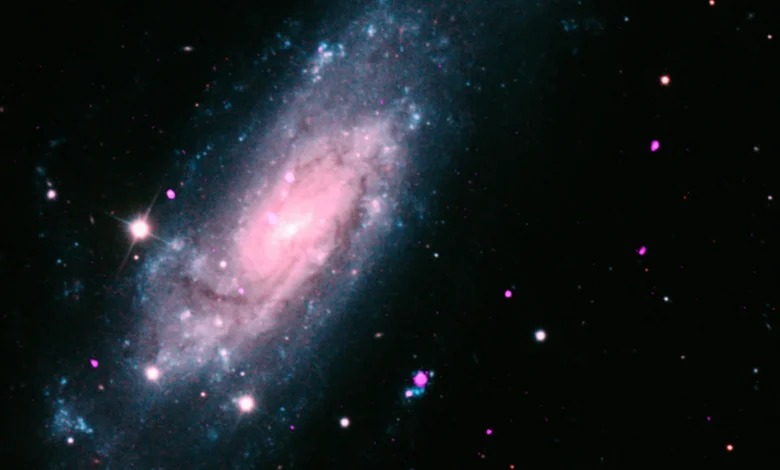
Astronomers utilizing NASA’s premier space-based X-ray telescope have successfully solved a long-standing celestial mystery involving AT 2016blu, a massive, highly volatile star situated roughly 30 million light-years away from Earth. For over a decade and a half, researchers have closely tracked this stellar titan as it periodically flared up in optical light before dimming back down in a predictable rhythm. Now, fresh data captured by the Chandra X-ray Observatory has unmasked the culprit behind these rhythmic outbursts: a previously obscured, ultra-dense stellar companion locked in a tight gravitational dance with the super-giant star.
The findings, detailed in recent observations, shed new light on the complex interaction between massive binary systems in distant galaxies. Located within the outer reaches of the picturesque spiral galaxy NGC 4559, AT 2016blu boasts a mass estimated to be at least 33 times that of our own Sun. However, its immense scale and optical flickering were only symptoms of a much more violent, hidden dynamic playing out in the deep cosmos.
Decoding the Rhythmic Outbursts
For more than 15 years, the scientific community watched AT 2016blu with a mixture of curiosity and confusion. Optical telescopes on Earth recorded a distinct pattern: the star would regularly brighten and then fade on a steady cycle. While massive stars are inherently unstable and prone to mass-loss episodes, stellar winds alone could not easily account for the crisp, clockwork regularity of these outbursts.
To peel back the layers of dust and plasma surrounding the star, researchers turned to high-energy astrophysics. By utilizing the Chandra X-ray Observatory, the research team—led by astronomers from the University of Virginia, including M. Aghakhanloo and colleagues—focused on the high-energy emissions emanating from the system.
The X-ray data revealed intense thermal activity that pointed decisively toward the existence of a compact companion object. According to the analysis, this hidden partner is likely either a stellar-mass black hole or a neutron star. As the two celestial bodies orbit one another every 113 days, the ultra-dense companion makes a close approach, using its immense gravitational pull to strip material directly away from the outer envelope of the gargantuan AT 2016blu.
As this stolen stellar material is violently dragged inward, it accelerates and heats up to extreme temperatures. This super
heated gas and plasma glow intensely in X-rays, providing the unmistakable signature that finally unmasked the companion’s presence to Chandra’s sensitive detectors.
A Timeline of Discovery in NGC 4559
The unveiling of AT 2016blu’s secret companion is the culmination of years of multi-wavelength astronomical observation, blending ground-based optical surveys with space-based X-ray astronomy.
- Pre-2016: Early photometric surveys begin capturing unusual optical variability in a region near the outer edge of the spiral galaxy NGC 4559, though the exact nature of the star remains unverified.
- 2016: The transient event is cataloged as AT 2016blu, prompting concerted monitoring campaigns by optical and infrared astronomers to track its persistent, rhythmic brightening phases.
- Mid-2010s to Early 2020s: Optical monitoring over a span exceeding 15 years confirms that the star brightens and dims on a recurring schedule, ruling out random cataclysmic explosions like standard supernovae and pointing toward a periodic orbital mechanism.
- Recent Observations (Released November 2026): Utilizing targeted observations from NASA’s Chandra X-ray Observatory, combined with archival optical data from the Sloan Digital Sky Survey (SDSS) and image processing by the Chandra X-ray Center (CXC) and SAO’s P. Edmonds, researchers successfully identify the 113-day X-ray signature. This confirms that mass transfer onto a compact companion is the engine driving the outbursts.
Unraveling the Binary System Dynamics
To fully understand the significance of AT 2016blu, astrophysicists must examine the life cycle and mechanics of massive binary star systems. Stars that possess 33 times the mass of the Sun live fast and die young. Their immense core pressures fuse hydrogen at prodigious rates, leading to powerful stellar winds and extreme luminosity.
When such a massive star forms part of a binary pair with a compact remnant—such as a neutron star or a stellar-mass black hole—the system enters a complex evolutionary phase. The compact object represents the leftover core of an even earlier, massive star that exhausted its nuclear fuel and underwent a supernova explosion long ago.
In the case of AT 2016blu, the orbital period of 113 days dictates a relatively tight separation between the two objects given their combined mass. Every time the compact object swings past periastron (its closest orbital point to the super-giant), its gravitational tidal forces disrupt the outer atmosphere of AT 2016blu. A plume of stellar material is captured by the compact object, forming a temporary accretion disk. The friction and gravitational compression within this disk generate millions of degrees of heat, creating the periodic X-ray flares detected by Chandra.
Surrounding the system within the composite images of NGC 4559 are numerous other pink and blue specks. Astronomers note that these are unrelated, unresolved background stars or distant star clusters that happen to share the same line of sight, highlighting the precision required by researchers to isolate AT 2016blu from the crowded stellar neighborhoods of its host galaxy.
Broader Astrophysical Implications
The discovery of the hidden companion in the AT 2016blu system carries profound implications for the study of stellar evolution, mass transfer physics, and the demographics of binary systems throughout the universe.
Massive star binaries are the primary progenitors of some of the most exotic phenomena in modern astrophysics, including gravitational wave sources detected by facilities like LIGO, Virgo, and KAGRA. Understanding how black holes and neutron stars interact with their massive, luminous companions during the late stages of stellar evolution helps scientists chart the pathways that lead to binary black hole mergers and intense X-ray binaries.
Furthermore, catching a system in this specific transitional phase provides a rare laboratory for studying unstable mass loss. Massive stars are notoriously difficult to model when they approach the ends of their lives. By measuring the exact mass transfer rate and the energetic response of the system every 113 days, astrophysicists can refine theoretical models regarding how stars shed their outer envelopes prior to core-collapse supernovae.
The collaboration between space-based observatories like Chandra and wide-field optical surveys continues to prove invaluable. Without the high-resolution X-ray vision provided by NASA’s observatory, the true engine behind AT 2016blu’s multi-year optical heartbeat might have remained hidden indefinitely beneath thick veils of stellar wind and cosmic dust. As researchers continue to analyze the data from NGC 4559, AT 2016blu stands out as a prime celestial laboratory for probing the violent, hidden forces that shape the life and death of giant stars.