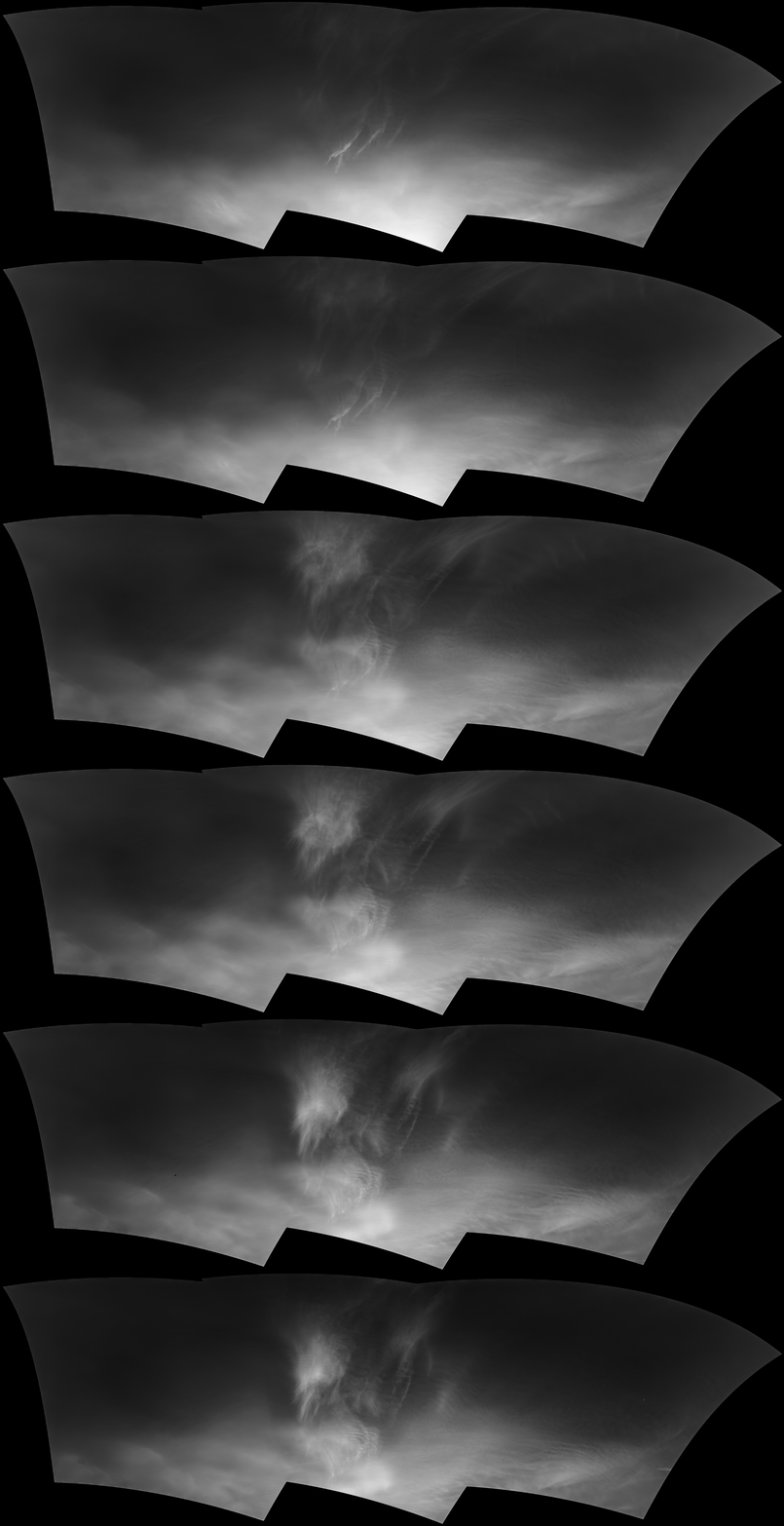
Operating in the vast, rust-colored expanse of Gale Crater, NASA’s Curiosity Mars rover has once again provided scientists and space enthusiasts back on Earth with a breathtaking glimpse of planetary meteorology. On October 31, 2026—marking the 5,061st Martian day, or sol, of its unprecedented mission—the stalwart robotic explorer trained its navigation cameras upward to capture a panoramic mosaic of wispy twilight clouds. These delicate formations, drifting quietly against the dark Martian background and glowing brightly near the lower horizon, offer far more than just a picturesque view; they serve as critical data points in humanity’s ongoing quest to understand the complex climate history of the Red Planet.
Main Facts of the Martian Twilight Cloud Observation
The newly released image, cataloged officially as PIA26805, reveals a black-and-white panoramic mosaic showcasing twilight clouds lingering after sunset. Unlike traditional weather clouds that form during the heat of the day, these post-sunset phenomena appear exclusively during a short-lived seasonal window each Martian fall over Gale Crater.
Curiosity, which has been continuously exploring the crater for more than 14 years, captured the scene using its high-resolution navigation cameras. The resulting images display thin, wispy bands of clouds illuminated by the faint rays of a Martian sun dipping below the horizon. Because Mars possesses a thin carbon dioxide atmosphere that is roughly one percent as dense as Earth’s, sunlight scatters differently, allowing ice crystals high in the atmosphere to glow brilliantly against the encroaching darkness of night.
The mission is managed for NASA by the Jet Propulsion Laboratory (JPL) in Pasadena, California, a division of Caltech. JPL oversees the overarching Mars Exploration Program portfolio for NASA’s Science Mission Directorate in Washington, ensuring that engineering feats on the Martian surface translate directly into groundbreaking scientific discoveries.
Chronology and Mission Milestones
To fully appreciate the significance of Curiosity’s latest atmospheric snapshot, it is necessary to examine the timeline of the rover’s journey and its long-term study of Martian weather:
- November 26, 2011: NASA launches the Mars Science Laboratory mission carrying the Curiosity rover from Cape Canaveral Air Force Station in Florida.
- August 6, 2012: After a perilous entry, descent, and landing sequence utilizing the famous "Sky Crane" maneuver, Curiosity successfully touches down inside Gale Crater, a massive impact basin chosen for its rich geological record.
- 2014–2015: Curiosity reaches the foothills of Mount Sharp (Aeolis Mons), a towering mountain at the center of Gale Crater, beginning its primary phase of analyzing stratified geological layers to search for past habitable environments.
- 2019–2021: The rover significantly expands its meteorological investigations, frequently documenting seasonal phenomena such as passing dust devils, atmospheric pressure waves, and early-forming high-altitude clouds.
- October 31, 2026 (Sol 5061): Curiosity utilizes its navigation camera suite to capture the detailed twilight cloud mosaic, marking another milestone in its extended multi-year mission.
Supporting Data and Atmospheric Mechanics
The Martian atmosphere is a dynamic, albeit thin, envelope of gases composed primarily of carbon dioxide (95%), with minor amounts of nitrogen, argon, and trace quantities of water vapor and oxygen. Understanding how water vapor behaves in this arid environment is crucial for reconstructing the planet’s climatic evolution.
Unlike terrestrial clouds composed of liquid water droplets, Martian clouds—particularly those forming at high altitudes—are frequently composed of carbon dioxide ice (dry ice) or water-ice crystals. The twilight clouds observed by Curiosity on Sol 5061 are typically water-ice clouds that form when Mars is at its aphelion, the point in its elliptical orbit furthest from the Sun. During this season, temperatures in the upper atmosphere plummet, allowing trace amounts of atmospheric water vapor to condense around microscopic dust particles suspended high above the surface.
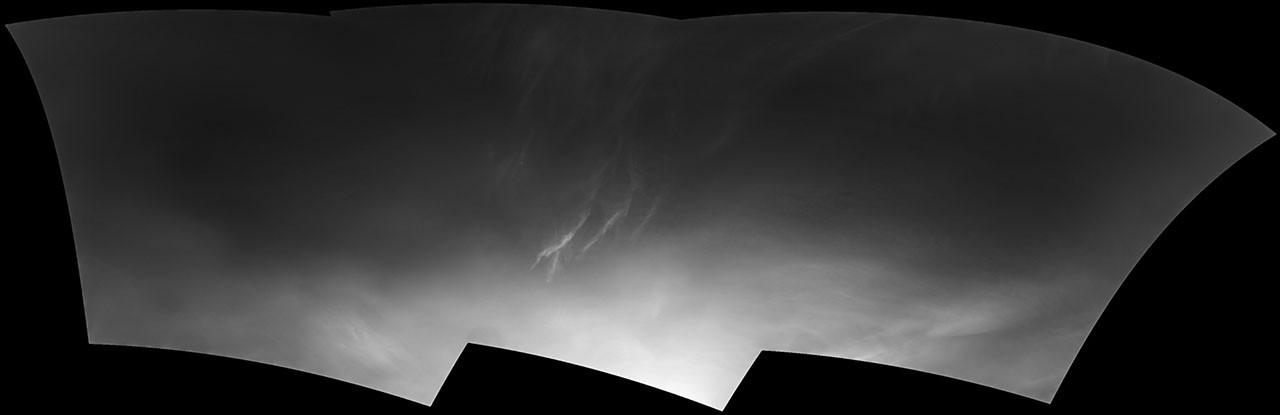
Data returned from Curiosity, combined with orbital observations from spacecraft such as the Mars Reconnaissance Orbiter (MRO), indicate that these high-altitude clouds typically form at altitudes ranging from 30 to 50 miles (50 to 80 kilometers) above the surface. Because they reside so high in the atmosphere, they continue to be illuminated by the Sun long after night has fallen on the surface below, creating the characteristic glowing twilight effect captured by the rover’s cameras.
Official Perspectives and Scientific Implications
While atmospheric scientists at NASA and participating academic institutions analyze the structural composition of these clouds, the implications extend far beyond basic meteorology. Planetary scientists rely on cloud tracking and formation patterns to map global wind circulation models on Mars. By observing how clouds drift, dissipate, or thicken over Gale Crater, researchers can infer wind speeds, vertical atmospheric mixing, and the global distribution of water vapor.
"Every time we capture these seasonal cloud events, we gain a clearer picture of the modern Martian water cycle," notes planetary researchers tracking the mission telemetry. "While Mars appears dry and barren at the surface today, studying how moisture moves through the atmosphere provides invaluable clues about where water went over billions of years."
Furthermore, these observations tie directly into astrobiological objectives. Gale Crater once held ancient lakes and groundwater systems capable of supporting microbial life. By understanding the modern climate—including how the atmosphere retains or loses moisture—scientists can better model ancient Martian climates, helping to answer fundamental questions about planetary habitability across the solar system.
Broader Impact on Future Exploration
As Curiosity enters its fourteenth year of operations on the Martian surface, achievements like the capture of Sol 5061 twilight clouds demonstrate the remarkable durability and scientific utility of robotic explorers. Originally designed for a primary mission lasting just one Martian year (about 687 Earth days), the nuclear-powered rover continues to exceed mission parameters, serving as a stationary and mobile meteorological station rolled into one.
The data gathered by Curiosity also paves the way for future human exploration. Understanding atmospheric dynamics, wind patterns, and cloud formation is essential for planning safe landing trajectories, predicting weather hazards, and managing solar power generation for future crewed missions to Mars. As dust storms and atmospheric variations pose significant engineering challenges, daily tracking by rovers on the ground remains a cornerstone of planetary defense and mission success.
For space enthusiasts and researchers alike, images like PIA26805 serve as a reminder of the stark beauty of neighboring worlds. Though millions of miles away from Earth, the familiar sight of wispy clouds drifting across a twilight sky bridges the cosmic distance, reminding observers that Mars is a dynamic world governed by physical laws akin to our own.