In the vast, swirling expanse of the Andromeda Galaxy, a celestial drama unfolded over nearly a decade that has provided scientists with the first direct observation of a phenomenon theorized since the 1970s. A giant star, approximately seven times the mass of our Sun, slowly consumed a smaller companion star in a process known as common envelope evolution. This rare cosmic event, which culminated in a violent eruption in late 2025, has offered astronomers an unprecedented look at how binary star systems evolve, shrink, and ultimately merge, reshaping our understanding of stellar life cycles.
The study, published in the journal Nature, was led by astrophysicist Viraj Karambelkar of Columbia University. By synthesizing data from a dozen different telescopes—including the Wide-field Infrared Transient Explorer (WINTER) at Palomar Observatory and NASA’s Near-Earth Object Wide-field Infrared Survey Explorer (NEOWISE)—the research team successfully captured the entire timeline of the engulfment, from the subtle initial brightening to the final, explosive collision.
The Mechanics of Common Envelope Evolution
Binary star systems are common throughout the universe, but many exist in such tight proximity that they could not have formed in their current configuration. For decades, the "common envelope" model has served as the primary scientific explanation for this phenomenon. The theory suggests that as one star in a binary system ages and expands into a red giant, its outer atmosphere expands to the point where it begins to swallow its smaller companion.
Once inside the larger star’s gaseous envelope, the companion star is subjected to intense frictional drag. This friction leeches orbital energy from the smaller star, causing it to spiral inward toward the core of the giant. Depending on the density of the envelope and the mass of the stars involved, the system may survive this phase as a tighter binary or suffer a complete, catastrophic merger. While this process is believed to be a fundamental driver of stellar evolution, observing it in real-time has historically been impossible due to the relatively short duration of the event—lasting only a few years to decades—compared to the millions of years typically required for stellar evolution.
A Chronology of Destruction: AT 2025abao
The system, cataloged as AT 2025abao, provided the perfect laboratory for researchers to track this process. By analyzing historical data, including photographic sky plates dating back to 1989, the team established a baseline of the star’s behavior. For nearly three decades, the system remained relatively stable. During this period, the giant star grew to a diameter approximately 350 times that of the Sun. The smaller companion, however, remained hidden from view, masked by the overwhelming brightness of the primary star, which outshined its partner by a factor of 18,000.
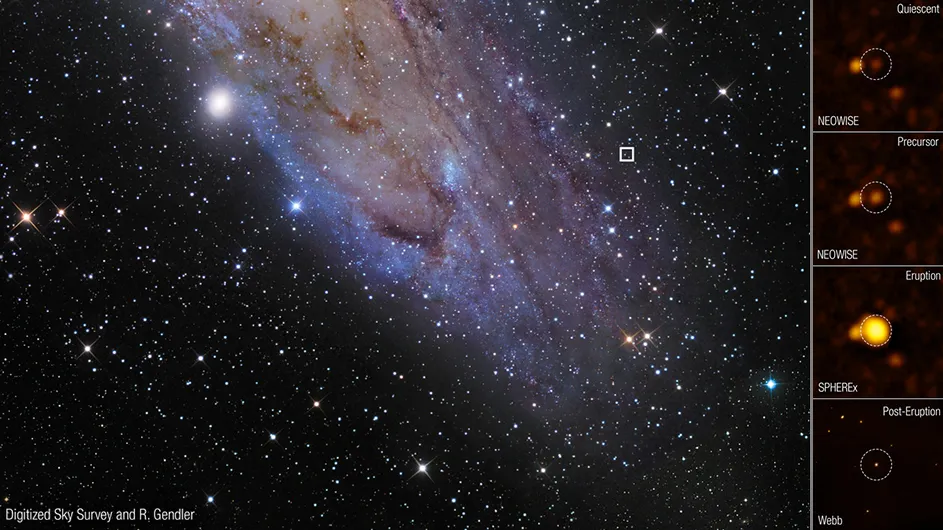
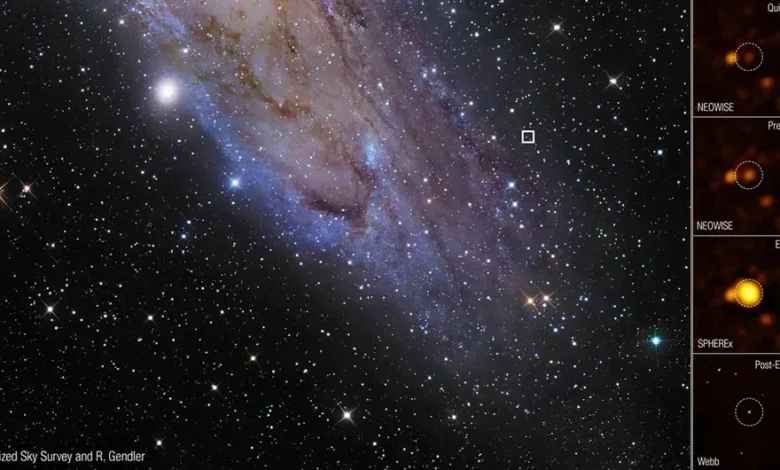
The transition from stability to disruption began around 2018. Over the next seven years, the giant star began to brighten significantly in visible light, swelling in size while maintaining a constant temperature. Researchers noted that the increase in infrared radiation was a key indicator of the ongoing engulfment, as the energy dissipated by the friction of the spiraling companion heated the surrounding gas.
By April 2025, the research team identified AT 2025abao as a candidate for an active common envelope event. While they considered alternative explanations—such as internal core instabilities—subsequent data confirmed the engulfment theory. In July 2025, NASA’s SPHEREx space telescope observed the giant star having expanded to 860 times the size of the Sun, draped in a shroud of newly formed dust.
The event reached its climax in October 2025. In a span of just 25 days, the star’s luminosity increased 100-fold, peaking at a brightness equivalent to 1.5 million Suns. According to Karambelkar, this rapid brightening was the direct result of the companion star falling deep into the envelope and colliding with the primary star’s core. This "bomb" effect ejected a significant portion of the envelope into space, marking the final stage of the merger.
Analyzing the Energy Budget
One of the most significant contributions of this study is the detailed analysis of how energy is distributed during a stellar merger. Astronomers often use an efficiency parameter to estimate how much energy from a sinking companion goes into blowing away the host star’s outer layers.
The data from AT 2025abao revealed that the energy distribution is highly dynamic. During the initial, slow-spiral phase, the energy was primarily released as light. However, during the final, high-velocity plunge, the energy output spiked, with roughly 99 percent of the released energy being utilized to hurl approximately 10 percent of the star’s envelope outward at speeds ten times higher than the star’s escape velocity. The remaining gas stayed bound, strongly suggesting that the companion did not survive the encounter but instead merged permanently with the core of the giant.
This finding challenges some existing mathematical models. While the current formulas act as a useful rule of thumb, they often fail to account for the high-speed ejection of material observed in this event, indicating that the physics of common envelope evolution is more complex than previously assumed.

Implications for Cosmic Structures
The observations of AT 2025abao also offer a potential solution to a long-standing mystery in astronomy: the origin of hourglass-shaped nebulae. Scientists have long hypothesized that these structures are carved out by binary interactions, but evidence has been scarce.
In this case, the gas shed during the slow-spiral phase of the engulfment accumulated along the orbital plane of the binary. When the final explosion occurred, the ejected material was blocked around the equator but expanded freely toward the poles, naturally forming an hourglass shape. This observation provides the strongest evidence to date that binary interactions are the primary architects of these distinct nebular structures.
Future Research and Global Monitoring
The research team plans to continue monitoring AT 2025abao for the foreseeable future. Because the explosion generated significant amounts of dust, the inner regions of the system are currently obscured. As this dust clears over the coming years or decades, astronomers hope to see what remains of the core, which will provide definitive proof of whether a total merger occurred or if a remnant of the companion survived.
The successful identification and tracking of AT 2025abao serve as a proof-of-concept for future surveys. With current technology, such events can only be reliably detected within the Andromeda Galaxy. However, the next generation of observatories—including the Vera Rubin Observatory and the Nancy Grace Roman Space Telescope—are expected to revolutionize this field. Experts anticipate that these instruments will be capable of identifying several similar events annually within 50 million light-years of Earth, potentially capturing these rare, "blip-in-time" events in dozens of Milky Way-like galaxies.
By shifting from lucky, serendipitous discoveries to a systematic survey of these cosmic mergers, astronomers hope to build a comprehensive catalog of stellar deaths. This will not only refine our understanding of the life cycles of massive stars but also clarify how binary systems contribute to the chemical and structural evolution of galaxies across the universe. The case of AT 2025abao, therefore, is not merely a singular curiosity, but the opening chapter in a new era of high-cadence, multi-messenger stellar observation.