Phoebe Bridgers Stuns on Saturday Night Live With Practical Effects and Emotional Dualism

Phoebe Bridgers made her highly anticipated return to the Studio 8H stage as a solo musical guest on Saturday Night Live, delivering a performance that immediately dominated cultural discourse across digital platforms. Marking her first solo appearance on the iconic NBC sketch-comedy program since 2021—when she famously smashed her guitar against a stage monitor during a fiery rendition of "I Know the End"—Bridgers opted for a far more subtle, yet profoundly chilling, visual statement this time around. Rather than relying on physical destruction, the indie-rock luminary transfixed audiences with an illusion of mortality, pairing deeply confessional lyricism with a sudden, haunting transformation into a skeleton.
The musical presentation served as a microcosm of her latest artistic era, capturing both the agonizing grief of loss and the euphoric infancy of new romance. By juxtaposing the crushing weight of familial mourning with the bright, driving optimism of fresh affection, Bridgers showcased the full spectrum of her songwriting breadth. The broadcast not only reinforced her status as one of the premier contemporary lyricists of her generation but also provided a masterclass in staging television performance art.
A Haunting Illusion: Breaking Down the SNL "Still Standing" Visual Effect
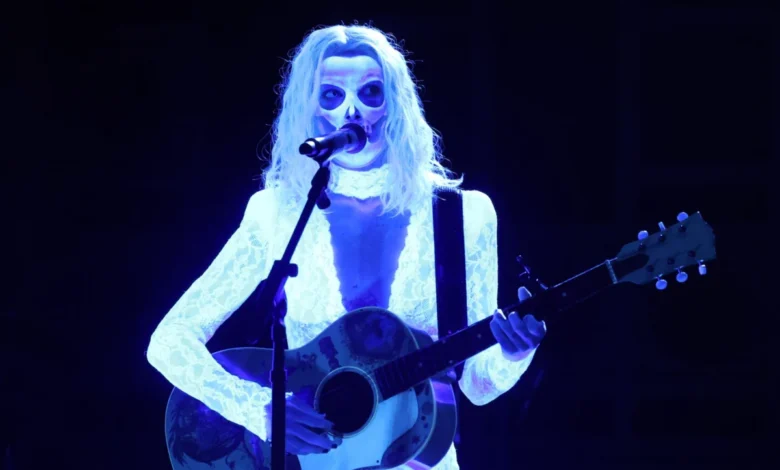
The centerpiece of Bridgers’ musical segment was her performance of "Still Standing," a standout track from her recent critically acclaimed album, Lost Horizon. Midway through the stripped-down, acoustic-driven number, a jarring visual shift occurred near the close of the song. Without a perceptible cut or a standard television editing trick, Bridgers’ face abruptly transformed into an illuminated skull, sending a collective jolt through the viewing audience.
Industry insiders and sharp-eyed fans quickly dissected the mechanics of the illusion. Rather than utilizing digital post-production or a live CGI filter, the production relied on a sophisticated practical effect. Bridgers wore specialized, ultraviolet-sensitive skull makeup layered discreetly beneath her standard television cosmetics throughout the entire broadcast, including her first musical number. When the studio lighting shifted to heavily feature black lights at the precise emotional climax of the song, the hidden pigment was activated, bringing the skeletal visage to life with startling clarity.
The choice of effect was far from a mere belated Halloween stunt. In the context of "Still Standing"—a deeply personal composition centered on the complex passing of her father—the visual served as a stark, visceral manifestation of mortality. Cultural critics and fans alike interpreted the transformation as a symbolic crossing of the threshold, visually illustrating the artist’s journey to confront the lingering legacy of a complicated familial relationship.
Context and Chronology: The Evolution of "Still Horizon" and the Lost Tour
To fully understand the weight of Bridgers’ SNL appearance, one must examine the trajectory that led to this artistic epoch. Following the massive success of her sophomore studio album, Punisher, and her subsequent collaborative work with the supergroup boygenius, Bridgers entered a period of intense personal reflection following the death of her father. These experiences laid the emotional groundwork for Lost Horizon, an album that immediately resonated with listeners upon its release.
The chronology of the Lost Tour further cemented the cultural significance of "Still Standing." Throughout her recent arena tour across the United States, the song functioned as an emotional anchor for the live setlist. Eschewing the digital noise of modern concertgoing, Bridgers instituted strict policy measures at her shows, requiring fans to lock up their mobile devices in pouches to preserve intimacy. On a nightly basis, she would take to a secondary B-stage, offering unrecorded, confessional remarks regarding her father’s death before softly delivering the track.
This nightly ritual built a powerful word-of-mouth momentum among her fan base, turning "Still Standing" into one of the most anticipated and discussed songs of her catalog. Translating that raw, hushed intimacy to the bustling television environment of Saturday Night Live presented a unique logistical and emotional challenge, which Bridgers and her creative team navigated by leaning into the theatricality of the UV makeup effect.

Lyrical Analysis: Processing Grief and Family Complexities
"Still Standing" stands out in modern pop and indie music for its refusal to romanticize grief or sanitize difficult familial relationships. The song navigates the turbulent waters of growing up under the shadow of a parent marked by physical and psychological abuse, alongside profound emotional indifference.
Lines such as "You tried to make me afraid / We were both shining" encapsulate the dualities of childhood trauma, where fear and affection frequently intertwine. In the song’s final stanza, Bridgers confronts the definitive nature of death with unflinching honesty: "Sometimes I want you back / Not today… I can’t imagine you dead / But you are every day / Thank you for everything."
Musicologists and literary critics have praised the track for its emotional universality. While the specific details remain deeply autobiographical, the core sentiment—grappling with how to mourn a figure who caused substantial pain during his lifetime—strikes a chord with a broad demographic of listeners. By delivering these heavy lines while visually embodying a skeleton, Bridgers elevated the performance from a standard musical guest spot to a profound artistic statement on human vulnerability.
The Yin and Yang of Lost Horizon: Shifting Gears to "Bobby"
In keeping with the structural duality of Lost Horizon, Bridgers countered the crushing melancholy of "Still Standing" with the vibrant, life-affirming energy of its counterpart track, "Bobby." If the former represents the darkness of losing a crucial figure, the latter captures the radiant ebullience of building a new relationship—widely understood by fans and critics to reference her partner, comedian and filmmaker Bo Burnham.
Taking the stage with a full, lively backing band, Bridgers offered a spirited rendition of "Bobby" that maintained the lyrical spirit of the recorded track while injecting a renewed sense of live vocal fervor. At several points during the performance, her delivery grew intensely powerful, nearly crossing over into the cathartic, screaming crescendos familiar to fans from her older anthem, "I Know the End." However, rather than signaling impending doom, the vocal intensity was channeled into a celebration of new beginnings.
Belting out the refrain, "This could be the end of wanting," followed by the repeated, hopeful declaration, "This could be the end," Bridgers transformed uncertainty into a promise. The performance highlighted her remarkable artistic range, demonstrating an effortless ability to transition from the quiet agony of confronting mortality to the joyful thrill of discovering a new chapter in life within the span of a single television program.
Industry Implications and Cultural Impact
Bridgers’ triumphant return to Saturday Night Live arrives at a pivotal juncture in the contemporary music landscape. As streaming models continue to fragment audience attention, artists face mounting pressure to deliver high-concept, memorable moments that can immediately transcend linear television broadcasts and circulate across social media algorithms.
By executing a practical visual effect that prioritized artistic resonance over cheap shock value, Bridgers successfully avoided the pitfalls of modern television gimmicks. The performance generated immediate, sustained analysis across major cultural publications, fan forums, and industry trades, solidifying the commercial and critical momentum of Lost Horizon.
Furthermore, the broadcast reinforced the viability of vulnerability in prime-time television. In an era where pop music often leans toward polished perfection, Bridgers’ willingness to lean into discomfort—both through her raw lyrical admissions about familial trauma and her striking visual transformation—demonstrates a growing appetite among audiences for authenticity and emotional depth. As the Lost Tour continues its international legs, the cultural footprint of her SNL appearance will undoubtedly influence how fans engage with her music live, proving once again that Phoebe Bridgers remains one of the most compelling and unpredictable voices in modern popular music.
Related posts: