The political landscape of the United States has witnessed a series of unconventional developments throughout late 2026, culminating in a social media suggestion from White House Communications Director Steven Cheung that hip-hop icon Nicki Minaj could be considered for the role of White House Press Secretary. This suggestion followed a week of administrative turnover that saw the departure of Katie Zacharia, who resigned from the position after only five days in office citing intense media scrutiny. The intersection of pop culture and executive communication has become a recurring theme in the current administration, with Minaj serving as one of the most prominent celebrity figures to align herself with the Republican platform.
The discourse surrounding Minaj’s potential suitability for the press briefing room began in earnest over the weekend, following the circulation of a video recorded aboard Air Force One. In the footage, shared by Cheung, Minaj articulated her support for Donald Trump, framing her endorsement through the lens of economic pragmatism. She characterized the former president as a self-made billionaire whose business acumen qualifies him to navigate the complexities of the national economy. Cheung’s subsequent post on the social media platform X, in which he labeled the rapper as a potential candidate for the press secretary role, drew significant attention, signaling a pivot toward unconventional public relations strategies.
A Chronology of Political Alignment
Nicki Minaj’s transition into conservative political circles has been a gradual, albeit high-profile, process. Her involvement with the current administration is not an isolated incident but rather the result of a long-term engagement with conservative ideological platforms.
The trajectory began in late 2025, when Minaj appeared as a surprise guest at a Turning Point USA event. During this appearance, she shared the stage with Erika Kirk, the widow of political commentator Charlie Kirk. The event marked a departure from her previous public stances, as she publicly praised Donald Trump’s leadership and criticized California Governor Gavin Newsom. The immediate aftermath of this appearance was characterized by a sharp divide in public opinion, with the artist facing significant backlash, including the deactivation of her Instagram account and the emergence of online petitions calling for her deportation—a reflection of the intense polarization that currently defines American political discourse.
Following the initial fallout, Minaj doubled down on her ideological shift. In September 2026, she made an appearance on Fox News’ The Ingraham Angle. During this broadcast, she defended her political alignment, stating that she felt a personal connection to Trump’s communication style. She described the president as "grounded" and "easy to connect with," effectively positioning herself as a bridge between the entertainment industry and the populist conservative movement.
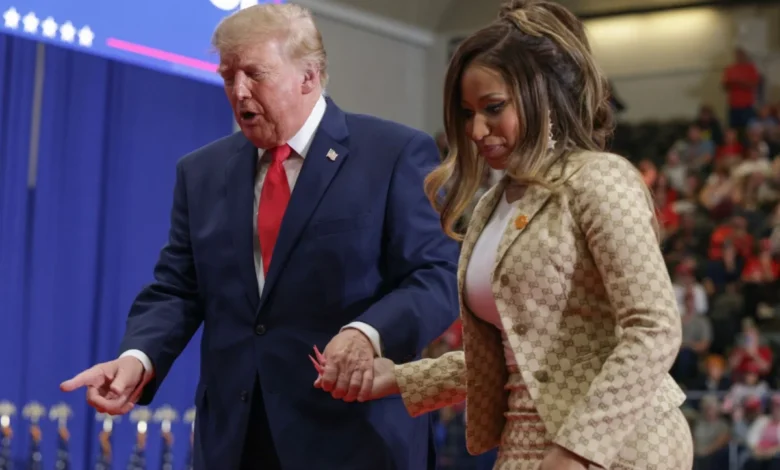
The culmination of this series of appearances occurred on October 26, 2026, at a campaign rally in Port Huron, Michigan. During the event, Donald Trump publicly acknowledged the rapper’s presence, making comments regarding her appearance that drew both cheers from the crowd and media commentary. Minaj used the platform to reiterate her support, arguing that the nation is at a "major turning point" and calling for the election of candidates aligned with the current administration’s vision.
Administrative Instability and Communication Strategy
The suggestion that a non-traditional candidate might fill the role of White House Press Secretary arises against the backdrop of significant personnel instability. The appointment of Katie Zacharia was intended to stabilize the administration’s messaging; however, her rapid departure underscored the difficulty of managing the modern 24-hour news cycle, particularly given the aggressive scrutiny of current political reporting.
The Press Secretary role is traditionally held by individuals with extensive backgrounds in government, journalism, or public policy. The suggestion of a celebrity surrogate for the role reflects a broader trend in political communications: the prioritizing of "authenticity" and social reach over traditional bureaucratic experience. By aligning with influential cultural figures, the administration seeks to bypass traditional media gatekeepers, instead utilizing the massive followings of figures like Minaj to disseminate its message directly to the electorate.
Supporting Data and Societal Context
The intersection of celebrity endorsements and electoral politics has been studied extensively by political scientists. According to data from the Pew Research Center, while celebrity endorsements rarely shift the underlying party identification of voters, they are highly effective at mobilizing the base and increasing voter turnout among younger demographics. Minaj, who boasts one of the largest social media followings globally, occupies a unique position in this regard.
However, this strategy carries inherent risks. The "Minaj effect"—characterized by high levels of public engagement followed by significant social media backlash—demonstrates the volatility of celebrity political involvement. The petitions for her deportation, while legally non-binding, illustrate the intensity of the reaction from the opposing political faction. Such reactions often serve to harden partisan lines, making it difficult for the administration to reach undecided voters who may be alienated by the perceived politicization of entertainment figures.
Furthermore, the economic argument presented by Minaj—that a billionaire’s success is an inherent indicator of policy competence—is a staple of populist economic rhetoric. Economists often note that the skills required to manage a global business conglomerate do not always translate directly to federal fiscal management, which involves complex trade-offs between social spending, taxation, and international trade policy. The repetition of this narrative, however, provides a simplified, relatable framing that resonates with a significant portion of the electorate who feel disconnected from traditional political discourse.
Broader Implications for the 2026-2028 Cycle
As the country looks toward the 2028 presidential cycle, the role of celebrity surrogates will likely continue to expand. The interaction between Trump and Minaj in Michigan serves as a blueprint for how campaigns intend to utilize high-profile individuals to dominate the news cycle. By creating viral moments—such as the Air Force One clip or the candid remarks made at rallies—the campaign ensures that its message remains in the headlines, effectively displacing policy-based reporting with personality-driven narratives.
The implications for the office of the Press Secretary are also significant. If the administration continues to view the role as a platform for cultural performance rather than institutional briefing, the traditional function of the office may undergo a permanent transformation. The Press Secretary, once the primary interface between the administration and the institutional press corps, may find their role increasingly relegated to that of a media personality, tasked with managing narratives on digital platforms rather than answering questions in a formal setting.
Conclusion and Future Outlook
While it remains highly unlikely that Nicki Minaj will formally assume the role of White House Press Secretary, the mere suggestion of her candidacy is a testament to the current state of American political communication. The administration’s willingness to entertain such a prospect indicates a strategic shift toward disruption and a rejection of conventional political norms.
Whether this strategy will yield electoral dividends remains to be seen. While Minaj’s support provides a boost to the administration’s visibility among specific demographics, it also provides ammunition for critics who argue that the government is becoming increasingly detached from the formal processes of democratic oversight. As the next phase of the administration’s legislative agenda approaches, the focus will likely shift from these viral moments back to policy implementation. However, the precedent has been set: in the current political environment, the line between celebrity advocacy and governance is increasingly porous, and the ability to command the digital spotlight is increasingly viewed as a key asset in the pursuit of political power. The coming months will be crucial in determining whether this celebrity-centric approach will define the remainder of the current administration’s tenure or if it will ultimately be viewed as a transient strategy in an era of unprecedented political polarization.