The Battle Over Russell Brand’s YouTube Channel Tests the Boundaries of Free Speech, Prison Rules, and Digital Accountability

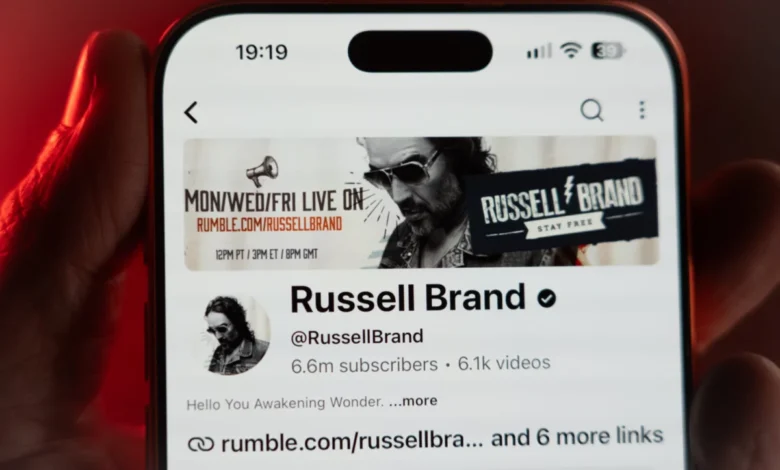
The intersection of modern digital media, incarcerated penal policy, and high-profile criminal sentencing has created an unprecedented regulatory battle in the United Kingdom. Following the November 2026 sentencing of comedian and commentator Russell Brand to ten years and six months in prison for one count of rape and three counts of sexual assault, a controversy erupted over a video posted to his massive YouTube channel. The hour-long broadcast, featuring Brand’s wife reading a message in which he proclaimed his absolute innocence, has ignited a fierce national and international debate. It has forced tech giant Google, prison authorities, government ministers, and legal experts to confront a critical gap in digital age governance: how to handle content distributed by convicted felons with pre-existing, multi-million-follower media platforms.
The incident underscores a fundamental structural loophole in content moderation. Even when a creator is completely stripped of their monetization privileges and banned from YouTube’s lucrative Partner Program—as Brand was in September 2023 following initial public allegations—their distribution infrastructure remains intact. A channel boasting over six million subscribers retains the capacity to bypass traditional broadcast gatekeepers, pushing content directly into algorithmic subscriber feeds, cross-platform messaging group chats, and global networks. This case has brought the systemic challenges of decentralized internet publishing into sharp focus, raising critical questions about whether existing legal frameworks are adequate to prevent convicted criminals from using digital megaphones to potentially inflict ongoing distress upon their victims.
Chronology of Events and Escalation
The trajectory from legal accountability to digital controversy unfolded across a precise timeline, highlighting the friction between swift penal oversight and the deliberate pace of corporate tech compliance.
In September 2023, public allegations of sexual misconduct and assault against Brand came to light. YouTube acted swiftly within its internal policy framework, suspending Brand’s channel from its Partner Program for violating creator responsibility policies, effectively cutting off his ad revenue streams while leaving the channel operational.
On November 9, 2026, a UK court formally sentenced Brand to 10 years and 6 months in prison following a rigorous trial that established his guilt on one count of rape and three counts of sexual assault.
Just six days later, on November 15, a video titled "The Good Work Continues" was uploaded to Brand’s YouTube channel by his wife, Laura Gallacher. Hosted alongside their regular Christian-themed "Sunday Service" programming, the video featured Gallacher reading a prepared statement from Brand. In the message, Brand asserted his innocence, stating, "Beloved brothers and sisters in Christ, God bless you for your support. As you know, I am not guilty for the offenses I have been jailed for, so something strange is happening." The video quickly surpassed one million views, catalyzing immediate demands for intervention from legal authorities.
By November 16, the Prison Service of England and Wales, alongside the Ministry of Justice, registered formal objections, requesting that Google remove the content due to its potential to cause severe psychological distress to Brand’s victims. Google initially declined the takedown request on November 18, asserting that the video did not technically violate YouTube’s published community guidelines. However, mounting political and public pressure prompted a reversal of sorts; by November 19, Google announced it was actively investigating the material, though the video remained accessible as institutional pressure mounted.
Concurrently, the Ministry of Justice launched a formal probe into whether Brand violated internal prison communication regulations by routing a public statement through external channels.
Institutional Responses and Government Scrutiny
The publication of the post-sentencing video triggered immediate and unified condemnation from senior British government officials, who argued that the broadcast undermined the integrity of the judicial process and disrespected the survivors of Brand’s crimes.

Justice Secretary Alex Norris publicly characterized the broadcast as "completely unacceptable," signaling that the government expected swift institutional consequences if investigators determined Brand breached prison communications rules. Under current regulations governing the Prison Service of England and Wales, inmates are strictly prohibited from discussing their active criminal cases or convictions in correspondence intended for publication or broadcast. While narrow exceptions exist for legitimate, formal legal representations regarding a conviction or sentence, utilizing a public-facing YouTube channel to broadcast a declaration of innocence falls sharply outside traditional legal channels. Furthermore, prison service guidelines mandate that officials weigh whether any approved media access could cause "serious distress" to victims.
Prime Minister Andy Burnham added his voice to the chorus of disapproval, urging social media conglomerates to demonstrate basic corporate citizenship and voluntary restraint. "Show some decency," Burnham remarked, calling on platforms to preemptively self-police content generated by incarcerated felons.
Yet, translating political outrage into tangible regulatory action has exposed sharp divisions within Parliament. Housing Minister Matthew Pennycook reiterated that while the government strongly favored the removal of the video, the ultimate enforcement decision rested squarely with Google’s corporate governance teams.
The Legislative Blind Spot: The Online Safety Act Examined
The controversy has exposed a significant vulnerability in the United Kingdom’s flagship digital legislation, the Online Safety Act. Designed primarily to compel tech platforms to mitigate illegal content, protect minors from psychological harm, and manage systemic online risks, the current statutory framework lacks specific mechanisms to regulate media generated by incarcerated individuals and funneled through pre-existing commercial channels.
Prominent political figures have argued that legislative reform is long overdue. Labour MP and former safeguarding minister Jess Phillips emerged as a leading voice for expanding the scope of British media law. Speaking on BBC programming, Phillips noted the unique nature of the modern penal landscape, observing that previous generations of prisoners did not possess access to massive, pre-established YouTube followings capable of broadcasting directly to millions of global adherents. Phillips suggested that lawmakers must evaluate the necessity of drafting secondary or amended legislation to close the loophole that allows convicted offenders to circumvent communication restrictions via proxy posters.
Conversely, the proposition of tightening internet censorship has drawn sharp resistance from political opponents and civil liberties advocates. Conservative Party leader Kemi Badenoch cautioned against knee-jerk legislative overhauls, arguing that authorities should first definitively establish whether existing laws or prison rules were broken before leaning on private corporate entities to suppress speech.
The debate has also attracted international scrutiny. High-profile U.S. media commentators, including Megyn Kelly, sharply criticized the British government’s attempts to secure the video’s removal, framing the coordinated pressure from state officials as a draconian encroachment on free expression and digital liberties.
Implications for Tech Governance and Victim Advocacy
The ongoing standoff between the UK government and Google highlights a growing dilemma for multinational technology platforms operating across diverse legal jurisdictions. As digital creators face severe criminal convictions, platforms are increasingly forced to navigate the delicate equilibrium between upholding open-internet principles and demonstrating social responsibility toward victims of violent crime.
For survivors, the presence of such content inflicts lingering psychological harm. Mia Latter, who has previously and publicly accused Brand of sexual assault outside the scope of the criminal trial, articulated the broader emotional toll to media outlets, noting that seeing the offender’s platform remain active forces survivors to relive their trauma and diminishes the hard-won closure achieved through a criminal conviction.
As Google’s internal investigation into the video continues, the outcome risks setting a dangerous precedent for how digital platforms manage content originating from behind bars. If tech companies maintain that content produced by inmates does not violate platform rules unless it explicitly threatens or incites violence, governments will likely be forced to choose between rewriting national telecommunications laws or accepting that incarcerated individuals can maintain digital influence from their cells. Ultimately, the Russell Brand case serves as a watershed moment, demanding that lawmakers, technology executives, and civil society establish clearer definitions for digital accountability in the shadow of criminal justice.