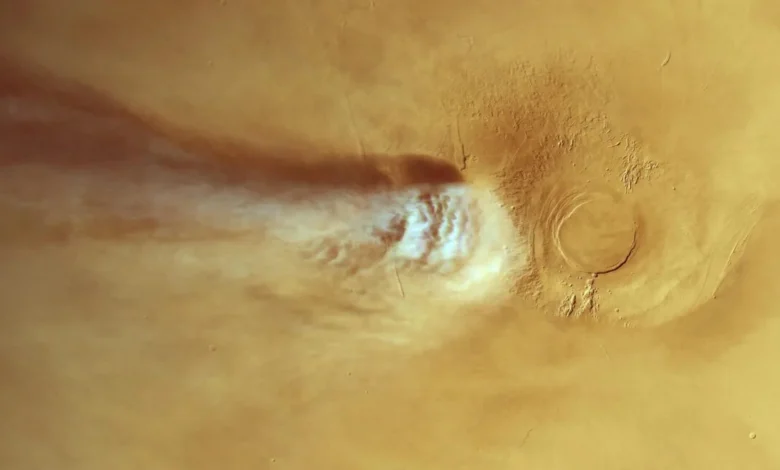
The Red Planet has long captivated astronomers with its complex weather patterns, but a recent investigation into the Arsia Mons Elongated Cloud (AMEC) has unveiled a meteorological phenomenon that challenges our fundamental understanding of cloud formation. Published in the journal Nature Geoscience, the study details how this gargantuan, 1,800-kilometer-long cloud defies traditional terrestrial models of nucleation. By analyzing data collected from Mars-orbiting spacecraft, researchers have discovered that the Martian atmosphere is capable of sustaining extreme conditions that trigger ice crystal formation without the aid of dust or salt particles, a process known as homogeneous nucleation.
Understanding the Mechanics of AMEC
On Earth, the birth of a cloud is a communal event. Water vapor typically requires a "seed"—a tiny particle of dust, sea salt, pollen, or soot—to serve as a surface upon which liquid droplets or ice crystals can accumulate. This process, termed heterogeneous nucleation, is the standard for almost all cloud cover observed on our planet. However, the AMEC, which periodically emerges near the 65,000-foot-tall Arsia Mons volcano, operates under an entirely different set of physical laws.
According to the study’s lead author, Jorge Hernández-Bernal, the formation of these clouds is an anomaly that defies terrestrial intuition. "It’s akin to droplets of condensation appearing in the middle of a room, rather than on a window," Hernández-Bernal explained. "It’s wholly unexpected." In this unique Martian environment, vapor transitions directly into ice crystals in a vacuum-like state, entirely independent of atmospheric debris. This suggests that the upper atmosphere of Mars possesses chemical and physical properties far more dynamic than previously modeled by planetary scientists.
The Volcanic Catalyst and Thermodynamic Extremes
The existence of the AMEC is inextricably linked to the geography of Mars. Arsia Mons, a massive shield volcano located near the Martian equator, serves as a physical obstruction to prevailing wind currents. When these winds strike the towering peak, they are forced upward in a phenomenon known as orographic lifting. This rapid vertical displacement pushes moist air into the upper reaches of the Martian atmosphere in a matter of minutes.
The thermodynamics required for this process are staggering. For homogeneous nucleation to occur, the atmosphere must undergo a sharp temperature drop of approximately 30 degrees Celsius within a ten-minute window, accompanied by extreme relative humidity. While such conditions are unheard of in Earth’s meteorology, the Martian environment, characterized by its thin atmosphere and rapid heat radiation, facilitates these volatile swings.
The specific humidity levels required for this process are particularly notable. Researchers have calculated that the humidity in these localized plumes is more than 100,000 times greater than any value ever recorded in Earth’s atmosphere. Prior to this study, scientists were unaware that such high-saturation environments could exist on Mars, leading to a significant reassessment of the planet’s water cycle and atmospheric capacity.
Chronology of Observation and Modeling
The quest to understand the Arsia Mons Elongated Cloud has been a decades-long endeavor. While the cloud has been documented in various imagery since the early days of the Viking missions in the 1970s, it was initially dismissed as a seasonal curiosity or a byproduct of volcanic outgassing. It was not until the arrival of more sophisticated orbiters, such as the Mars Express and the Mars Reconnaissance Orbiter, that researchers were able to capture the high-resolution data necessary to map the cloud’s rapid evolution.
In recent years, the scientific community began to focus on the diurnal nature of the AMEC. Observations confirmed that the cloud appears every Martian day during the solstice season, stretching across the sky before dissipating as the sun sets and the atmosphere warms. By utilizing advanced global circulation models (GCMs), the research team was able to simulate these daily cycles. The breakthrough came when the models finally accounted for the extreme, localized cooling induced by the volcanic obstruction, successfully reproducing the cloud’s lifecycle with unprecedented accuracy.
Implications for Planetary Science
The discovery that homogeneous nucleation occurs on Mars has profound implications for our broader understanding of planetary atmospheres. Scientists have long hypothesized that such processes might occur on other worlds, including Venus and the gas giants of the outer solar system, yet empirical evidence has remained elusive. The confirmation of this process on Mars serves as a "smoking gun," proving that given the right geographic and thermal conditions, a planetary atmosphere can generate clouds through pure vapor-to-ice transition.
Furthermore, this study highlights a critical gap in our knowledge regarding Martian water vapor. For years, the scientific community operated under the assumption that the Martian atmosphere was too dry to support such high-density ice formations. "We don’t have nearly as much information about Mars’ atmosphere as we do about Earth’s, so reproducing the AMEC to this degree is a big success," Hernández-Bernal noted. "The result is remarkable."
This reassessment suggests that water vapor may be transported through the Martian atmosphere in ways that were previously overlooked. This has secondary implications for the study of Martian paleoclimatology; if the atmosphere can hold more water than previously estimated, it changes the historical models regarding how water was lost to space over the last several billion years.
Future Directions and Comparative Meteorology
As space agencies prepare for future robotic and human exploration of Mars, understanding the localized weather patterns of the planet becomes a priority. The AMEC is not just a scientific curiosity; it represents a significant weather event that could impact future landing operations or long-term infrastructure.
The success of the current study also paves the way for comparative meteorology. By contrasting the formation of the AMEC with the development of pyrocumulonimbus clouds on Earth—which are driven by wildfires and intense heat—researchers can develop a more robust framework for cloud physics across the solar system. While Earth’s clouds remain dominated by particles and aerosols, the "clean" nucleation observed on Mars offers a pristine, if extreme, laboratory for testing fluid dynamics.
Moving forward, the team aims to expand their modeling to other volcanic features on the Red Planet, such as the Tharsis Montes range, to see if similar phenomena occur elsewhere. The ability to model these events with such precision provides a roadmap for future missions, potentially allowing orbiters to predict these cloud formations in real-time, providing valuable data on the transport of water vapor from the surface to the upper atmosphere.
Conclusion
The study of the Arsia Mons Elongated Cloud serves as a reminder of how much remains to be learned about our planetary neighbor. What began as a visual anomaly in grainy satellite photographs has evolved into a sophisticated case study of extreme thermodynamics. By demonstrating that the Martian atmosphere can bypass the traditional need for "seeds" in cloud formation, the researchers have opened a new chapter in meteorology. As data from current and future Mars missions continues to arrive, the lessons learned from the AMEC will undoubtedly influence how we model the atmospheres of terrestrial planets throughout the galaxy, shifting our perspective from a narrow, Earth-centric view of weather to a more comprehensive understanding of the physical processes that govern the heavens.
Related posts: