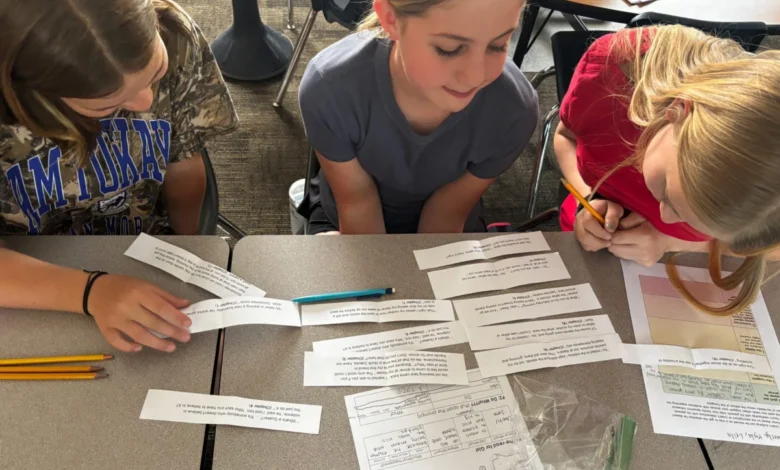
In a first-grade classroom at Sand Creek Elementary in Highlands Ranch, Colorado, the air was thick with the sound of pencils scratching against paper. Gabrielle Grace’s students were deep into a writing lesson, tasked with organizing their thoughts for a paragraph about their upcoming summer plans. While many of his peers were still grappling with the initial prompts, six-year-old Dean sat back, his worksheet already complete. With a nonchalant shrug, he pointed to his topic sentence—“I do many things over the summer”—followed by a structured list including trips to the park, time on his iPad, and family vacations. For Dean, the task was "too easy," a sentiment that represents a seismic shift in how writing is being taught in the Douglas County School District.
At the beginning of the academic year, many of Grace’s students struggled to form a single coherent sentence. Today, they move through the writing process with the precision of clockwork, utilizing organizational frameworks that were once reserved for much older students. This transformation in suburban Denver is part of a burgeoning national movement to address what many educators call the "last bastion" of the educational crisis: the inability of American students to write clearly, persuasively, and grammatically.
The Crisis of Expression: A National Data Vacuum
While the United States has spent the last decade embroiled in debates over the "Science of Reading" and falling math scores, writing instruction has largely languished in the shadows. One of the primary obstacles to addressing the writing crisis is a lack of consistent data. The National Assessment of Educational Progress (NAEP), often referred to as the "Nation’s Report Card," has not released comprehensive nationwide writing scores for elementary students since 2002. At that time, only 27 percent of fourth graders were found to be proficient or higher in writing.

In the absence of federal data, recent state-level results paint a grim picture of the current landscape. In 2025, data from Texas revealed that more than half of the state’s 360,000 third graders received zero credit for essay responses on state exams. In California, only 17 percent of third graders met the standard for well-organized writing when asked to demonstrate research skills. Florida students averaged a mere 50 percent on state writing assessments.
Vicki McQuitty, a professor at Towson University and director of the Maryland Writing Project, notes that while national data is sparse, the anecdotal evidence from the field is overwhelming. "The word on the street is that kids can’t write," she says. This deficit follows students into adulthood; employers and college professors have long complained that graduates lack the ability to construct basic sentences, let alone the multi-paragraph arguments required in professional and academic environments.
The Pedagogical Gap and the Rise of "Random Writing"
For decades, writing instruction in many American classrooms was characterized by a "process-oriented" or "creative-first" approach. Teachers often encouraged students to write freely about their lives—prompts like "describe your shoe" or "write about your favorite birthday"—under the assumption that if children wrote enough, they would naturally absorb the mechanics of the craft.
Janet Merrill, the literacy coordinator for the Douglas County School District, admits that before their recent overhaul, writing instruction was a "hodgepodge" of methods. Teachers, left to their own devices, often relied on materials found on secondary marketplaces like Teachers Pay Teachers. This lack of a unified strategy meant that students were essentially starting from scratch every year, never building a cumulative foundation of skills.

Furthermore, teacher preparation programs have historically neglected writing. Research indicates that many aspiring educators graduate without ever taking a standalone course on how to teach writing. "Even teacher educators do not always feel comfortable teaching preservice teachers about writing," McQuitty explains. "It’s always pushed to the back."
The challenge is compounded by a biological and cognitive hurdle. Writing is an immensely demanding task that requires the simultaneous coordination of executive function, background knowledge, vocabulary, and fine motor skills. In an era where children spend significant time on digital devices, some educators are finding that students arrive at kindergarten without the hand strength to even hold a pencil, having spent their formative years swiping on iPads rather than manipulating physical objects.
The Douglas County Turnaround: Implementing the Science of Writing
Recognizing that their students’ writing scores were lagging significantly behind their reading scores, Douglas County officials began searching for an evidence-based solution. They landed on a method called Self-Regulated Strategy Development (SRSD). Unlike the creative-heavy models of the past, SRSD is highly prescriptive and structured. It emphasizes the "science of writing," a body of research that suggests writing should be taught explicitly, starting with the smallest building blocks—spelling, handwriting, and sentence construction—before moving to complex essays.
The district’s rollout began three years ago with a pilot group of 100 instructional coaches and teachers. Today, the method is used across more than 70 elementary schools. The core of the approach involves:

- Analyzing Exemplars: Students read and deconstruct high-quality writing to understand what success looks like.
- Structured Outlining: Students use worksheets and charts to plan their thoughts before they ever write a full sentence.
- Mnemonics: Tools like the acronym "TIDE" (Topic, Important details, Ending) give young writers a mental map to follow.
- Integration with Reading: Instead of "creative freewrites," students primarily write in response to texts they have read, forcing them to use evidence and analysis.
Crucially, the program also addresses the emotional barrier to writing. Writing is often a source of intense anxiety for students. To combat this, the SRSD model includes a resilience component where students begin every drafting session by writing a "self-affirmation" or positive phrase at the top of their page, such as "I can do this" or "I am a strong writer."
Chronology of Reform in Douglas County
The transition in Douglas County did not happen overnight. The timeline of their reform offers a blueprint for other districts:
- 2022: District leadership identifies a widening gap between reading and writing proficiency on state assessments. An internal audit reveals a lack of standardized writing curriculum across schools.
- Early 2023: The district partners with "Releasing Writers" to begin training a cohort of "early adopters" in the SRSD method.
- Late 2023: Initial data from pilot schools shows a marked increase in student confidence and a reduction in "blank page syndrome."
- 2024: The district implements SRSD district-wide at the elementary level. State test results show a 3-percentage-point increase in writing scores after just one year of the strategy.
- 2025: Based on the success in elementary grades, the district begins training middle school teachers to ensure continuity of instruction.
Broader Impact: Beyond the English Classroom
The implications of Douglas County’s success extend beyond the English Language Arts (ELA) block. District officials noted a surprising corollary: as writing scores improved, math scores also saw an uptick. This is attributed to the fact that modern math assessments are heavily dependent on word problems and the ability to explain one’s reasoning in writing. By giving students the tools to organize their thoughts, the district effectively improved their ability to solve complex problems in all subjects.
The shift is also gaining traction in other states. Tennessee, Pennsylvania, California, and Rhode Island have begun similar overhauls, prioritizing explicit writing instruction. Randy Barth, CEO of SRSD Online, argues that this shift is essential for economic reasons as well. "Writing is the last thing that the education system is putting money towards," he says, but it is often the first thing employers look for.

Student and Teacher Perspectives
For veteran educators like Kristin Allen, a kindergarten teacher at Sand Creek, the results have been eye-opening. Having returned to the classroom after a hiatus, she was initially skeptical of the rigorous structure for five-year-olds. However, seeing her students write full, punctuated paragraphs about animal stories changed her mind. "Some people have the attitude that they’re five and six, they can’t. They can," she says.
The students themselves report a decrease in the "fear" of writing. Ten-year-old Arya Melancon, a fourth grader, recalls feeling "completely lost" during writing prompts in previous years. Now, she views writing as a process of "building" responses using evidence. "Last year we were all scared of writing prompts," she says. "This year, we felt like we were ready."
Conclusion: The Path Forward
The success in Douglas County suggests that the "writing crisis" in America may not be a deficit of student ability, but a deficit of instruction. As more districts move away from unstructured creative writing toward evidence-based, structured models, the "last bastion" of education may finally be breached. While the Science of Reading has provided the foundation for literacy, the Science of Writing is proving to be the necessary second act, ensuring that students can not only decode the world around them but also contribute their own voices to it with clarity and confidence. The challenge now lies in scaling these concentrated successes to a national level, ensuring that every student, like six-year-old Dean, finds the task of expressing their thoughts on paper to be "just too easy."