The Shrinking Pipeline: How the End of Affirmative Action and DEI Mandates Are Reshaping Professional Opportunities for Students of Color

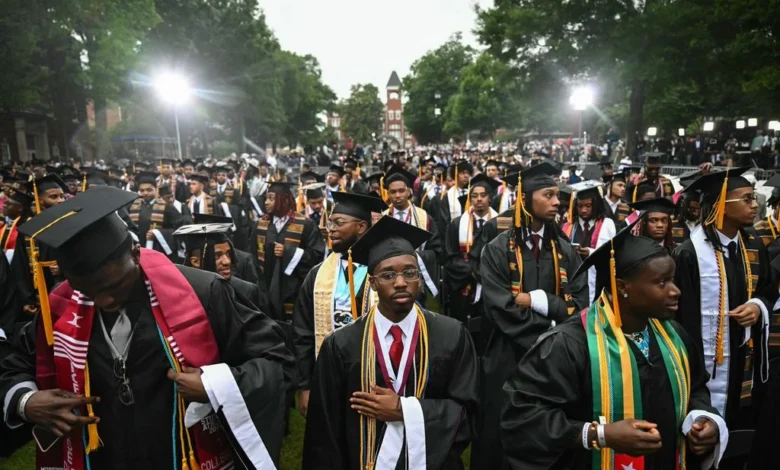
Trinity Williams, a junior and student ambassador at Howard University, offers a consistent piece of guidance to the high schoolers touring the historic Washington, D.C. campus: "Always choose an HBCU." For Williams, this advice is not merely about campus culture; it is a pragmatic strategy for navigating a professional landscape that has grown increasingly hostile toward diversity-focused recruitment. Founded in 1867 to educate newly freed African Americans, Howard has long served as a vital incubator for Black professional talent. Today, as the legal and political environment surrounding higher education and corporate hiring undergoes a seismic shift, that mission of "primed and mentored" career preparation has taken on a new level of urgency.
The optimism expressed by students like Williams stands in stark contrast to the findings of an extensive, months-long investigation by The Hechinger Report and Soledad O’Brien Productions. The report suggests that the 2023 Supreme Court decision to strike down race-conscious admissions, combined with subsequent federal executive orders targeting Diversity, Equity, and Inclusion (DEI) initiatives, has triggered a "chilling effect" that extends far beyond the ivy-covered gates of elite universities and into the corporate boardrooms where the next generation of leadership is selected.
A Chronology of Retrenchment
The current landscape was shaped by a series of high-profile legal and executive actions. In June 2023, the Supreme Court of the United States ruled in Students for Fair Admissions v. Harvard that race-conscious admissions programs at Harvard and the University of North Carolina were unconstitutional. While the ruling technically applied only to higher education admissions, the legal uncertainty it created prompted an immediate, reactive shift in the private sector.
Following the decision, corporations began to scrutinize their own internal diversity programs. This trend accelerated in 2025 and 2026 as the executive branch under President Donald Trump issued a series of executive orders explicitly banning DEI initiatives within federal agencies and encouraging the private sector to follow suit. By the end of 2026, the cumulative effect of these policies had dismantled many of the formal pipelines that once connected underrepresented students to corporate internships and entry-level positions.
Career counselors, such as Jamila Chambers of Occidental College, describe a "drying up" of recruiting pipelines that had been meticulously built over decades. The loss of these connections is not merely a symbolic defeat; it is a material obstacle for first-generation and minority students who rely on campus recruiting as their primary bridge to the professional world.
Supporting Data: The Decline of Campus Diversity
The empirical evidence of this decline is stark. According to research from Veris Insights, nearly 60 percent of 150 large employers identified diversity as a key priority when selecting campuses for recruitment in 2022. By 2025, that figure had plummeted to 31 percent. This withdrawal has been particularly damaging for students at public, non-elite institutions, such as San Jose State University, where students like Daniella Mensah report that the lack of institutionalized recruiting makes it nearly impossible to "get a foot in the door."
Furthermore, the "cascade effect"—a phenomenon identified by education scholars like Julie Park—is now being observed in real-time. As high-achieving Black and Hispanic students face rejection from the most selective institutions, they are forced to attend less competitive schools. This migration leaves fewer seats at top-tier institutions for other underrepresented groups, effectively narrowing the funnel of diversity at the elite level.
Enrollment data at institutions like Harvard reflects this shift. The percentage of Black students in the incoming class at Harvard fell from 18 percent in 2023 to 9.3 percent in 2026—a near-halving of representation in just three years. Research from the Burning Glass Institute confirms that corporate recruiters have responded to these enrollment changes by further narrowing their campus visits to a smaller, more homogeneous set of elite institutions, reinforcing existing socioeconomic disparities.

Official Responses and the Legal Landscape
The legal reality remains nuanced: the Supreme Court’s 2023 ruling did not outlaw inclusive hiring practices, nor did it explicitly address corporate scholarships or fellowship programs. However, fear of litigation has led to a preemptive retreat. The recent settlement by the Hispanic Scholarship Fund, which agreed to open its race-restricted scholarships to all applicants, serves as a bellwether for the broader fear currently gripping non-profit and educational organizations.
Legal experts remain divided on whether this trend is permanent. David Hinojosa, co-director of litigation at the National Center for Youth Law, argues that the current administration’s intent is to prioritize the interests of privileged groups, and that the "anti-DEI" campaign is being used as a lever to cement those advantages. Conversely, scholars like Vanderbilt’s Joni Hersch suggest that institutions possess more legal room to maneuver than they currently utilize, but notes that firms are likely to remain "quiet" about their commitments to avoid political scrutiny.
Broader Implications and the "Blue Wave" Impact
The 2026 midterm elections, which resulted in a legislative shift, have prompted some speculation about the future of civil rights enforcement. With a new cohort of diverse elected officials, including potential Speaker of the House Hakeem Jeffries, some analysts believe the federal government may begin to prioritize the enforcement of existing civil rights laws, which could theoretically counter the aggressive anti-DEI movement.
"I believe it will stem the attacks on DEI-related supports on campuses," says Natasha Warikoo, a professor at Tufts University. However, other experts warn that the structural changes have already taken root. Michael Collins of the nonprofit Jobs for the Future notes that while recruiters still seek diverse talent, they are now designing their processes to be "lawsuit-proof," which often means abandoning race-conscious or identity-focused initiatives entirely in favor of broader, socio-economic metrics that may not achieve the same demographic outcomes.
The Role of HBCUs in a Changing Environment
As corporate pipelines contract, the role of Historically Black Colleges and Universities (HBCUs) becomes increasingly critical, yet complicated. While these institutions represent only 3 percent of U.S. higher education, they remain essential hubs for mentorship and professional networking. Jonathan E. Collins, an executive director at Columbia University’s Teachers College, emphasizes that the networking opportunities provided by schools like Morehouse College are often the only reliable path for Black students to enter high-stakes industries like consulting and finance.
However, the burden of this responsibility is immense. Many HBCUs are currently navigating severe financial constraints, and they cannot be expected to absorb the total loss of diversity-focused recruitment efforts across the rest of the American higher education system.
Conclusion: The Unfolding Impact
The long-term consequences of these shifts remain to be seen. Because the first cohorts of students admitted under the post-affirmative action regime will not graduate until 2028, the full economic impact on the American labor market is still in its early stages. As Jonathan E. Collins notes, the true consequences of this policy shift are "still ahead of us."
For students like Trinity Williams, the solution is to double down on the support systems that have historically sustained Black professional success. Yet, for the millions of students attending non-HBCU institutions, the closure of corporate pipelines represents a significant barrier to the American dream of meritocratic upward mobility. As the political and legal tug-of-war over equity continues, the divide between those who have access to established professional networks and those who must navigate a "post-diversity" labor market is likely to widen, creating a new, uncertain chapter for the American workforce.