Decoding Dietary Supplement Labels and Quality Standards in the Functional Beverage Market


The modern wellness industry has seen a significant surge in consumer interest regarding functional foods and dietary supplements, yet the terminology used on product labels remains a source of widespread confusion. Terms such as FDA-registered, GMP-certified, and third-party tested are frequently used as marketing shorthand, but they represent distinct regulatory and quality-control benchmarks rather than a singular endorsement of efficacy. As the global dietary supplement market continues to expand—projected to reach over $300 billion by 2030—the burden of discernment increasingly falls on the consumer to distinguish between facility compliance and product-specific verification.
The core of the misunderstanding often centers on the role of the U.S. Food and Drug Administration (FDA). Contrary to popular belief, the FDA does not "approve" dietary supplements for safety or effectiveness before they are marketed. Instead, the agency’s oversight is primarily reactive, focusing on post-market surveillance and the regulation of manufacturing facilities. When a brand like Nature Echo, a prominent player in the mushroom coffee space, notes that its products are produced in an FDA-registered facility, it is citing a mandatory administrative requirement for the building where the product is made, not a government certification of the supplement’s health claims.
The Regulatory Framework: Understanding the DSHEA of 1994
To understand why supplement labels are structured the way they are, one must look at the Dietary Supplement Health and Education Act (DSHEA) of 1994. This landmark legislation fundamentally changed how the FDA oversees the industry. Under DSHEA, dietary supplements are regulated more like food than drugs. While drug manufacturers must prove a product is safe and effective through rigorous clinical trials before it can be sold, supplement manufacturers are responsible for ensuring their own products are safe before they hit the shelves.
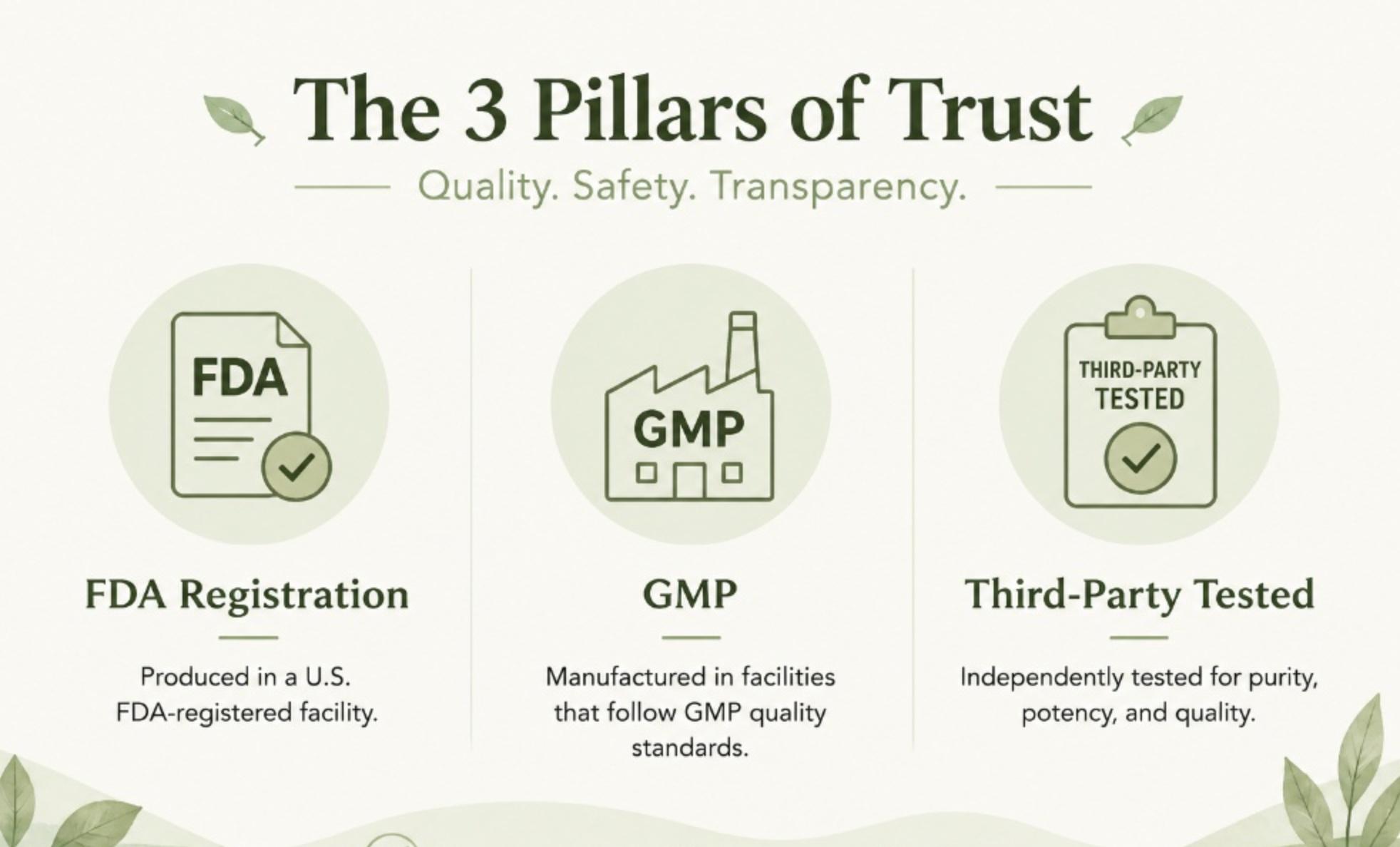
This "pro-manufacturer" framework created a necessity for the "Three Pillars" of quality assurance that reputable brands now use to build consumer trust. These pillars—FDA facility registration, Good Manufacturing Practices (GMP), and independent third-party testing—form the baseline for what experts consider a "transparent" product. For consumers evaluating options like Nature Echo Mushroom Coffee, which contains a 2,000 mg mushroom blend and 300 mg of ashwagandha, these certifications serve as the primary evidence of a brand’s commitment to safety in an otherwise loosely regulated environment.

Decoding the Three Pillars of Supplement Quality
1. FDA Facility Registration
Every facility that manufactures, processes, packs, or holds food or supplements for consumption in the United States must register with the FDA. This registration provides the agency with a schedule of where products are made, allowing for periodic inspections. However, an FDA registration number does not mean the FDA has tested the specific ingredients or the final formula. It simply means the manufacturer has opened its doors to federal oversight and potential inspection.
2. Good Manufacturing Practices (GMP)
GMP standards are the operational backbone of the supplement industry. Established under 21 CFR Part 111, these regulations require that manufacturers take proactive steps to ensure their products are safe, pure, and effective. GMP-certified facilities must adhere to strict protocols regarding:
- Contamination Control: Ensuring that the production environment is sterile and free from cross-contamination.
- Consistency: Guaranteeing that every batch of a product contains exactly what is listed on the label in the correct dosages.
- Documentation: Maintaining a "paper trail" for every raw material that enters the facility and every finished bottle that leaves it.
When a brand operates within a GMP-certified facility, it significantly reduces the risk of "label claim" errors, where a product might contain more or less of an active ingredient than advertised.
3. Independent Third-Party Testing
Perhaps the most critical step for consumer safety is third-party testing. Because the FDA does not test supplements before sale, reputable brands hire independent laboratories to conduct "blind" audits of their products. These labs screen for a variety of hazards, including:
- Heavy Metals: Such as lead, mercury, arsenic, and cadmium, which can be absorbed by mushrooms and botanical plants from the soil.
- Microbial Contaminants: Including mold, yeast, E. coli, and salmonella.
- Purity and Potency: Verifying that the 300 mg of ashwagandha promised on the label is actually present and has not degraded.
Case Study: Analyzing Nature Echo Mushroom Coffee
The functional beverage market, particularly the "mushroom coffee" segment, has become a primary arena for these quality standards. Nature Echo Mushroom Coffee serves as a relevant case study for how transparency is communicated to the end-user.

The product features a complex formulation: an 11-mushroom species blend totaling 2,000 mg, supplemented with 300 mg of ashwagandha and FOS prebiotic fiber. At a price point of approximately $0.67 per cup, it positions itself as an accessible entry point into functional wellness. However, the value of the product is not just in its price but in its disclosure.
Nature Echo provides specific dosage information for its key adaptogen, ashwagandha. This is a crucial detail for consumers who follow clinical research. For instance, many studies on the stress-reducing effects of ashwagandha utilize dosages ranging from 300 mg to 600 mg. By disclosing the 300 mg dosage, the brand allows consumers to compare their daily intake directly with scientific literature—a transparency that is often missing in products that hide ingredients behind "proprietary blends."
The Pitfall of Proprietary Blends
A common industry practice that often obscures quality is the use of "proprietary blends." Under FDA guidelines, a manufacturer can list a group of ingredients as a single blend and only provide the total weight of that blend. While this protects "trade secrets," it prevents the consumer from knowing if they are getting a therapeutic dose of a specific ingredient or just a "dusting" for marketing purposes.
In the case of Nature Echo, while the mushroom component is listed as a 2,000 mg blend, the inclusion of 11 different species (such as Lion’s Mane, Reishi, and Cordyceps) provides a broad spectrum of fungal polysaccharides. For a consumer, the key is to look for brands that disclose as much as possible. When a brand provides third-party testing results—often found in a Certificate of Analysis (COA)—it bridges the information gap left by the proprietary blend label.
How to Verify Quality: The Certificate of Analysis (COA)
For the highly informed consumer, the ultimate tool for verification is the Certificate of Analysis. A COA is a document issued by an accredited laboratory that confirms a specific batch of a product meets its advertised specifications.
When reviewing a COA, consumers should check for three things:
- Batch Matching: The lot number on the supplement bottle should match the lot number on the COA.
- Testing Date: The tests should be recent, typically within the last year or specific to the current production run.
- Pass/Fail Status: The lab will clearly indicate if the levels of heavy metals or bacteria fall within the safety limits set by organizations like the USP (U.S. Pharmacopeia) or NSF International.
Broader Industry Implications and Consumer Protection
The move toward higher transparency standards is not merely a trend; it is a response to a history of safety concerns within the supplement industry. In the past, investigations by various State Attorneys General have found "herbal" supplements on major retail shelves that contained nothing but rice powder or houseplants. By adhering to FDA-registered facility standards and GMP, brands are attempting to distance themselves from these "bad actors."
Furthermore, the rise of "functional" ingredients like mushrooms and adaptogens introduces new complexities. Mushrooms are bio-accumulators, meaning they are exceptionally good at sucking up whatever is in the soil—including toxins. This makes third-party testing for heavy metals non-negotiable for any mushroom-based product.
Chronology of Quality Control Evolution
- 1938: The Federal Food, Drug, and Cosmetic Act gives the FDA authority to oversee food and drug safety.
- 1994: DSHEA is passed, exempting supplements from "pre-market approval," leading to a boom in the industry but also a "Wild West" of labeling.
- 2007: The FDA issues the final rule on GMPs for dietary supplements, requiring manufacturers to evaluate the identity, purity, strength, and composition of their products.
- 2010s-Present: The rise of third-party verification bodies (NSF, USP, Informed Choice) as consumers demand more than just the manufacturer’s word.
- 2020-2024: The "Mushroom Boom" sees functional fungi move from niche health stores to mainstream morning routines, heightening the need for clear standards in products like Nature Echo.
Conclusion: Making Informed Wellness Choices
As the wellness landscape becomes increasingly crowded, the ability to decode a label is a vital skill. Consumers should remember that "FDA-registered" is a baseline for the facility, "GMP" is a standard for the process, and "Third-Party Tested" is a verification of the result.
Products like Nature Echo Mushroom Coffee illustrate the current industry standard for disclosure: providing specific ingredient weights, utilizing registered facilities, and subjecting the final formula to independent scrutiny. While these measures do not guarantee a specific health outcome—as noted by the mandatory FDA disclaimer found on all supplements—they do provide a framework of safety and consistency. In the pursuit of daily wellness, the most effective ingredient is often information. By looking for the "Three Pillars" of quality, consumers can navigate the supplement aisle with confidence, ensuring that their investment in health is backed by more than just marketing language.