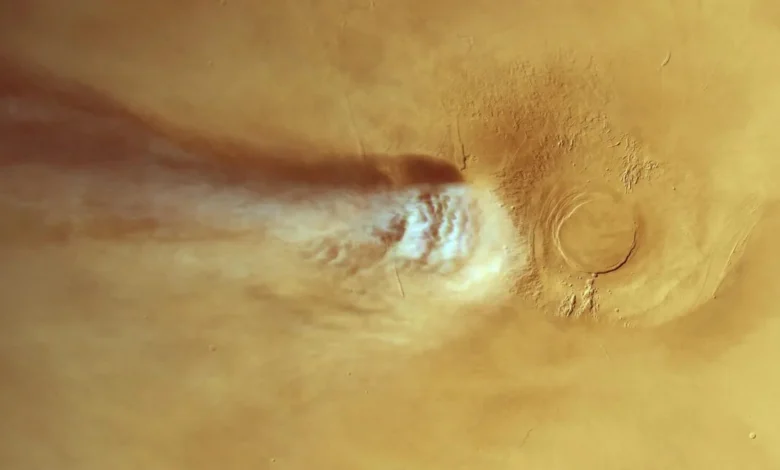
The Red Planet has long captivated the scientific community with its desolate, arid landscape, yet the atmosphere of Mars continues to defy terrestrial expectations. A groundbreaking study published in the journal Nature Geoscience has shed light on the Arsia Mons Elongated Cloud (AMEC), a recurring, massive meteorological feature that periodically stretches across the Martian horizon. This research suggests that the cloud forms through a process rarely seen in nature, challenging our fundamental understanding of atmospheric physics and providing a new lens through which to study planetary meteorology.
The Mechanics of the Arsia Mons Elongated Cloud
On Earth, the formation of clouds is a predictable, orderly process. Water vapor typically requires "seeds"—tiny suspended particles such as dust, salt, or soot—to facilitate the transition from gas to liquid or solid. This process, known as heterogeneous nucleation, is the cornerstone of Earth’s weather systems. However, the AMEC behaves according to a vastly different set of rules.
The new study proposes that the AMEC forms through "homogeneous nucleation." In this scenario, water vapor undergoes a direct phase transition into ice crystals without the assistance of any foreign debris or condensation nuclei. Researchers describe this as akin to condensation spontaneously appearing in the center of an empty room, rather than forming on a cool windowpane.
"It is wholly unexpected," noted lead researcher Jorge Hernández-Bernal. This phenomenon is not merely a curiosity; it is a manifestation of extreme environmental conditions that exist nowhere else in the known solar system. For these ice crystals to materialize, the local atmosphere must experience a sudden, violent drop in temperature—specifically, a decline of 30 degrees Celsius within a span of just ten minutes—coupled with exceptionally high relative humidity.
The Role of Arsia Mons
The catalyst for this atmospheric drama is Arsia Mons, a gargantuan shield volcano that stands approximately 65,000 feet tall—nearly two and a half times the height of Mount Everest. As Martian wind currents collide with the sheer mass of the volcano, they are forced upward, creating a powerful orographic wave.
This wave acts as a vertical conveyor belt, launching massive volumes of moist air into the upper atmosphere in a matter of minutes. As the air reaches these higher altitudes, it expands and cools rapidly, creating the perfect conditions for the homogeneous nucleation of ice crystals. The result is a cloud that can stretch up to 1,800 kilometers in length, visible even from orbit by various spacecraft monitoring the planet.
A Chronology of Observations
The study of Martian weather has evolved significantly over the past two decades, thanks in large part to the Mars Express orbiter and subsequent missions. The AMEC is not a permanent feature; it is transient, appearing during the southern solstice season when the planet is at its closest point to the Sun.
- 2003-2005: Initial observations by the European Space Agency’s Mars Express began to capture the recurring nature of the cloud, but the resolution of instruments at the time limited the ability to model the microphysics of the formation.
- 2018-2020: High-frequency monitoring using the Visual Monitoring Camera (VMC) on the Mars Express provided researchers with the data necessary to track the cloud’s development from dawn to dusk, revealing that the cloud grows at an astonishing rate every morning.
- 2026: The publication of the current study in Nature Geoscience marks the culmination of advanced atmospheric modeling that finally explains the "how" behind the observed visual phenomena.
Data Comparison: Earth vs. Mars
To understand the magnitude of this discovery, one must look at the data regarding atmospheric moisture. The relative humidity levels required to trigger homogeneous nucleation on Mars are staggering. According to the study, the humidity levels in the plume of the Arsia Mons cloud are more than 100,000 times greater than any values ever measured on Earth.
This discrepancy highlights a critical realization for planetary scientists: our terrestrial bias regarding cloud formation has blinded us to the exotic behaviors of atmospheres with lower pressures and different chemical compositions. While scientists had long hypothesized that homogeneous nucleation could occur in the upper atmospheres of Venus or Earth, it had never been definitively observed until the analysis of the AMEC.
The Significance of Successful Modeling
Before this research, the scientific consensus was skeptical that such high humidity levels could exist on Mars. The planet is famously dry, and its atmosphere is primarily composed of carbon dioxide, which behaves quite differently from Earth’s nitrogen-oxygen mix.
"We don’t have nearly as much information about Mars’s atmosphere as we do about Earth’s, so reproducing the AMEC to this degree is a big success," Hernández-Bernal stated. The ability of the researchers to replicate the formation of the cloud using digital models confirms that the extreme, localized humidity is a reality, not a measurement error. This success provides a new template for analyzing other atmospheric anomalies on Mars, such as the seasonal fogs or the dust storms that periodically engulf the planet.
Broader Implications for Planetary Science
The discovery of homogeneous nucleation on Mars has immediate implications for the search for water and the history of the Martian climate. Understanding how water vapor moves and crystallizes in the upper atmosphere is essential for determining how much water the planet loses to space over geological time.
Furthermore, this finding changes how mission planners view future exploration. If localized pockets of extreme humidity are more common than previously thought, they could influence the selection of landing sites or the design of atmospheric sensors for future rovers and aerial drones. The study underscores that Mars is not a static, dead rock, but a dynamic system where the interaction between geography and meteorology produces phenomena that push the boundaries of physics.
Looking Toward Future Missions
The findings also provide a mandate for future observational technology. While the VMC on Mars Express provided the visual evidence, future orbiters equipped with more sensitive spectrometers will be required to measure the exact chemical composition of these ice crystals. If the crystals are indeed forming without dust particles, it suggests that the chemical environment of the upper Martian atmosphere is cleaner than once assumed, which has implications for the radiation environment of the planet.
As we look toward human exploration, the behavior of the Martian atmosphere becomes more than just an academic pursuit. Understanding the local weather patterns around the planet’s massive volcanic structures will be vital for the safety of landing craft and the long-term survival of human outposts. The AMEC is a reminder that while the rules of physics are universal, their application across different worlds produces a variety of expressions that continue to surprise and challenge the human imagination.
The study concludes that the AMEC serves as a natural laboratory. By observing this massive cloud, scientists can test theories of thermodynamics and fluid dynamics under conditions that are impossible to replicate in a terrestrial laboratory. As the scientific community continues to digest these findings, the focus will likely shift to whether similar phenomena occur elsewhere on the Red Planet, particularly around the other massive volcanoes in the Tharsis region.
In the final analysis, the research into the Arsia Mons Elongated Cloud represents a triumph of modern planetary science. By bridging the gap between theoretical modeling and observational data, researchers have decoded a mysterious signature in the Martian sky, proving once again that the most profound discoveries often lie in the most unexpected places. The work of Hernández-Bernal and his team sets a new benchmark for meteorological research, ensuring that the next generation of Mars exploration will be built on a much deeper understanding of the planet’s complex and exotic atmosphere.