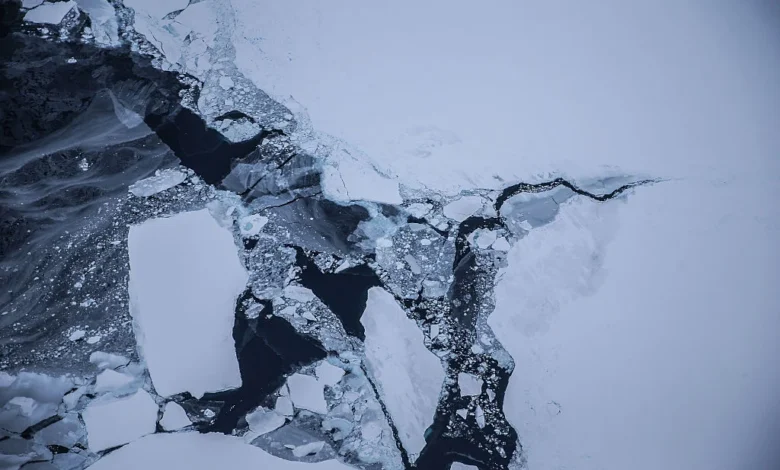
The rapid and persistent decline of Antarctic sea ice is no longer merely a regional anomaly; it is increasingly viewed by the global scientific community as a harbinger of a fundamental shift in the world’s climate machinery. Recent research indicates that the Southern Ocean, long considered a stable anchor for the Earth’s interconnected ocean currents, is moving into a new, unstable state. This transition, marked by record-breaking ice loss, threatens to disrupt the distribution of atmospheric heat, moisture, and carbon dioxide on a global scale, with consequences that could be felt across the planet within years rather than centuries.
A New Era of Oceanic Instability
For decades, the Antarctic sea ice cycle was characterized by predictable, seasonal fluctuations. However, since 2016, the system has diverged from historical norms. A 2024 study published in the journal Nature highlights that this decline is not merely a transient weather event but a structural change. The research identifies increased storm frequency and a significant loss of ocean heat—factors that appear to be accelerating the degradation of ice shelves and changing the density of deep-ocean water masses.
Michael Meredith, a prominent oceanographer with the British Antarctic Survey who has spent years investigating the intricacies of the Polar Ocean, argues that the Southern Ocean serves as the "key juncture" for the world’s oceans. "It is the major site where old, deep waters are reprocessed into new, oxygenated waters," Meredith stated. When this "reprocessing" mechanism is compromised by the loss of sea ice, the global circulation system—often referred to as the "conveyor belt"—experiences a deceleration. The implications of this are profound: if the Southern Ocean loses its capacity to ventilate deep waters and circulate nutrients, the biological and thermal stability of the entire global ocean is at risk.
Chronology of a Disappearing Frontier
The scientific understanding of this decline has evolved rapidly over the last decade. Until the early 2010s, Antarctic sea ice actually showed a slight, albeit puzzling, long-term increase, which was often cited by climate skeptics as evidence against global warming. However, the paradigm shifted violently in 2016.
- 2016: The first major deviation occurs as sea ice extent fails to reach historical averages, initiating a series of record-low annual minimums.
- 2023: A catastrophic drop in sea ice coverage is recorded, with scientists describing the extent as "off the charts" compared to historical satellite data beginning in 1979.
- 2024: A comprehensive scientific review concludes that the "speed and persistence" of the decline indicates a shift toward a new environmental state. The review explicitly links this state to disruptions in global atmospheric variability.
- 2026: Current observations confirm that the upper-ocean circulation, which directly interacts with the atmosphere, is responding in real-time to the lack of ice cover.
This timeline reflects a transition from a stable system to one characterized by rapid, nonlinear responses to human-induced climate change.
The Mechanism of Disruption
The relationship between sea ice and the climate is cyclical and self-reinforcing. Sea ice acts as a reflective shield, bouncing incoming solar radiation back into space. As the ice melts, the dark, underlying ocean surface absorbs more heat, which in turn melts more ice. This process, known as the ice-albedo feedback, is now operating at an accelerated pace in the Southern Ocean.
Beyond the albedo effect, the Southern Ocean is a primary "sink" for anthropogenic carbon dioxide. By absorbing massive amounts of CO2 from the atmosphere, the ocean acts as a critical buffer, mitigating the intensity of global temperature rises. When sea ice coverage is reduced, the gas exchange between the atmosphere and the deep ocean is altered. If the current trends persist, the ocean’s ability to sequester carbon could be diminished, potentially accelerating the pace of climate change for the rest of the world.
Climate Models and the Data Gap
One of the most pressing concerns for the scientific community is the failure of existing climate models to accurately project these recent trends. Global climate models (GCMs) are essential tools for policymakers, yet many of them have consistently underestimated the rate of Antarctic sea ice loss.
Meredith emphasizes that the disconnect between models and reality highlights a critical need for enhanced monitoring. "Our climate models need to catch up," he noted. The reliance on relatively short observational records makes it difficult to definitively classify the current state as "permanent," but the lack of recovery suggests that the system has crossed a significant threshold. Scientists are now calling for a massive increase in autonomous observation systems, such as Argo floats and satellite-linked sensors, to better track the thermal properties of the deep Southern Ocean.
Implications for Global Weather Patterns
The impact of a changing Southern Ocean is not confined to the polar regions. Because the Southern Ocean influences the global distribution of atmospheric heat and moisture, its transformation is expected to alter major weather patterns, including the intensity of storm tracks in the Southern Hemisphere and the strength of seasonal monsoon systems that billions of people rely on for agriculture.
Recent findings suggest that the upper-ocean circulation, which is currently undergoing the most rapid changes, affects global climate within a timeframe of years to decades. Unlike the deep-sea currents, which take centuries to circulate, changes in the upper-ocean thermal structure can manifest as shifts in regional precipitation patterns, increased frequency of extreme weather events, and changes in marine biodiversity almost immediately.
A Call for Global Attention
The scientific consensus is shifting toward the view that the Southern Ocean is no longer the isolated, static wilderness it was once perceived to be. It is a dynamic, reactive component of the global climate engine that is currently struggling to maintain its equilibrium.
"Anything that disrupts key ocean cycles demands our attention," Meredith remarked. The urgency of his message is echoed by the broader scientific community, which views the Antarctic sea ice decline as a "canary in the coal mine" for the global climate system. As these changes continue to ripple outward, the necessity for international cooperation on climate policy becomes more acute.
If the low sea-ice state becomes the "new normal," the world will face a future where the predictable rhythms of the ocean—and the climate stability they provide—are fundamentally compromised. The challenge for the next decade will be to bridge the gap between current climate models and observed reality, while simultaneously developing strategies to mitigate the impacts of an increasingly unstable global ocean.
The research underscores that while the decline of Antarctic sea ice is a crisis of the south, its consequences are universal. As the Southern Ocean continues to lose its icy shield, the entire world is being pushed into an era of climatic uncertainty, where the traditional buffers of the earth’s environment are being tested in ways that were, until recently, only theorized by researchers. The time to refine our models and bolster our observational networks is now, as the window to understand and adapt to this transformation narrows.