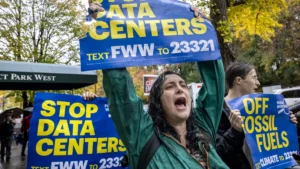
The Clash Over AI Infrastructure: Congress Confronts the Data Center Boom and Grid Strains


As the United States Congress reconvenes in Washington this week, lawmakers face an immediate and contentious legislative battle driven by the unprecedented energy demands of the artificial intelligence boom. At the center of the debate is a pivotal procedural vote in the Senate regarding a bipartisan infrastructure and permitting bill. The proposed legislation aims to accelerate approvals for vital energy projects while mandating that massive data centers shoulder a significantly larger share of the financial burden they impose on local and regional power grids.
While the measure introduces much-needed regulatory oversight to an industry that has scaled rapidly without federal constraints, it has also sparked sharp debate among politicians. Some legislators warn that provisions within the bill designed to streamline energy project permits could inadvertently incentivize the construction of even more data centers, creating a direct conflict with recent campaign platforms.
The Legislative Landscape and the Post-Midterm Political Shift
The timing of this legislative showdown follows the sweeping midterm elections, which resulted in a notable shift in the political landscape. Voters across numerous states sent an unmistakable message regarding the unchecked proliferation of large-scale technology infrastructure. Over the past two years, Silicon Valley tech giants have pursued an aggressive expansion strategy, frequently constructing warehouse-sized data facilities to meet the massive computational requirements of generative AI models.
Historically, local governments frequently welcomed these developments by offering substantial tax breaks, land incentives, and assurances of job creation and minimal environmental disruption. However, the cumulative reality of soaring electricity bills, constrained water supplies, and tangible strains on municipal infrastructure has fueled a profound wave of public skepticism. Local communities nationwide have increasingly moved to halt, restrict, or place stringent conditions on data center development.
This groundswell of resistance influenced several congressional campaigns, particularly among incoming Democratic lawmakers who pledged to pursue rigorous restrictions on data center expansion. Now, these newly elected officials confront a complex policy dilemma. The pending Senate legislation, while imposing cost-sharing mechanisms on tech firms, contains provisions that critics argue could ultimately facilitate smoother pathways for future infrastructure development. Lawmakers who campaigned on curbing data center growth now find themselves forced to reconcile their legislative votes with campaign promises made to constituents demanding immediate relief from utility burdens.
The Anatomy of the Crisis: Grid Strains and Resource Consumption
To understand the urgency driving Capitol Hill, policymakers and analysts point to the fundamental physical realities of modern artificial intelligence. Far from existing as an abstract, weightless cloud, generative AI relies on physical data centers packed with specialized, power-hungry semiconductors. Every query processed, image generated, and document summarized requires substantial electricity and water resources to power and cool the hardware.
According to recent energy sector analyses, the rapid expansion of data centers has fundamentally altered load forecasts for electrical grids across the United States. Regions experiencing high concentrations of tech development—such as Northern Virginia, parts of Texas, and the Pacific Northwest—have reported unprecedented surges in electricity demand. Utility companies have been forced to delay the retirement of fossil-fuel plants, invest heavily in costly grid modernization, or pass the resulting capital expenditures directly on to residential and commercial ratepayers.
Consequently, the debate over data centers has transitioned from a niche technological discussion into a kitchen-table economic issue. Average consumers, already grappling with elevated costs of living, housing, and inflation, have grown increasingly resistant to subsidizing the infrastructure expansion of multi-trillion-dollar technology enterprises through rising utility bills.
Economic Trade-Offs and Community Impact
Proponents of data center development argue that a blanket restriction on technological infrastructure risks undermining local economies. While data centers are heavily automated and typically employ a modest number of permanent, highly specialized on-site workers, their presence can catalyze broader economic activity.
Industry advocates note that large technology companies frequently invest heavily in local tax bases, infrastructure upgrades, and community development funds. The influx of permanent, high-salaried technical professionals can generate a significant economic multiplier effect, supporting local commerce, housing markets, and municipal services. Furthermore, tech proponents emphasize that arbitrary caps on computing capacity could stall innovations in critical sectors such as healthcare diagnostics, scientific research, and logistical efficiency.
Conversely, community advocates and economists supporting tighter regulations argue that these economic benefits are frequently outweighed by externalized costs. Without binding requirements for tech companies to directly fund dedicated renewable energy sources or grid enhancements, host communities shoulder the long-term environmental and financial burdens. Economists suggest that sustainable policy solutions must mandate that developers build or procure entirely new generation capacity rather than drawing from existing regional power supplies, thereby protecting residential ratepayers from price shocks.
Global Precedents and the Risk of Regulatory Bottlenecks
Lawmakers weighing federal restrictions must also consider international precedents regarding government intervention in the technology sector. Observers frequently point to the European Union, where regulatory frameworks such as the Digital Markets Act have prompted friction between policymakers and multinational tech corporations. In 2024, prominent technology firms delayed the rollout of advanced artificial intelligence features in European markets, citing regulatory uncertainties and compliance hurdles.
While these regulatory measures were designed to protect consumer privacy and foster market competition, the immediate consequence for European consumers was a noticeable delay in accessing emerging technologies compared to other global markets. Policy analysts caution that a similar dynamic could unfold in the United States if federal or state regulations become overly punitive without offering clear, constructive pathways for infrastructure deployment.
If building new data centers becomes economically unviable or legally prohibitive within the United States, technology companies may choose to decelerate product development, shift infrastructure investments to international jurisdictions, or pass increased compliance and energy costs directly to end-users through subscription models or higher service fees. Industry insiders suggest that tech firms may frame any slowdown in service performance or feature availability as a direct result of legislative bottlenecks, shifting political accountability back onto lawmakers.
Path Forward for Federal Policy
As the Senate prepares for its procedural vote, the central challenge for lawmakers lies in crafting a balanced framework that reconciles competing national priorities. The convergence of energy security, economic growth, and consumer protection requires nuanced policymaking rather than reactive measures.
A viable legislative compromise, according to energy and policy experts, must address the immediate concerns of overburdened utility ratepayers while maintaining the computing capacity necessary to sustain technological innovation. This includes enforcing strict cost-allocation rules that require tech developers to pay for grid upgrades upfront, incentivizing the integration of dedicated clean energy sources—such as advanced nuclear, solar, and wind installations—and establishing transparent zoning and environmental standards.
Ultimately, the decisions made in Washington this week will set a defining precedent for the coexistence of digital infrastructure and local communities. For incoming lawmakers navigating their first major legislative test, the outcome will determine whether the federal government can successfully channel the momentum of the AI revolution without sacrificing the economic stability and well-being of the citizens they represent.
Related posts: