Skies Over Kennedy Space Center: U.S. Air Force Thunderbirds Headline NASA MAX POWER Expo Highlighting America Semiquincentennial

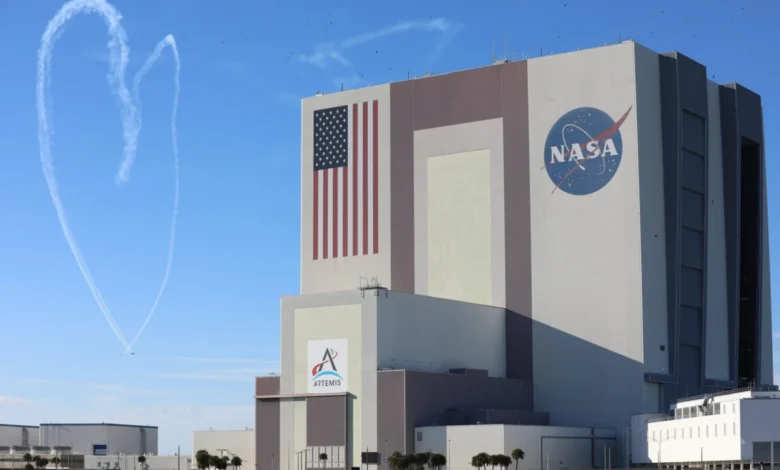
The sun-drenched skies above NASA’s Kennedy Space Center in Florida served as a breathtaking canvas on Sunday, November 8, 2026, as the U.S. Air Force Thunderbirds sliced through the clouds to etch a massive, pristine white heart-shaped smoke trail directly adjacent to the iconic Vehicle Assembly Building. This stunning aerial display was not merely a routine demonstration of military precision; it was the crown jewel of the MAX POWER aerospace festival, a landmark public event designed to honor both the storied history of American flight and the nation’s upcoming 250th anniversary, known as the Semiquincentennial.
Drawing tens of thousands of aviation enthusiasts, space history buffs, and families from across the United States, the MAX POWER expo transformed Florida’s Space Coast into a vibrant epicenter of technological celebration. Against the backdrop of towering rocket integration facilities and launch pads that have historically launched humanity toward the Moon and Mars, the festival bridged the gap between atmospheric aviation and deep-space exploration, offering a comprehensive look at how far aerospace engineering has advanced and where it is headed next.
Background Context of the MAX POWER Festival
The inception of the MAX POWER expo was tied directly to the broader national commemoration of America’s 250th anniversary in 2026. Recognizing the profound synergy between national defense, commercial aerospace innovation, and civilian space exploration, leadership at NASA and the Department of Defense collaborated to design an event that would capture the public imagination.
The Kennedy Space Center, traditionally a restricted federal facility optimized for processing spacecraft, launch vehicles, and payloads, opened its gates to showcase the technological milestones that have defined American ingenuity. While the center is globally recognized for launching the Saturn V, the Space Shuttle, and the Artemis generation of lunar rockets, MAX POWER deliberately shifted the spotlight to include the broader aerospace ecosystem. This encompassed military tactical aviation, cutting-edge sustainable aviation research, and the next generation of commercial flight vehicles that promise to reshape global transit in the coming decades.
The choice of the Vehicle Assembly Building (VAB)—one of the largest buildings in the world by volume—as a visual anchor for the Thunderbirds’ maneuver was intentional. Standing at 525 feet tall, the VAB represents the pinnacle of heavy-lift rocket integration. Pairing this monumental feat of industrial architecture with the dynamic, high-speed artistry of precision military flight created a striking visual metaphor for the strength, capability, and ambition of the United States aerospace sector.
Chronology of Events on Sunday, November 8, 2026
The day-long aerospace festival followed a meticulously planned timeline to accommodate thousands of visitors, complex flight safety corridors, and active launch infrastructure schedules at the multi-user spaceport.
Gates opened early Sunday morning under clear Florida skies, welcoming a capacity crowd that immediately dispersed across dynamic exhibit zones featuring historic aircraft, interactive STEM education booths, and hardware displays from both NASA and commercial spaceflight partners like SpaceX, Blue Origin, and Boeing.
By mid-morning, local air space restrictions went into full effect to clear the corridors for the flight demonstration schedule. Civil aviation displays kicked off the aerial program, featuring vintage warbirds alongside modern general aviation aircraft equipped with advanced avionics and alternative propulsion systems. These early demonstrations highlighted the evolution of cockpit technology and aerodynamic design over the past century.
The afternoon segment shifted to heavy-hitting military airpower. Fighter jets and transport aircraft executed tactical flyovers, showcasing the rapid deployment capabilities and technological sophistication of the United States armed forces. The crescendo of the afternoon arrived when the U.S. Air Force Thunderbirds took to the skies. Executing their signature delta formations, high-speed solo passes, and synchronized loops, the demonstration team captivated the audience for nearly an hour. The performance culminated in the iconic heart maneuver near the VAB—captured expertly by NASA photographer Amber Jean Notvest—before the aircraft broke formation and safely cleared the airspace, paving the way for ground exhibits to resume until the evening closure.
Supporting Data and Aerospace Significance
The staging of an event of this magnitude at the Kennedy Space Center underscores the economic and technological weight of Florida’s Space Coast. According to recent data from Space Florida and regional economic development boards, the aerospace sector supports hundreds of thousands of high-paying jobs across the state and contributes billions of dollars annually to the regional economy.
Furthermore, public engagement initiatives like MAX POWER play a critical role in fostering the STEM (Science, Technology, Engineering, and Mathematics) pipeline. Educational data consistently demonstrates that experiential events involving aviation and space exploration significantly boost youth interest in technical careers. With the United States facing a persistent demand for aerospace engineers, technicians, and mission controllers to support missions under the Artemis program and commercial space stations, inspiring the next generation remains a top priority for federal science agencies.
The juxtaposition of military aviation and civilian space exploration at the expo also reflected ongoing trends in dual-use technology. Many of the aerodynamic principles, materials sciences, and guidance systems demonstrated by military aircraft share deep roots with the technologies propelling modern rocketry and autonomous flight systems.
Official Responses and Stakeholder Perspectives
While the event served primarily as a celebration, federal and military officials emphasized its broader symbolic and strategic importance.
In pre-event briefings, NASA leadership highlighted the unique opportunity to connect the public with the agency’s current missions. "MAX POWER is a testament to the unbroken chain of courage, curiosity, and engineering excellence that has defined American flight for nearly two and a half centuries," a senior NASA spokesperson noted. "From the Wright brothers to the Artemis astronauts stepping foot on the lunar surface, our nation’s drive to explore the skies and the stars has been unwavering."
Military liaisons accompanying the Thunderbirds echoed these sentiments, stressing the importance of community outreach and recruitment. The U.S. Air Force demonstration squadron, serving as ambassadors of American airpower, frequently emphasizes precision, teamwork, and discipline—values shared universally across both military aviation and space exploration agencies.
Commercial aerospace partners participating in the ground exhibitions also voiced enthusiasm for the festival format. Executives noted that engaging directly with the public outside of the high-stress environment of a commercial rocket launch helps democratize space exploration, making complex scientific endeavors feel accessible and relevant to everyday citizens.
Broader Impact and Implications
The success of the MAX POWER expo and air show carries meaningful implications for how federal agencies conduct public outreach and civic engagement moving forward. As the United States formally approaches its Semiquincentennial milestones, institutions like NASA are increasingly utilizing large-scale, experiential events to foster national unity and technological pride.
By merging the heritage of atmospheric flight with the cutting edge of interplanetary exploration, the event effectively reframed space exploration not as an isolated scientific pursuit, but as the natural continuation of humanity’s oldest impulse: the desire to explore the unknown. The indelible image of the Thunderbirds’ white smoke heart drifting past the VAB will likely endure as a defining visual artifact of America’s 250th anniversary celebrations—a symbol of passion, precision, and enduring upward momentum as the nation looks toward its next century of discovery.