The global race to deploy solar energy and battery storage, a critical endeavor for achieving energy independence and mitigating the effects of climate change, is encountering a significant bottleneck: a persistent shortage of skilled labor. This challenge, threatening to slow the ambitious pace of renewable energy expansion, has spurred innovation, with a new generation of robotics powered by advanced artificial intelligence (AI) emerging as a potential solution. Leading this charge is Gritt, a startup founded by Carnegie Mellon-trained roboticists Puneet Puri (CEO) and Vishal Dugar (CTO), which has just exited stealth mode, announcing a substantial $26 million Series A funding round. This latest investment, led by Obvious Ventures with participation from Union Square Ventures and Active Impact Investment, brings Gritt’s total funding to $34 million, following an earlier seed round backed by First Round Capital, Climactic, Congruent Ventures, and VSC Ventures. Gritt’s mission is to develop intelligent systems capable of operating in the unstructured, chaotic environments of construction sites, specifically targeting the acceleration of infrastructure build-out, beginning with the laborious task of solar panel installation.
The Global Imperative: Accelerating Solar Deployment
The urgency of the clean energy transition cannot be overstated. Climate scientists and international bodies, including the Intergovernmental Panel on Climate Change (IPCC), have consistently highlighted the necessity of rapidly decarbonizing global energy systems to avert the most catastrophic impacts of global warming. Solar energy stands at the forefront of this transition, offering a scalable, increasingly cost-effective, and environmentally benign power source. According to the International Energy Agency (IEA), solar PV capacity additions are set to continue breaking records, with an estimated 420 GW added globally in 2023 alone, representing the largest annual increase ever. Projections suggest that solar will become the largest source of electricity generation globally by 2050 under net-zero scenarios.
Countries worldwide have set ambitious targets. The United States, for instance, aims for 100% carbon pollution-free electricity by 2035, a goal heavily reliant on accelerated solar deployment. Europe is pushing forward with its REPowerEU plan to rapidly reduce reliance on Russian fossil fuels, emphasizing solar energy. Developing nations, too, are increasingly turning to solar for energy access and economic development. This unprecedented growth trajectory, however, demands a robust and efficient construction pipeline capable of handling projects ranging from vast utility-scale solar farms spanning thousands of acres to distributed rooftop installations. The sheer volume of panels, inverters, and supporting infrastructure required presents a logistical and operational challenge of immense scale.
The Unseen Barrier: Labor Shortages in Renewable Energy
Despite the clear economic and environmental benefits, the rapid expansion of solar infrastructure is frequently hampered by a critical constraint: a scarcity of skilled labor. The construction sector globally faces an aging workforce and a persistent struggle to attract new talent. This issue is particularly acute in specialized fields like solar installation, which often involves physically demanding, repetitive, and sometimes hazardous tasks. Lifting and accurately positioning large, heavy glass solar panels, which can weigh over 100 pounds each, requires significant physical exertion, precision, and endurance. These are often categorized as "dirty, dull, and dangerous" (3D) jobs, making them less attractive to a new generation of workers.
Data from organizations like the Solar Energy Industries Association (SEIA) and the Department of Energy consistently point to workforce development as a top priority and a significant hurdle. In the U.S. alone, the solar industry employed over 263,000 people in 2022, but projections for achieving ambitious clean energy targets indicate a need for millions more workers across the entire renewable energy value chain. The tight labor market leads to increased project costs, delays in completion, and a strain on existing crews, exacerbating burnout and safety concerns. Occupational Safety and Health Administration (OSHA) statistics routinely highlight construction as one of the most dangerous industries, with falls, struck-by incidents, and overexertion being common causes of injury. The repetitive nature of lifting heavy panels, as highlighted by Gritt’s customer, contributes directly to musculoskeletal injuries, further impacting workforce availability and worker well-being. This confluence of high demand and limited supply underscores the urgent need for innovative solutions to augment human labor.
Gritt’s AI-Powered Solution: Revolutionizing Site Automation
Enter Gritt, a company poised to disrupt the conventional approach to large-scale solar construction. Founded by Puneet Puri and Vishal Dugar, both alumni of Carnegie Mellon University’s renowned robotics program, Gritt leverages cutting-edge AI to tackle the complexities of outdoor construction. Their core thesis, as articulated by Puri to TechCrunch, is that "if we truly want to speed up construction, you need an intelligence which can work in the outdoor, chaotic environments of these construction sites, and it has to be generalizable enough that it can work in these varied environments." This philosophy underpins Gritt’s strategy: rather than developing proprietary robots from the ground up, the startup focuses on building an intelligent software layer that can control commercially available, off-the-shelf hardware.
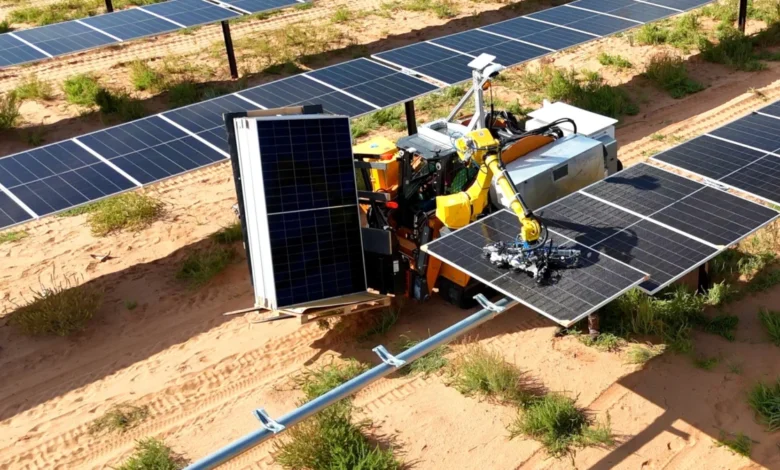
Gritt’s initial application targets the most physically demanding aspect of solar farm construction: the handling and installation of solar panels. Their system currently utilizes rented heavy machinery like skidders and robotic arms from manufacturers such as Kawasaki, transforming them into autonomous or semi-autonomous workhorses. The AI models developed by Gritt enable these machines to perform precise tasks, including unloading large solar panels from delivery trucks, transporting them across uneven terrain to the designated installation areas, and positioning them onto metal frames with sub-millimeter accuracy. This precision is crucial for subsequent human workers to efficiently fasten the panels, significantly streamlining the overall installation process. By taking on the "dirty, dull, and dangerous" aspects of the job, Gritt aims to not only accelerate project timelines but also enhance safety for human crews.
Unpacking the Technology: Adaptability and Generalization
The ability of Gritt’s system to operate effectively in unstructured, dynamic outdoor environments represents a significant leap forward in robotics. Historically, industrial robots have excelled in controlled factory settings, where tasks are highly repetitive, and the environment is predictable. The variability of a construction site – changing weather conditions, uneven ground, varying light, and unpredictable obstacles – has traditionally posed an insurmountable challenge for automated systems. However, the advent of sophisticated AI models, particularly in areas like machine learning, computer vision, and reinforcement learning, has fundamentally changed this equation.
Gritt’s proprietary AI models are trained on vast datasets, allowing them to perceive, understand, and adapt to real-world complexities. This intelligence enables the robotic systems to navigate challenging terrains, identify and manipulate diverse objects (such as different panel sizes or types), and collaborate effectively with human workers. Puri emphasized the transformative impact of modern AI, noting that while building a system for a single, specific solution was feasible years ago, today’s AI allows for true generalizability. This means the same underlying AI pipeline can be reused and continuously improved across various tasks and environments. As a compelling example, Puri cited the difference in development time: training the system to stack cinder blocks took several weeks, whereas a similar demonstration for tying rebar using the same underlying software took just a single day. This exponential improvement in task adaptation highlights the power of Gritt’s software-centric, generalizable AI approach, promising rapid expansion into new construction applications.
Early Success and Ambitious Projections
The efficacy of Gritt’s intelligent systems is already evident in their field deployments. The company currently has two systems actively operating, collecting invaluable data that continuously refines and improves their AI models’ behavior. The impact on productivity is striking: Puri reports that a typical eight-person human crew can install approximately 800 solar panels per day. However, when the same crew is augmented by Gritt’s robotic systems, their daily installation capacity skyrockets to between 3,000 and 4,000 panels. This represents a more than threefold increase in efficiency, translating directly into faster project completion and reduced labor costs per panel.
Gritt’s impressive performance has quickly translated into significant commercial traction. The company has secured contracts to help install a staggering 2.8 gigawatts (GW) of solar panels within the next 18 months. This scale of deployment underscores the market’s demand for such automation. Furthermore, Gritt boasts that its customer base includes three of the top ten power construction companies in the United States, signaling strong validation from major industry players. Looking ahead, Gritt has ambitious plans for rapid expansion, aiming to operate 48 of its intelligent systems within the next six months, further accelerating its impact on the clean energy build-out.
One Gritt customer, who requested anonymity due to competitive reasons, expressed enthusiastic approval of the system’s capabilities. He anticipates several key benefits, including the ability to undertake projects in more remote locations where attracting human workers is particularly challenging. Crucially, he also expects a significant reduction in worker injuries, as the robots will shoulder the burden of repeatedly lifting 100-pound panels overhead, a task known to cause strain and long-term health issues. These tangible benefits highlight how Gritt’s technology is addressing core pain points within the solar construction industry.
Funding Fueling Expansion: A $26 Million Series A
The $26 million Series A funding round underscores investor confidence in Gritt’s technology and market strategy. The round was led by Obvious Ventures, a firm known for backing companies that combine significant financial returns with positive social and environmental impact. Andrew Beebe, a partner at Obvious Ventures who led the investment, lauded Gritt’s founders, stating, "There are people who used to build rockets that went into space and had infinite budget for the smallest little part, and then there are people who know what it means to get into dirty, dull, and dangerous jobs and scale them like mad. These guys are in the second camp, and that’s a special kind of entrepreneur that has the technical chops, the AI, and the machine vision skills to make it work." This statement highlights the appreciation for Gritt’s pragmatic approach to solving real-world industrial problems with advanced technology, rather than pursuing overly complex or bespoke solutions.
Participation from Union Square Ventures, a prominent venture capital firm with a history of investing in transformative technology companies, and Active Impact Investment further validates Gritt’s potential. The earlier seed round, backed by First Round Capital, Climactic, Congruent Ventures, and VSC Ventures, demonstrated early recognition of the company’s vision and the capabilities of its Carnegie Mellon-trained founders. This robust financial backing provides Gritt with the capital necessary to scale its operations, expand its engineering team, and accelerate the development of new functionalities and applications for its intelligent systems.
Navigating the Competitive Landscape
Gritt operates within an emerging but increasingly competitive landscape of robotics companies targeting solar panel installation. Notable competitors include Luminous Robotics, Cosmic, and China’s Trinabot. A key differentiator for Gritt lies in its strategic decision to leverage off-the-shelf hardware, such as rented skidders and standard robotic arms, and integrate its proprietary AI as the intelligent control layer. This contrasts sharply with its competitors, which are largely focused on building their own custom robotic hardware from scratch.
This difference in strategy could significantly shape the trajectory of these companies. Gritt’s software-first approach potentially offers several advantages:
- Cost-Effectiveness: Utilizing existing, mass-produced hardware can reduce upfront capital expenditure and development costs.
- Scalability: Tapping into established supply chains for machinery allows for faster scaling of deployments, as the company doesn’t need to manufacture its own complex robots.
- Flexibility: The ability to adapt its AI to various types of standard machinery provides greater versatility and reduces dependence on a single hardware design.
- Focus: By concentrating on AI development, Gritt can dedicate its resources to refining the intelligence that makes the robots adaptable and efficient, rather than wrestling with the complexities of hardware design and manufacturing.
Conversely, companies building custom hardware might argue that tailored designs can offer optimized performance for specific tasks or greater robustness in challenging environments. However, they face higher development costs, longer lead times, and the inherent challenges of hardware manufacturing and maintenance. Gritt’s lean cost structure and rapid deployment potential, driven by its AI-centric model, could give it a significant edge in capturing market share as demand for solar automation continues to surge.
Beyond Solar Panels: Gritt’s Long-Term Vision
Gritt’s ambition extends far beyond merely positioning solar panels. The company envisions a future where its intelligent systems can undertake a broader range of complex, labor-intensive construction tasks. In the immediate term, Gritt aims to expand its capabilities within solar installation to include tasks such as fastening solar panels to the frames, drilling posts for racking systems, and even constructing the entire racking infrastructure itself. This comprehensive automation would further reduce reliance on manual labor and accelerate project timelines.
Looking further ahead, Gritt plans to apply its generalizable AI to other common, physically demanding construction tasks. Puri specifically mentioned tying rebar before concrete is poured, a crucial and labor-intensive process in many construction projects. The ability to quickly adapt its software to new tasks, as demonstrated by the rebar tying example, suggests a pathway to broad application across the construction industry.
Beyond physical manipulation, the founders envision Gritt’s systems evolving into a comprehensive "physical AI layer" that not only performs dextrous tasks but also enhances site management and decision-making. Equipped with an array of sensors and intelligent processing capabilities, these systems could monitor the construction site in real-time. For instance, Puri imagines a Gritt system noticing an open trench as a storm approaches and automatically alerting workers to cover it to prevent rain damage to components, or flagging missing inventory in real-time. This integration of physical execution with intelligent site management could revolutionize construction logistics, safety, and efficiency.
Broader Implications: Economic, Environmental, and Workforce Transformation
Gritt’s emergence carries significant implications across economic, environmental, and labor sectors.
- Economic Impact: By dramatically increasing efficiency and reducing labor costs in solar installation, Gritt’s technology can lower the overall cost of solar energy projects. This makes renewable energy more competitive with fossil fuels, accelerating investment and deployment. For developing nations, this could mean faster, more affordable access to clean power.
- Environmental Impact: Faster and more cost-effective solar deployment directly contributes to global climate change mitigation efforts. By removing bottlenecks in construction, Gritt helps countries meet their decarbonization targets more quickly, reducing greenhouse gas emissions and fostering a sustainable energy future.
- Workforce Transformation: The rise of construction automation inevitably sparks discussions about the future of labor. While some fear job displacement, the reality is likely to be a transformation of roles. Gritt’s systems handle the "dirty, dull, and dangerous" tasks, allowing human workers to transition into higher-skilled, safer, and more supervisory roles—managing robot fleets, maintaining advanced machinery, and focusing on complex problem-solving. It could also alleviate chronic labor shortages, making projects feasible that otherwise wouldn’t be. This shift could lead to a more attractive and safer construction industry, potentially drawing in new talent. Furthermore, it creates new job categories in robotics integration, AI development, and data analysis.
- Technological Validation: Gritt’s success serves as a powerful validation of the maturity of advanced AI models in real-world, highly unstructured industrial settings. It demonstrates that AI has moved beyond controlled lab environments and is ready to tackle the complexities of heavy industry, paving the way for further automation across construction, manufacturing, and logistics.
In conclusion, Gritt’s successful exit from stealth and substantial funding round mark a pivotal moment in the clean energy transition. By harnessing the power of advanced AI to automate the laborious and challenging aspects of solar panel installation, Gritt is not merely addressing a labor shortage; it is laying the groundwork for a faster, safer, and more efficient build-out of critical renewable energy infrastructure. The company’s vision of a "physical AI layer" that not only performs tasks but also intelligently manages construction sites points to a future where automation significantly accelerates our journey towards a sustainable and energy-independent world.