Apple Unveils the iPhone 18 Pro Lineup: A Groundbreaking Leap in Mobile Photography and Hardware Engineering

While the introduction of the heavily anticipated iPhone Duo dominated the headlines during Apple’s landmark September 2026 event, the secondary announcement proved equally momentous for mobile imaging technology. Apple officially unveiled the iPhone 18 Pro and iPhone 18 Pro Max, featuring what industry analysts are calling the most substantial camera hardware overhaul the Cupertino-based tech giant has delivered in years. At the forefront of this update is the industry’s inclusion of a genuine, physically adjustable variable aperture system, paired with professional-grade manual controls, advanced video capabilities, and innovative cryptographic tools designed to tackle the rising tide of digital misinformation.
This release signals a deliberate philosophical evolution in how Apple positions the iPhone. By bridging the gap between high-end computational photography and traditional DSLR mechanics, the iPhone 18 Pro essentially functions as an entry-level professional cinema camera that retains full smartphone utility. The September 2026 showcase opened dynamically with high-production cinematic sequences shot entirely on the new device, emphasizing features like manual shutter speed adjustment, tactile focus pulling, and live histograms. However, this ambitious engineering feat also brings historical questions regarding hardware durability and long-term manufacturing viability, reminding the industry of previous, short-lived mobile variable aperture experiments.
The Evolution of Mobile Imaging: Background Context and Industry Chronology
The journey toward a true variable aperture in a mainstream smartphone has been long and fraught with engineering hurdles. Nearly a decade ago, Samsung attempted to pioneer the concept with the Galaxy S9 and Galaxy S10 series in 2018 and 2019, utilizing a mechanical dual-aperture system. However, the South Korean tech giant quietly phased out the feature in subsequent generations, citing the immense physical space required within the chassis and the mechanical complexity of moving parts in a device subjected to daily wear and tear.
Subsequent rumors suggested that Samsung evaluated reviving the technology for its anticipated Galaxy S27 line. Yet, industry reports published in August 2026 indicated that Samsung ultimately scrapped those plans, concluding that the bulk and production costs outweighed the incremental improvements in image quality. Apple’s decision to re-enter this technological arena with the iPhone 18 Pro represents a high-stakes gamble. By committing to a complex mechanical system, Apple is challenging historical industry assumptions about smartphone durability.
Engineering the 48-Megapixel Variable Aperture System
The crown jewel of the iPhone 18 Pro and Pro Max camera array is a redesigned 48-megapixel main sensor built around a physically adjustable lens aperture. Historically, modern smartphones have relied on fixed apertures—such as the f/1.78 setup found on the preceding iPhone 17 Pro—forcing software algorithms to compensate for varying lighting conditions and depth-of-field requirements.

Apple’s new implementation utilizes a sophisticated assembly of six laser-cut, hair-thin mechanical blades. These blades dynamically widen or narrow across four distinct aperture settings, moving physically in response to the environment.
- A wider aperture setting permits a greater volume of light to hit the sensor, enhancing low-light performance in dimly lit environments while producing a natural, creamy background blur (bokeh) for portraits.
- A narrower aperture restricts light intake, bringing expansive group shots and landscape details into sharp, uniform focus across the entire frame.
While the optical benefits are clear—offering superior background separation in group photographs and enhanced low-light fidelity—the primary concern for consumers and repair technicians remains structural longevity. Smartphones are frequently subjected to drops, vibrations, and extreme temperatures. Introducing delicate mechanical actuators into an enclosed mobile chassis creates an unprecedented point of physical failure. Whether Apple’s proprietary engineering can withstand years of rigorous daily use without mechanical degradation remains one of the most closely watched aspects of the new hardware generation.
Professional Pro Controls and Computational Architecture
For enthusiasts and professional videographers accustomed to manual setups, Apple has introduced a comprehensive "Pro controls" interface natively integrated into the iOS Camera application. This interface grants direct user manipulation over key photographic parameters that were previously locked behind automated software processing:
- Aperture Control: Direct selection of the physical lens opening to manually dictate depth of field and exposure limits.
- Shutter Speed: Precise command over sensor exposure duration, enabling users to freeze fast-moving subjects or deliberately introduce motion blur for artistic effect.
- White Balance: Advanced color correction tools to eliminate unwanted ambient color casts—such as harsh orange indoor lighting or cool blue shadows—ensuring neutral color reproduction.
- Live Histogram: A real-time graphical representation of tonal distribution across the frame, allowing shooters to immediately identify underexposed shadows (bunched to the left) or blown-out highlights (bunched to the right).
Beneath these manual adjustments lies a heavily reworked computational imaging pipeline. While traditional smartphone photography heavily relies on aggressive algorithmic stacking—merging multiple exposures and applying noise reduction—the iPhone 18 Pro balances this with cleaner, more naturally detailed raw captures. Additionally, Photographic Styles now incorporates granular texture and grain controls, giving creators tactile mastery over the aesthetic mood of their images.
Advanced Video Suite and Intelligent Focus Tracking
The video recording suite on the iPhone 18 Pro has received a parallel tier of upgrades designed to streamline professional mobile workflows:
- Post-Capture Cinematic Effects: Users can now apply and adjust cinematic depth-of-field effects after recording footage captured at frame rates up to 60 frames per second.
- High-Resolution Time-Lapse: Time-lapse capture has been upgraded to support pristine 4K resolution paired with Dolby Vision HDR.
- Audio Mix Optimization: Enhanced machine learning algorithms isolate human voices with greater clarity while more effectively suppressing background noise and environmental interference.
- AI Smart Focus Tracking: A new intelligent tracking system locks onto and maintains continuous focus on unpredictable moving subjects, such as children, pets, or athletes, ensuring sharp framing during chaotic action sequences.
Addressing Digital Authenticity with Apple Reference Image
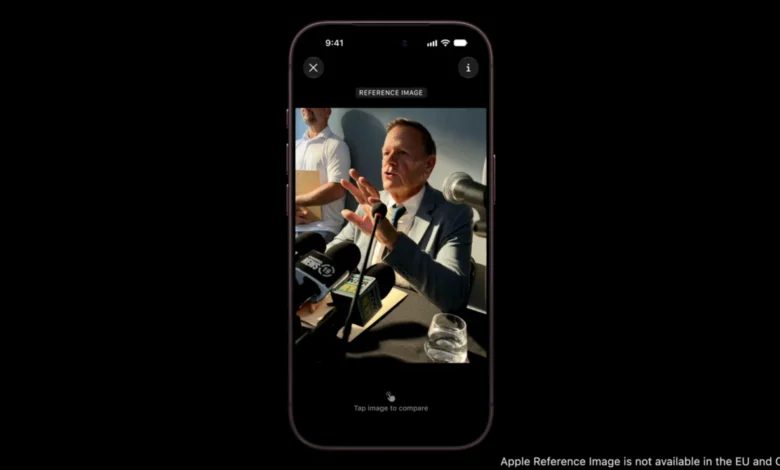
Beyond hardware mechanics and creative tools, Apple introduced a vital software security measure aimed at combating the rising prevalence of synthetic media: Apple Reference Image. Integrated directly into the main camera sensor architecture, this feature addresses the authenticity crisis fueled by sophisticated generative artificial intelligence and deepfake manipulation.

When a user captures a photograph in the specialized "Reference" mode, the raw sensor data is immediately cryptographically signed. This data is then processed through Apple’s secure Private Cloud Compute infrastructure to generate an unalterable digital negative. This reference file is safely stored alongside the final edited image within the native Photos app, allowing journalists, investigators, and everyday consumers to perform side-by-side authenticity checks.
Furthermore, this cryptographic verification works in tandem with built-in metadata tracking and upcoming native support for the SynthID watermarking standard—a tool designed to transparently flag AI-generated or AI-modified content. By introducing this verification layer, Apple is positioning the iPhone 18 Pro as a trusted tool for photojournalism and legal documentation in an era where visual media can no longer be taken at face value.
Market Implications and Outlook
The release of the iPhone 18 Pro and Pro Max marks a pivotal moment for consumer technology. By attempting to merge professional-grade optical hardware—specifically a mechanical variable aperture—with the rugged demands of a pocket-sized handheld device, Apple is pushing the boundaries of modern manufacturing. At the same time, the inclusion of cryptographic provenance tools like Apple Reference Image establishes a new industry benchmark for digital accountability.
As the iPhone 18 Pro reaches consumers and independent testing laboratories evaluate the long-term durability of its mechanical components, the tech industry will closely monitor whether Apple’s bold engineering choices pave the way for a permanent renaissance in mobile photography, or if physical aperture adjustments remain a fleeting experiment in smartphone history.