End of an Era: Pioneer Digital Publication Salon Shuts Down After 31 Years as Media Economics Shift

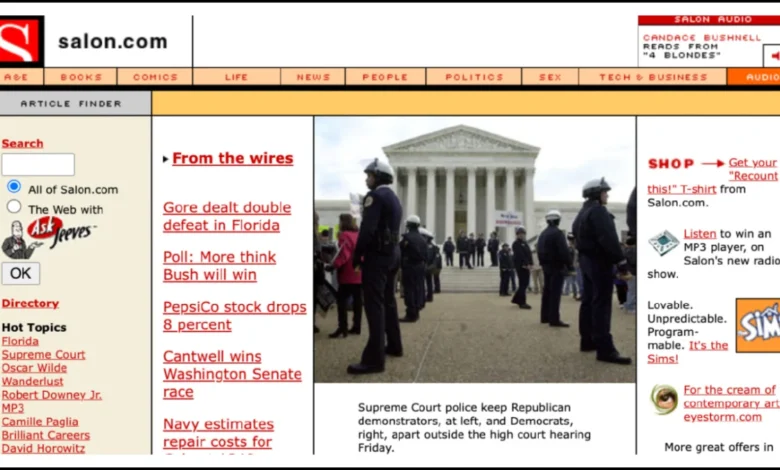
The landscape of independent digital journalism has suffered a profound loss with the closure of Salon, a pioneering left-leaning news and cultural commentary website that operated for over three decades. Launched in November 1995, Salon helped define the architecture, tone, and possibilities of native internet publishing long before mainstream media organizations established a permanent digital footprint. The publication’s closure, announced via an unsigned farewell message on Thursday, underscores the deepening crisis facing digital media outlets as they contend with collapsing web traffic, shifting search algorithms, and the rapid rise of artificial intelligence-driven information platforms.
The decision to shutter operations brings an end to a 31-year run characterized by incisive political reporting, sharp cultural criticism, and intellectual debate. In its final statement, the editorial team reflected on the outlet’s origins as an experiment during the early days of the commercial internet, noting that its foundational publishing model is no longer financially viable in the modern digital ecosystem.
A Historic Run in Digital Publishing
Salon was born out of a distinct era in media history. Founded in 1995 by David Talbot, who served as the editor of the San Francisco Examiner at the time, the publication was conceived as an early digital experiment that operated entirely online without a print counterpart. At a time when traditional print media viewed the internet with skepticism or treated it as a mere repository for scanned newspaper articles, Salon embraced the medium’s interactive potential, pioneering a distinct form of digital journalism that combined long-form essays, sharp political analysis, and cultural critique.
Four years after its initial launch, the company went public in 1999, navigating the turbulent waters of the dot-com boom and bust. Over the subsequent decades, Salon established itself as a formidable voice on the American political left, providing a platform for critical commentary on power, policy, and society. Beyond its political output, the site carved out a unique cultural footprint, capturing the zeitgeist of the early-to-mid internet era. Notably, the publication achieved a level of pop-culture immortality when it was featured prominently in Nora Ephron’s 2009 biographical comedy-drama Julie & Julia, serving as the digital home for the blog authored by Julie Powell, played by Amy Adams, as she cooked every recipe in Julia Child’s foundational cookbook over the course of a single year.
A Launchpad for Media Luminaries
Throughout its 31-year history, Salon functioned as an essential incubator for journalistic talent, serving as the launching pad for numerous reporters, editors, and commentators who went on to occupy prominent roles across the mainstream and alternative media landscapes.
Among the alumni who got their journalistic footing at the website are CNN anchor Jake Tapper, NBC News national correspondent Steve Kornacki, and Glenn Greenwald, founder of The Intercept. Joan Walsh, who served as Salon’s editor-in-chief for five years, further solidified the publication’s national profile before transitioning to her role as a national affairs correspondent for The Nation. The institutional knowledge and distinct editorial voice cultivated within Salon’s virtual newsroom eventually permeated the broader American media ecosystem, influencing how news is analyzed, debated, and consumed online.
Chronology of a Digital Pioneer
November 1995: David Talbot launches Salon as an independent, web-first publication featuring original journalism, cultural criticism, and political commentary.
1999: Salon goes public, navigating the volatile economic conditions of the late-1990s tech market.
2009: The website gains mainstream cinematic recognition, featuring prominently in Nora Ephron’s film Julie & Julia.
2016: Meta (then Facebook) implements a significant algorithm change to its news feed, prioritizing content from family and friends over publishers. This shift triggers a dramatic, industry-wide decline in referral traffic, severely impacting independent digital outlets, including Salon.
2023: Find.co acquires Salon from its previous owners, Drew Schoentrup and Chris Richmond. Find.co, a privately held marketing operation centered on cryptocurrency brands, takes control of a portfolio that also includes outlets such as CCN, Webopedia, and CryptoManiaks.
November 2026: Salon publishes an unsigned farewell announcement, officially declaring that its publishing model is no longer sustainable and ceasing publication after 31 years.
The Structural Crisis of Modern Digital Media
Salon’s closure is emblematic of a broader, systemic crisis facing digital publishers. For decades, the economic model of online journalism relied heavily on display advertising, which in turn depended on high volumes of web traffic. However, the mechanisms for driving traffic have undergone seismic shifts that have devastated legacy digital outlets.
The first major blow to independent publishers occurred in 2016, when major social media platforms altered their distribution algorithms. When Facebook modified its news feed to favor personal interactions over publisher content, outlets that had come to rely on social media referrals experienced immediate, catastrophic drops in readership. Salon was among the many digital publications that absorbed the shockwaves of this algorithmic pivot, forcing management to constantly adapt to an increasingly volatile reader-acquisition market.
In recent years, the challenges have multiplied. The dominance of traditional search engines has given way to artificial intelligence search overviews and generative AI summaries. These tools allow users to glean information directly from search result pages without needing to click through to the original publisher’s website. Consequently, digital media organizations are experiencing unprecedented declines in referral traffic, starving them of the page views required to generate advertising revenue. In this unforgiving landscape, historical longevity, brand recognition, and editorial influence no longer guarantee financial survival.
Corporate Acquisition and Changing Hands
As the financial pressures mounted, Salon’s ownership changed hands. In 2023, the website was acquired by Find.co from its prior owners, Drew Schoentrup and Chris Richmond. Find.co, a privately held digital marketing firm deeply embedded in the cryptocurrency sector, integrated Salon into a portfolio that included digital properties like CCN, Webopedia, and CryptoManiaks.
While the acquisition aimed to stabilize the publication’s operations, the broader macroeconomic headwinds facing digital media proved insurmountable. The intersection of dwindling ad revenues, rising operational costs, and the inability to monetize traffic in an AI-dominated search environment ultimately sealed the fate of the historic outlet.
Uncertainty Surrounding the Archival Legacy
With the announcement of the shutdown, questions immediately arose regarding the preservation of Salon’s vast digital archive, which chronicles three decades of American political and cultural history. The publication’s final Thursday statement did not explicitly outline the long-term fate of its extensive library of articles, essays, and interviews.
However, addressing readers and media observers on the social media platform Bluesky, Salon Chief Content Officer Erin Keane provided a temporary reassurance, stating that the website’s archive would "stay live for now." Whether the historical record of the publication will remain accessible indefinitely or face eventual removal or paywalling under its corporate parent remains to be seen.
Broader Industry Implications and Outlook
The demise of Salon serves as a sobering reminder of the fragility of the digital information ecosystem. As legacy pioneers of the internet era are forced to shutter, media analysts warn of a looming vacuum in deep-dive political analysis and independent cultural commentary.
The transition from an open web—where users actively discovered and engaged with distinct journalistic voices—to a consolidated ecosystem dominated by algorithmic feeds and generative AI summaries has fundamentally broken the economic engine of digital publishing. Without alternative funding models, such as robust subscription systems, philanthropic backing, or non-profit structures, even the most established and historically significant digital publications remain vulnerable to the unforgiving economics of the modern internet.
For three decades, Salon stood as a testament to the possibilities of web-based journalism. As the site goes dark, its legacy survives not only in the archives of its past reporting, but in the generation of journalists it trained and the enduring questions it raised about the vital intersection of media, technology, and democracy.