Fed Keeps Rates Steady at 3.75%-4.00% in Warsh-Led FOMC Meeting Amid Persistent Inflation and Strong Economic Growth

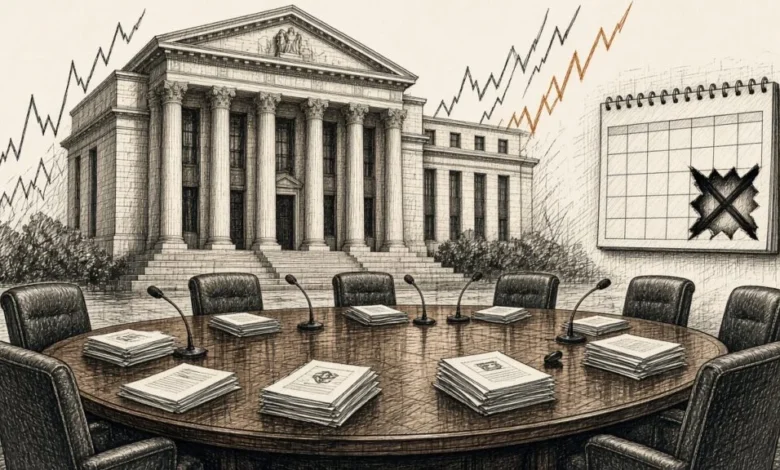
The United States Federal Reserve concluded its closely watched Federal Open Market Committee (FOMC) meeting by maintaining the federal funds rate at its current range of 3.75% to 4.00%. The decision, finalized after a two-day deliberation period ending October 28, 2026, reflects a central banking strategy prioritizing price stability amid an unexpectedly resilient domestic economy and stubbornly high inflation readings. While market participants had largely anticipated a pause following a sequence of aggressive adjustments earlier in the year, the meeting highlighted shifting internal dynamics, lingering policy debates, and a strategic pivot regarding how the central bank communicates its future monetary path.
Background and Context: Navigating a Resilient Economy and Sticky Inflation
The overarching narrative leading into the late-October FOMC gathering centered on the persistent strength of the U.S. economy, which has continually defied earlier projections of a broader slowdown. Despite elevated borrowing costs implemented over prior cycles, labor markets have remained robust, consumer spending has proven durable, and structural shifts driven by artificial intelligence and technological automation have sustained productivity growth.
However, this economic vigor has come with a trade-off: inflation has proven resistant to returning swiftly to the Fed’s targeted 2% threshold. Core inflation metrics have continued to hover above the central bank’s comfort zone, prompting policymakers to weigh the risks of premature monetary easing against the potential long-term costs of entrenched price instability.
In this environment, Fed leadership has opted for a cautious approach, balancing the necessity of suppressing demand-driven inflationary pressures against the vulnerabilities appearing in specific sectors of the financial system. The decision to hold rates steady was not unanimous, showcasing an evolving debate among committee members regarding the precise timing and trajectory of future adjustments.
Committee Dissents and Internal Policy Divisions
While the headline decision to maintain the 3.75%–4.00% range aligned with consensus expectations, the vote itself revealed notable friction within the FOMC. The final tally recorded a 10-to-2 vote, illustrating a divided committee.

Governor Lisa Cook dissented in favor of lowering the federal funds rate by 25 basis points, pointing to emerging signs of softness in labor demand and arguing that monetary policy had become excessively restrictive. Conversely, Boston Fed President Beth Hammack dissented from the other side, advocating for a 25-basis-point rate hike to aggressively counter persistent inflation risks.
This divergence underscores the delicate tightrope the Fed is walking. While some officials are increasingly concerned about the cumulative impact of tight financial conditions on employment and economic activity, others remain steadfastly focused on anchoring long-term inflation expectations and preventing any resurgence of price pressures.
Shift in Forward Guidance and Communication Strategy
One of the most significant developments coming out of the October FOMC meeting was not the rate decision itself, but a structural change in how the central bank communicates its policy intentions. Moving away from explicit, meeting-by-meeting forward guidance that dominated the post-2008 financial crisis era, the committee is shifting toward a broader strategic framework.
Under the updated communication approach, the Fed will issue its broad monetary policy strategy and dot plot projections less frequently, moving away from providing granular rate paths at every single gathering. According to policy analysts, this transition is designed to give the central bank greater flexibility, reducing market volatility tied to minor adjustments in quarterly economic forecasts while encouraging market participants to focus on macroeconomic fundamentals rather than short-term policy pivots.
Financial markets have historically fixated on the "dot plot"—the anonymous projection of future interest rates by FOMC participants—often treating these projections as concrete commitments rather than conditional forecasts. By scaling back the frequency of these detailed disclosures, the Fed aims to reduce market overreactions and reinforce the data-dependent nature of its decision-making process.
Political Pressures and Institutional Independence
The meeting also took place against a backdrop of ongoing external political pressure. The independence of the Federal Reserve has frequently become a point of contention among lawmakers and executive branch officials, with various political figures publicly criticizing the central bank’s handling of interest rates.

Despite external commentary, Fed leadership has consistently reiterated its commitment to making monetary policy decisions strictly based on economic data rather than political timelines. The presence of both dovish and hawkish dissents within the same meeting serves as an internal testament to this independence, demonstrating that committee members deliberate based on individual economic assessments rather than external directives. Market analysts have repeatedly emphasized that maintaining institutional credibility is vital for anchoring inflation expectations, particularly during periods of political polarization.
Implications for Bond Markets, Real Estate, and Risk Assets
The Fed’s decision to hold rates steady while signaling a longer-term, more flexible policy path has immediate implications across various asset classes. Fixed-income markets have experienced mixed reactions as traders reevaluate the future trajectory of borrowing costs.
For the housing market, which has struggled under the weight of elevated mortgage rates, the prolonged plateau offers a period of stabilization, though significant relief in borrowing costs remains distant. Prospective homebuyers continue to face affordability challenges, as mortgage rates are tied more closely to long-term Treasury yields than the federal funds rate alone.
Equity markets and risk assets have largely absorbed the central bank’s messaging, trading within familiar ranges as investors price in a "higher-for-longer" interest rate environment. While a prolonged pause provides a predictable baseline for corporate earnings, valuations across growth sectors remain sensitive to any unexpected shifts in inflation data or employment reports.
Looking Ahead: What to Watch in the Coming Months
As the Federal Reserve looks toward its final meetings of the year, market participants will closely monitor incoming data releases on employment, retail sales, and inflation indices. The debate between balancing maximum employment and stable prices will continue to dictate the rhythm of monetary policy.
With the transition toward a less rigid communication strategy underway, financial markets must adapt to a landscape where policy adjustments are signaled through broad economic assessments rather than precise quarterly forecasts. The ability of the central bank to navigate these crosscurrents will be critical in determining whether the U.S. economy can achieve a sustained economic expansion without triggering a resurgence of inflationary instability.