Georgia Uncovers Uncounted Ballots on Memory Card in Seminole County Midterm Election Scandal

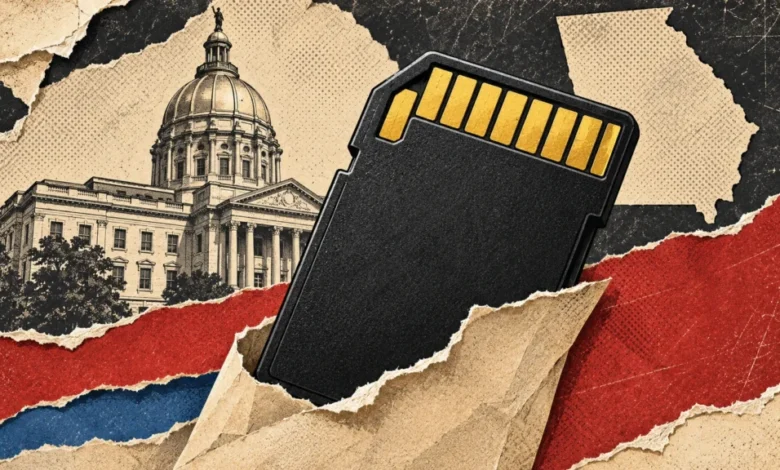
The 2026 midterm elections in the United States continue to face intense scrutiny and post-vote verification challenges following a stunning discovery in Seminole County, Georgia. Election officials in the county recently uncovered a forgotten memory card containing 388 uncounted votes, significantly altering the dynamics of a local legislative race and raising fresh questions about administrative oversight during a critical electoral cycle.
The discrepancy came to light during routine post-election canvassing and auditing procedures in Seminole County’s State House District 154 race. According to official preliminary results prior to the discovery, Republican challenger Harry James had secured 58 votes, trailing the incumbent Democratic Representative Gerald Greene, who held a seemingly insurmountable lead with 260 votes. However, a memory card discovered by county election officials challenged those totals entirely, compelling the Georgia Secretary of State’s office to step in and launch a formal investigation into the oversight.
The Anatomy of an Electoral Oversight
The voting irregularity was first brought to public attention when Seminole County election officials reported that a memory card containing hundreds of uncounted ballots had been left unuploaded during the initial tally. The total number of uncounted ballots discovered on the device amounted to 388, representing a substantial block of votes in a localized legislative district where margins are often razor-thin.
Georgia Secretary of State Brad Raffensperger addressed the incident swiftly, emphasizing the seriousness of the error while highlighting that the state’s multi-layered post-election auditing processes ultimately functioned as intended. In a public statement regarding the Seminole County investigation, Raffensperger noted that while the initial failure to upload the memory card was unacceptable, the system’s checks and balances successfully caught the discrepancy during the canvassing phase.
"Our office takes election integrity and administrative accuracy extremely seriously," Raffensperger stated. "While leaving a memory card uncounted during the initial reporting phase is a severe administrative failure, our rigorous post-election audit processes are explicitly designed to catch these exact discrepancies. We are fully investigating how this occurred to ensure accountability and transparency for the voters of Seminole County."
Detailed Breakdown of the Recount and Margins
To fully understand the impact of the newly discovered memory card, election analysts examined the updated precinct-level data provided by the Georgia Secretary of State’s office. A breakdown of the 388 uncounted ballots reveals a stark deviation from the previously reported totals.
Within the specific memory card, Democratic incumbent Gerald Greene captured 354 votes, while Republican challenger Harry James received only 34 votes. When these 388 votes were added to the previously certified county total of 320 votes, the cumulative totals shifted dramatically. Incumbent Representative Greene’s final tally increased by 262 votes, while challenger Harry James saw his total increase by only 58 votes.
Because the newly discovered votes skewed heavily in favor of the incumbent, the error did not alter the ultimate winner of the race. Representative Greene maintained his decisive victory in State House District 154. Nevertheless, the fact that nearly 400 votes went uncounted for days in a competitive election cycle has intensified broader discussions regarding poll worker training, ballot handling protocols, and chain-of-custody procedures across rural and suburban voting precincts alike.
Broader Context of Post-Election Scrutiny
The incident in Seminole County is part of a broader wave of post-election audits and verification challenges following the November 3 midterm elections. Across the United States, election administrators have faced immense pressure to finalize results while managing a complex landscape of legislative races, ballot measures, and heightened partisan attention.
In Georgia, election officials have maintained a strong commitment to transparency, conducting thorough audits to ensure that every valid vote is accurately recorded. However, the Seminole County incident is not an isolated administrative hiccup in the state’s electoral history. Historical data compiled by the Atlanta Journal-Constitution (AJC) highlights that similar reporting anomalies have occurred in past election cycles. For instance, an AJC investigation into previous Georgia elections revealed instances where a significant percentage of precincts experienced minor reporting delays or localized tabulation errors due to human oversight or technological glitches.
Election experts point out that while human error is an inevitable component of administering massive democratic exercises involving millions of voters, the existence of robust auditing frameworks is what separates a minor administrative correction from a systemic crisis. The ability of Georgia’s post-election audit system to flag the missing Seminole County memory card demonstrates that the state’s verification safeguards are actively working to protect the integrity of election outcomes.
Implications for Future Election Administration
The discovery in Seminole County serves as a cautionary tale for election boards nationwide. As state legislatures look ahead to future election cycles, policymakers and election administrators are expected to focus heavily on modernizing chain-of-custody protocols, enhancing poll worker training programs, and implementing technological redundancies to prevent memory cards from being overlooked during initial data transmission phases.
While the missing votes did not change the outcome of the State House District 154 race, the political and public relations ramifications of such errors are profound. In an era where public trust in democratic institutions is constantly tested, even minor procedural lapses can fuel skepticism and demand extraordinary transparency from election officials.
Moving forward, the Georgia Secretary of State’s office is expected to release a comprehensive report detailing the exact cause of the Seminole County oversight. The findings will likely be used to update statewide training guidelines and ensure that local election boards implement stricter dual-verification processes before certifying final election results in future cycles.
Related posts: